A good tea maker can transform a daily cup of tea from an ordinary routine into something genuinely enjoyable. Whether you prefer delicate Japanese green tea, rich Assam, fragrant oolong, or a soothing herbal infusion, the right equipment makes it easier to control water temperature, steeping time, and the amount of tea you prepare.
But choosing the best tea maker is not as straightforward as comparing prices or counting features. Some appliances automatically heat water and brew loose-leaf tea, while others simply provide precisely heated water for a separate teapot or infuser. There are also large hot-water dispensers designed for frequent tea drinking and inexpensive manual infusers that require no electricity at all.
For many households, a variable-temperature electric kettle paired with a good infuser provides the best combination of convenience, flexibility, and value. Dedicated automatic tea makers, however, offer advantages for people who frequently brew loose-leaf tea and want consistent results without monitoring every infusion.
This guide compares eight tea makers and brewing tools, from the fully automatic Breville Tea Maker to the simple Adagio ingenuiTEA 2. We’ll examine their capabilities, limitations, cleaning requirements, and suitability for different tea-drinking habits so you can choose equipment that actually improves your brewing experience.
Editorial note: This comparison is based on manufacturer specifications, published product documentation, and practical brewing considerations, rather than hands-on testing of every appliance. Recommendations reflect differences in design and functionality, not independently measured performance. Product availability, specifications, and prices may change.
🫖 Best Tea Makers at a Glance
| Tea Maker | Type | Capacity | Best For |
|---|---|---|---|
| Breville Tea Maker BTM800 | Automatic tea brewer | Approx. 41 oz brewing capacity | Fully automated loose-leaf tea |
| Adagio velociTEA | Automatic tea brewer | 8–40 oz | Affordable automated brewing |
| Ninja Precision Temperature KT200 | Electric kettle | 7 cups | Everyday tea and family use |
| Cuisinart PerfecTemp CPK-17P1 | Electric kettle | 1.7 L | Multiple tea varieties |
| OXO Brew Adjustable Temperature Kettle | Glass electric kettle | 1.75 L | Flexible temperature selection |
| Fellow Corvo EKG Pro | Precision electric kettle | 0.9 L | Specialty green tea and oolong |
| Zojirushi Micom CD-WCC30/40 | Water boiler and warmer | 3 or 4 L | All-day hot water |
| Adagio ingenuiTEA 2 | Manual tea infuser | 16 oz | Beginners and individual cups |
These products serve different purposes, so their capacities and features should not be interpreted as directly comparable. An automatic tea brewer combines water heating and infusion, while an electric kettle requires a separate brewing vessel. A water boiler keeps hot water available for later use, and a manual infuser relies on an external source of hot water.
The most useful first question is therefore not which appliance has the most features, but which part of your tea-making routine you want to simplify.
🍵 1. Breville Tea Maker BTM800 — Best Fully Automatic Tea Maker
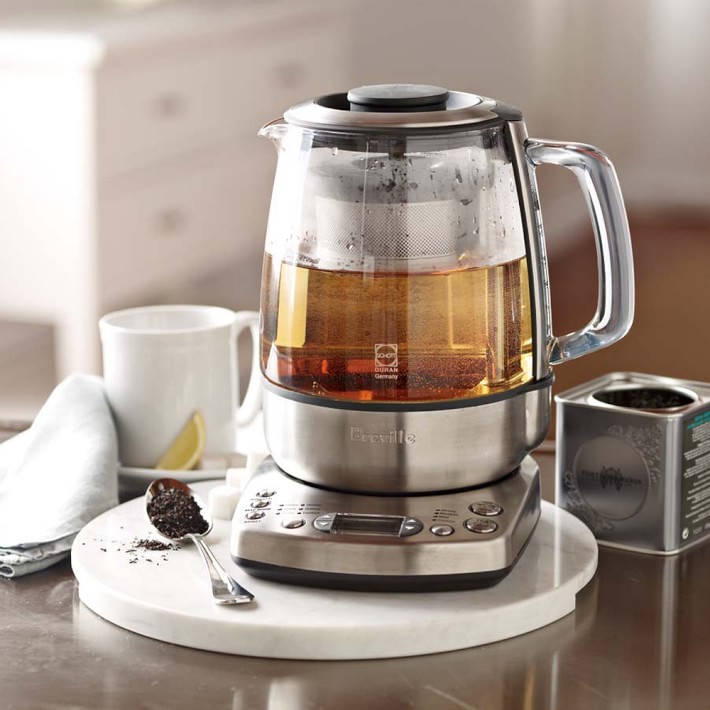
The Breville Tea Maker BTM800 is designed for people who regularly prepare loose-leaf tea and want the machine to manage nearly the entire brewing process. Its distinguishing feature is an automatic tea basket that moves into the heated water for steeping and rises again when the programmed infusion is complete.
This is a meaningful difference from an ordinary electric kettle with a removable infuser. Many kettles can heat water to a selected temperature, but they cannot prevent tea leaves from remaining submerged if you become distracted. The Breville addresses that problem by physically separating the leaves from the brewed tea.
The machine includes settings for black, green, white, oolong, and herbal teas, along with adjustable brewing strength and customizable temperature and time controls. An automatic-start feature allows brewing to be scheduled, and a keep-warm function maintains the finished beverage for up to 60 minutes.
What Makes the Breville Different?
The greatest advantage of the Breville is its combination of temperature control, infusion timing, and automatic leaf removal. These three functions work together to simplify brewing teas that can become unpleasantly bitter or astringent when steeped too long.
For example, someone preparing a pot of loose-leaf green tea can select the desired temperature and brewing strength, start the machine, and attend to another task. Once the infusion is complete, the basket rises rather than leaving the leaves in the hot water.
This is especially useful for households that prepare several cups at once or regularly switch among teas requiring different brewing conditions. The glass vessel also makes it possible to observe the infusion, which adds to the enjoyment of preparing loose-leaf tea.
What Are the Drawbacks?
The most obvious disadvantage is cost. The Breville is significantly more expensive than a conventional electric kettle and infuser combination, and its automatic mechanism adds complexity to the appliance.
Cleaning also requires more attention. Unlike a kettle used exclusively for water, the Breville’s basket and glass vessel come into direct contact with tea. That means tea residue, staining, and mineral deposits must all be managed according to the manufacturer’s cleaning instructions.
The machine also occupies more counter space than a simple infuser and may be unnecessary for someone who usually brews a single tea bag.
Best for: Dedicated loose-leaf tea drinkers who prepare multiple servings and appreciate automatic temperature, timing, and leaf separation.
Consider something else if: You primarily drink tea bags, brew only one cup at a time, or prefer traditional brewing methods such as a gaiwan.
⚡ 2. Adagio velociTEA — Best Affordable Automatic Tea Brewer
The Adagio velociTEA offers a less expensive approach to automated brewing. Instead of using a moving basket, the machine heats water and circulates it through an infuser containing the tea leaves.
The brewer can prepare approximately 8–40 ounces of tea, making it suitable for an individual cup, several servings, or a small pot. Preset brewing programs simplify temperature and timing choices, while the machine also includes a heat-only function for preparing hot water without tea.
Once the programmed brewing cycle finishes, the appliance signals completion and offers a 60-minute keep-warm function.
How Does the velociTEA Compare With the Breville?
Both machines combine heating and brewing in one appliance, but they manage the infusion differently. The Breville physically raises its tea basket out of the water, while the velociTEA uses pumped water circulation through a stationary infuser during its brewing cycle.
That distinction matters because automatic brewing is not always the same as automatic leaf separation. If avoiding all continued contact between tea and the brewing system is your priority, the Breville offers the clearer mechanical solution.
The velociTEA, however, provides much of the everyday convenience of a dedicated tea machine at a lower cost. It allows you to select a tea program and prepare a consistent batch without separately heating water, transferring it to a teapot, and monitoring a timer.
It is especially appealing to someone who enjoys loose-leaf tea but does not need the most sophisticated automated brewing mechanism.
Cleaning and Everyday Maintenance
Adagio recommends regular descaling to prevent mineral buildup, particularly when mineral-rich water is used. The removable infuser basket is listed as dishwasher-safe, although the electrical appliance itself must be cleaned according to the manufacturer’s instructions.
An automatic brewer of this type also has more surfaces that contact tea than a water-only kettle. That means occasional attention to tea staining and residue is part of ownership.
Best for: Tea drinkers who want automated brewing without paying premium prices.
Consider something else if: You want automatic removal of tea leaves, minimal cleaning, or a machine used only for heating water.
🌡️ 3. Ninja Precision Temperature KT200 — Best Everyday Electric Kettle
The Ninja Precision Temperature KT200 is a practical choice for households that drink several kinds of tea and want dependable temperature options without investing in an automatic tea-brewing machine.
It has a seven-cup capacity, seven preset programs, and manual temperature adjustment. The presets include options for green, white, oolong, black, and herbal tea, as well as coffee and boiling water. Its hold-temperature function keeps the selected water temperature available for up to 30 minutes.
The illuminated display provides a temperature reading, making it easier to see when the water is ready.
Why It Makes Sense for Everyday Tea
For many people, the greatest improvement an electric kettle can provide is removing the guesswork from water temperature. Delicate green tea may taste harsh when prepared with boiling water, while robust black tea often benefits from much hotter brewing temperatures.
The Ninja makes those adjustments straightforward. A person preparing sencha in the morning can select the green-tea preset, while someone brewing breakfast tea later can choose a hotter setting.
Its capacity also makes it practical for households with several tea drinkers. Rather than heating a small kettle repeatedly, the Ninja can prepare enough water for multiple mugs or a larger teapot.
The manual temperature setting adds flexibility beyond the presets, which is useful when a specific tea producer recommends a brewing temperature that differs from a general category setting.
Where It Falls Short
The Ninja does not brew tea automatically. You still need a mug infuser, teapot, gaiwan, or other brewing vessel, and you must remove the leaves after the appropriate steeping time.
Its digital features also do not replace good brewing judgment. A preset labeled “green tea” is a convenient starting point, but Japanese gyokuro and Chinese dragon well, for example, may benefit from different preparations.
Best for: Everyday tea drinkers who want multiple temperature settings, a generous capacity, and easy operation.
Consider something else if: You want a fully automated brewer or a smaller precision kettle designed for specialty brewing.
💧 4. Cuisinart PerfecTemp CPK-17P1 — Best for Multiple Tea Varieties
The Cuisinart PerfecTemp is another strong choice for everyday brewing, particularly for households that regularly prepare different varieties of tea.
This 1.7-liter stainless steel electric kettle features six temperature presets, including settings for delicate tea, green tea, white tea, oolong tea, French press coffee, and black or herbal tea. Its 1,500-watt heating system and 30-minute keep-warm function make it convenient for preparing several cups over a short period.
The kettle also includes automatic shutoff, boil-dry protection, and a removable scale filter. Its cordless serving design allows the kettle to be lifted from the powered base for pouring.
Why Preset Temperatures Are Useful
Different tea leaves respond differently to heat, and brewing temperature can affect bitterness, aroma, body, and sweetness.
Green teas are often prepared below boiling because excessively hot water can bring out more astringency than desired. Many black teas, by contrast, develop their characteristic richness when brewed with very hot water.
The Cuisinart’s preset approach makes these distinctions easy to incorporate into an everyday routine. Rather than selecting an exact temperature manually, you can choose the corresponding tea category.
For people who are new to loose-leaf tea, this can be particularly helpful. The presets provide a starting point for learning how temperature affects different teas without requiring a detailed understanding of brewing chemistry.
Cuisinart vs. Ninja: Which Is Better?
The Ninja and Cuisinart overlap considerably in their intended use. Both provide temperature presets, useful capacity, and a hold-temperature function, and neither automatically steeps tea leaves.
The Cuisinart emphasizes straightforward one-touch presets and a familiar stainless steel design. The Ninja adds a live temperature display and manual adjustment alongside its presets.
For someone who uses the same few tea temperatures every day, the Cuisinart may be all that is necessary. A person who enjoys experimenting with many individual teas may appreciate the Ninja’s more adjustable interface.
Best for: Households that want a straightforward, full-size electric kettle with tea-specific presets.
Consider something else if: You need an integrated infuser, automatic steeping, or more specialized temperature programming.
🫗 5. OXO Brew Adjustable Temperature Kettle — Best Glass Kettle
The OXO Brew Adjustable Temperature Kettle offers a different combination of features. Its 1.75-liter borosilicate glass body allows you to see the water as it heats, while the adjustable temperature dial provides a broad selection range from 104°F to 212°F.
The kettle can hold the selected temperature for up to 30 minutes and lifts from its base for cordless pouring. Its relatively large capacity makes it suitable for individual mugs, larger teapots, or several servings.
Why Choose a Glass Kettle?
Glass is appealing to tea drinkers who enjoy seeing the water heat and prefer a transparent vessel. It also makes mineral deposits relatively easy to spot, which can be helpful when deciding whether the kettle needs cleaning.
The OXO’s broad temperature range is particularly useful for brewing teas that require cooler water. Instead of being limited to a few predetermined categories, you can select a temperature that matches the instructions for a specific tea.
That flexibility is valuable for someone who regularly prepares specialty Japanese green teas, delicate white teas, or other infusions that benefit from careful water-temperature control.
The generous capacity is another advantage. Unlike some smaller precision kettles, the OXO can heat enough water for a group without requiring frequent refills.
Are There Any Disadvantages?
Glass kettles generally require more care than stainless steel models because the vessel can be damaged by impact. Mineral deposits may also be more noticeable against the transparent sides.
Although the adjustable dial offers useful flexibility, it does not automatically manage steeping time or remove tea leaves. You still need a separate infuser or teapot.
Best for: Tea drinkers who prefer a glass kettle, larger capacity, and flexible temperature selection.
Consider something else if: You prefer a more impact-resistant stainless steel body or want automatic tea brewing.
🍃 6. Fellow Corvo EKG Pro — Best Precision Kettle for Specialty Tea
The Fellow Corvo EKG Pro is designed for people who want detailed control over water temperature and appreciate a compact, thoughtfully designed electric kettle.
Its 0.9-liter capacity is considerably smaller than the Ninja, Cuisinart, and OXO kettles, but that is not necessarily a disadvantage. For someone preparing one or two carefully measured servings, the smaller size may be more convenient.
The Corvo EKG Pro provides fine temperature adjustment, scheduling, programmable temperature-hold options, and a wide pouring spout designed for general-purpose use.
Why Is Precision Important for Specialty Tea?
Tea enthusiasts who regularly drink Japanese green teas, high-quality oolongs, or delicate white teas often pay close attention to brewing temperature.
For example, gyokuro is commonly prepared with cooler water than many everyday green teas. Lower brewing temperatures can emphasize its characteristic sweetness, umami, and softer flavor profile.
The ability to select a precise temperature makes it easier to repeat a preparation once you have found a method you enjoy. Rather than approximating the temperature by allowing boiled water to cool, you can heat water directly to the setting you want.
The Corvo also offers a more suitable spout for everyday tea pouring than Fellow’s Stagg gooseneck kettles, which are designed primarily for controlled pour-over coffee preparation.
Is the Premium Price Worth It?
The Corvo makes the most sense for people who will actually use its precise controls. Its compact capacity and specialized interface are advantages for certain brewing styles, but they are not necessarily useful to everyone.
Someone who mainly prepares ordinary black tea or tea bags may find little practical benefit over a less expensive kettle. A household frequently serving several people may also find the smaller capacity inconvenient.
The additional scheduling and display features are useful conveniences, but they do not automatically improve the quality of the tea leaves or replace correct steeping times.
Best for: Specialty tea drinkers who want fine temperature control for green tea, white tea, and oolong.
Consider something else if: You regularly serve large groups or primarily use boiling water for everyday tea.
♨️ 7. Zojirushi Micom Water Boiler & Warmer — Best for All-Day Tea Drinking
The Zojirushi Micom Water Boiler & Warmer is quite different from a conventional electric kettle. Instead of heating a single batch of water whenever you want tea, it maintains a larger reservoir of heated water that can be dispensed throughout the day.
The CD-WCC series comes in 3-liter and 4-liter versions and offers four keep-warm temperatures: 160°F, 175°F, 195°F, and 208°F. It also includes a Quick Temp mode that can heat water to selected temperatures without first bringing it to a full boil.
An electric dispensing system allows users to fill mugs or teapots without lifting and pouring a heavy kettle.
Why a Water Boiler Can Be More Convenient
Consider a household in which several people drink tea at different times. One person may prepare green tea at breakfast, another might make oolong after lunch, and someone else may want herbal tea in the evening.
With a conventional kettle, water must be reheated for each separate brewing session. A water boiler keeps a substantial amount ready, reducing the need to repeat that process throughout the day.
This arrangement is especially useful in shared kitchens, offices, and households where hot water is used frequently.
The Zojirushi also makes it convenient to prepare several small infusions in succession, provided the selected water temperature suits the tea being brewed.
The Important Trade-Off
A water boiler is not necessarily the most energy-efficient choice for someone who drinks only one cup of tea a day. Maintaining hot water over an extended period consumes electricity, and the practical benefit depends on how frequently that water is used.
It also occupies more counter space and requires regular cleaning and descaling.
Another consideration is that the Zojirushi does not actually steep tea. It dispenses heated water, which you then use with a separate infuser, mug, teapot, or gaiwan.
Best for: Families, offices, and frequent tea drinkers who want several liters of heated water available throughout the day.
Consider something else if: You only prepare an occasional cup or have limited counter space.
🌿 8. Adagio ingenuiTEA 2 — Best Simple Loose-Leaf Tea Infuser
Not every useful tea-making tool requires electricity, temperature sensors, or complicated settings. The Adagio ingenuiTEA 2 is a manual brewing vessel designed to make loose-leaf tea preparation exceptionally straightforward.
It holds approximately 16 ounces and uses a bottom-dispensing mechanism. Tea leaves and hot water are placed inside the container, and once the infusion is complete, the brewer is positioned over a mug. A valve opens, allowing the prepared tea to drain into the cup while the filter retains the leaves.
The brewer is made from BPA-free Tritan plastic and includes a removable filter. Adagio also lists it as dishwasher-safe.
Why It Is Especially Good for Beginners
One of the challenges of preparing loose-leaf tea is finding an infuser that gives the leaves enough room to expand while keeping them out of the finished drink.
Small tea balls can restrict the movement of larger leaves, while some inexpensive strainers are awkward to handle or difficult to clean.
The ingenuiTEA 2 provides a generous brewing chamber that allows leaves to circulate through the water. Once steeping is complete, the tea can be transferred directly into a mug without a separate strainer.
That makes it appealing to someone moving from tea bags to loose-leaf tea for the first time. It is also convenient for office use, where storing a large electric appliance may not be practical.
What Doesn’t It Do?
The ingenuiTEA 2 does not heat water or control temperature. You will still need a kettle, and you must monitor the steeping time yourself.
Its plastic construction may also be a drawback for tea drinkers who prefer glass, porcelain, or stainless steel brewing vessels.
Still, for an inexpensive tool that makes loose-leaf tea accessible and easy to prepare, it is an appealing choice.
Best for: Beginners, individual servings, and anyone who wants a simple loose-leaf brewing method.
Consider something else if: You want automatic temperature control, integrated water heating, or a glass or ceramic brewing vessel.
🆚 Automatic Tea Maker vs. Electric Kettle vs. Infuser
Understanding what each type of tea maker actually does is more important than comparing their price tags.
An automatic tea maker combines heating and brewing in one appliance. Depending on the model, it may control temperature, circulate water through tea leaves, manage steeping time, and separate the leaves after infusion.
An electric kettle heats water to the desired temperature but generally does not brew the tea. You transfer the heated water to a teapot or infuser, add the leaves, and manage the infusion yourself.
A manual infuser provides a brewing chamber for loose-leaf tea but relies on water heated elsewhere. A hot-water boiler, meanwhile, maintains a large supply of heated water without directly preparing the tea.
| Feature | Automatic Brewer | Electric Kettle | Manual Infuser | Water Boiler |
|---|---|---|---|---|
| Heats water | Yes | Yes | No | Yes |
| Brews tea leaves | Yes | Usually no | Yes | No |
| Temperature selection | Usually | Model-dependent | No | Usually |
| Automatic steeping | Model-dependent | No | No | No |
| Separate infuser needed | No | Yes | No | Yes |
| Best advantage | Convenience | Versatility | Simplicity | Ready hot water |
For most tea drinkers, an electric kettle and separate infuser offer an excellent balance. The equipment can be used independently, the kettle remains free of tea residue, and the brewer can be chosen according to the type of tea being prepared.
Automatic machines become more attractive when repeated brewing steps feel inconvenient or when precise timing is particularly important.
🌡️ Why Water Temperature Matters When Choosing a Tea Maker
Water temperature affects how quickly different compounds are extracted from tea leaves. Too much heat can emphasize bitterness or astringency in some delicate teas, while water that is too cool may produce a weak infusion from robust leaves.
The best temperature depends on the individual tea, its processing style, leaf size, and the desired flavor profile. However, the following ranges are useful starting points.
| Tea Type | Suggested Starting Temperature |
|---|---|
| Japanese green tea | 140–175°F, depending on variety |
| Chinese green tea | 160–185°F |
| White tea | 175–195°F |
| Oolong tea | 185–205°F |
| Black tea | 195–212°F |
| Pu-erh tea | 195–212°F |
| Rooibos | 205–212°F |
| Many herbal infusions | 205–212°F |
These are general guidelines rather than universal rules. Some green teas benefit from unusually cool water, while certain white and oolong teas are intentionally brewed at higher temperatures. Manufacturer and tea-producer recommendations should take precedence when provided.
A variable-temperature kettle is useful because it makes experimentation easier. If a green tea tastes overly sharp, try reducing the brewing temperature slightly while keeping the leaf quantity and steeping time consistent. This allows you to determine whether temperature is responsible for the flavor difference.
For more detailed brewing advice, see How to Brew Tea: Water Temperature, Steeping Times & Brewing Methods and Best Water Temperature for Green Tea: Sencha, Matcha, Gyokuro & More.
🏡 Which Tea Maker Should You Choose for Your Daily Routine?
The most effective way to choose tea equipment is to think about what happens during a typical day rather than imagining every possible feature you might someday use.
For Someone Who Makes One Cup Every Morning
If you usually prepare a single mug of black tea, green tea, or an herbal infusion, a large automatic machine is probably unnecessary. A kettle paired with a generous basket infuser or bottom-dispensing brewer offers excellent flexibility.
The Adagio ingenuiTEA 2 is an attractive starting point if you already have a kettle. If you frequently drink teas requiring different temperatures, consider adding a variable-temperature electric kettle.
For a Household That Drinks Several Types of Tea
A larger variable-temperature kettle makes more sense when different family members prefer different drinks. The Ninja KT200, Cuisinart PerfecTemp, and OXO Brew Adjustable Temperature Kettle all offer sufficient capacity for preparing several servings.
The advantage is flexibility. The same appliance can heat water for green tea in the morning, black tea in the afternoon, and an herbal infusion before bed without needing a dedicated brewing mechanism for each beverage.
For Someone Who Drinks Specialty Loose-Leaf Tea
A precise temperature-controlled kettle paired with a suitable teapot or gaiwan is often the most versatile setup.
The Fellow Corvo EKG Pro is particularly appealing for this purpose because of its adjustable temperature controls and relatively compact size. It is well suited to people who enjoy carefully preparing small quantities of tea and experimenting with brewing variables.
For Someone Who Frequently Forgets to Remove the Tea Leaves
A fully automatic brewer provides a genuine advantage when steeping time is your biggest difficulty.
The Breville Tea Maker is particularly useful because it raises the tea basket after the programmed infusion, physically separating the leaves from the finished beverage. This reduces the chance that a forgotten pot will become excessively strong.
For an Office or Shared Kitchen
A large water boiler such as the Zojirushi Micom may be more convenient than repeatedly filling and reheating a kettle.
With hot water available throughout the day, each person can prepare tea using their preferred mug or infuser. The system also avoids leaving communal tea leaves or infusers inside the water reservoir.
🛒 Seven Things to Consider Before Buying a Tea Maker
Specifications are useful, but some of the most important buying considerations involve how the appliance will behave over months or years of regular use.
- Actual brewing function. Determine whether the product heats water, steeps leaves, separates the tea after brewing, or performs all three functions. Do not assume every product described as a tea maker is fully automatic.
- Capacity and minimum fill level. A large kettle may be useful for families, but it can be unnecessarily bulky for one person. Also check the minimum operating volume, particularly if you prepare small servings.
- Temperature flexibility. A few presets may be sufficient for everyday tea. Specialty tea enthusiasts may prefer finer adjustments, especially when brewing delicate green teas.
- Steeping control. An automatic timer is convenient, but it is important to know whether the machine actually removes the leaves or merely signals that brewing is complete.
- Cleaning requirements. Kettles used only for water generally require less cleaning than machines that brew tea internally. Check how easily baskets, filters, and lids can be removed.
- Replacement parts and warranty. An expensive appliance is a better long-term investment when replacement filters, lids, baskets, or other components are available from the manufacturer.
- Counter space and electrical compatibility. Consider the appliance’s dimensions, cord arrangement, voltage, and intended market. Imported electric tea appliances should only be used with compatible electrical systems.
These considerations often reveal more about long-term satisfaction than an attractive product photo or a long list of electronic features.
🧼 Which Tea Maker Is Easiest to Clean?
Ease of cleaning deserves particular attention because tea equipment is used frequently, often several times a day.
An ordinary electric kettle is generally one of the simplest options to maintain. When used only for water, the primary concern is mineral buildup, commonly called limescale. This appears as a white or chalky coating and may become more noticeable in areas with hard water.
Automatic tea makers require additional cleaning because tea comes into contact with their brewing chambers, filters, lids, and sometimes internal circulation components. Tea pigments and tannins can leave brown staining, even when the appliance is functioning normally.
Manual infusers require regular rinsing to remove leaves and residue, but they have fewer electrical or mechanical components to worry about.
For all electric appliances, follow the manufacturer’s descaling instructions and avoid immersing electrical bases in water. Do not assume that every kettle or brewer can be cleaned with the same vinegar concentration or commercial descaling solution.
The best maintenance schedule depends on your water hardness, frequency of use, and manufacturer’s recommendations. Regular attention to mineral deposits is generally easier than allowing heavy buildup to accumulate.
🍃 Do You Need an Expensive Tea Maker to Make Excellent Tea?
Expensive tea equipment can make brewing more convenient, but price alone does not determine how good the finished tea tastes.
An affordable kettle and quality infuser can produce an excellent cup when used with good tea leaves, appropriate water, accurate measurements, and suitable steeping conditions.
Premium appliances primarily add convenience. Precise temperature adjustment allows greater control, programmable settings make it easier to repeat a routine, and automatic brewing reduces the need for manual attention.
Those features are valuable when they solve an actual problem, but they do not guarantee better flavor.
For example, someone who makes loose-leaf green tea only occasionally may benefit more from purchasing fresh, carefully stored tea than from investing in an expensive automated brewer. On the other hand, someone who prepares several pots every day may appreciate the time saved by automatic temperature and steeping controls.
The most effective upgrade is usually the one that removes the biggest limitation in your current brewing routine.
🍵 What About Matcha, Gongfu Tea, and Traditional Teapots?
Not every tea preparation method benefits from automatic brewing equipment.
Matcha is prepared by whisking finely powdered tea into water rather than steeping leaves and removing them. A variable-temperature kettle can be useful, but a conventional automatic tea basket is unnecessary. A matcha bowl and whisk are more relevant tools.
Gongfu brewing involves relatively small quantities of water, generous amounts of tea leaf, and multiple short infusions. A gaiwan or small teapot allows the drinker to control each infusion closely, making it particularly suitable for certain oolongs, pu-erh teas, and other whole-leaf teas.
Traditional Western-style teapots also remain highly practical. A teapot with a removable basket infuser can accommodate several servings while allowing the leaves to be removed when steeping is complete.
For tea drinkers who enjoy the process of preparing tea, manual brewing is not an inconvenience to eliminate. It may be an important part of the experience itself.
❓ Frequently Asked Questions About Tea Makers
What Is the Best Tea Maker for Beginners?
For someone new to loose-leaf tea, a simple kettle and generously sized infuser are usually sufficient. The Adagio ingenuiTEA 2 is particularly approachable because it allows the leaves to steep freely and dispenses the finished tea directly into a mug.
A variable-temperature kettle is a worthwhile next step if you begin exploring green, white, or oolong teas with different brewing requirements.
What Is the Best Automatic Tea Maker?
The Breville Tea Maker BTM800 is a strong premium option for automated loose-leaf brewing. It combines temperature selection, programmed steeping, and a moving tea basket that separates the leaves from the brewed tea.
The Adagio velociTEA offers a more affordable alternative with integrated heating and brewing, although its infusion mechanism differs from the Breville’s.
Is an Electric Tea Kettle Better Than a Regular Kettle?
An electric kettle is not automatically better than a stovetop kettle, but models with adjustable temperature controls make it easier to prepare teas that require water below boiling.
The best choice depends on whether you value automatic shutoff, rapid operation, temperature selection, or the simplicity of a traditional stovetop design.
Can You Brew Loose-Leaf Tea Directly in an Electric Kettle?
Only if the manufacturer specifically designed the kettle for brewing tea. Most ordinary electric kettles are intended to heat water, not contain tea leaves.
Putting tea directly into an unsuitable kettle may cause staining, clog filters, interfere with cleaning, or violate the manufacturer’s instructions.
Is a Gooseneck Kettle Necessary for Tea?
No. Gooseneck kettles are especially popular for pour-over coffee because they provide controlled water flow, but ordinary tea preparation rarely requires that degree of pouring precision.
A standard spout is generally more convenient when filling teapots, mugs, and larger brewing vessels.
What Is the Best Tea Maker for Green Tea?
A variable-temperature kettle is particularly useful for green tea because many varieties benefit from brewing temperatures below boiling.
The Fellow Corvo EKG Pro offers detailed temperature adjustment, while the Ninja, Cuisinart, and OXO models provide practical alternatives for everyday use.
How Long Should a Tea Maker Keep Tea Warm?
Many electric appliances provide keep-warm settings lasting approximately 30–60 minutes, although the exact duration depends on the model.
It is important to distinguish between keeping water warm and holding already-brewed tea at an elevated temperature. Prolonged warming can gradually change the flavor of finished tea, so serving it relatively soon after brewing is often preferable.
Are Automatic Tea Makers Worth the Money?
They can be worthwhile for people who brew loose-leaf tea frequently, prepare multiple servings, or want to automate temperature and steeping control.
For occasional tea drinkers, a simpler kettle-and-infuser combination is usually more economical and provides greater flexibility.
🏆 Which Tea Maker Is Best Overall?
The best tea maker depends on the kind of tea you drink and how you prefer to prepare it.
For fully automated loose-leaf brewing, the Breville Tea Maker BTM800 offers the most distinctive functionality in this comparison. Its moving tea basket makes it especially useful for people who want consistent infusion timing without manually removing the leaves.
For everyday use, the Ninja Precision Temperature KT200 and Cuisinart PerfecTemp offer practical combinations of capacity, temperature presets, and convenience. The OXO Brew Adjustable Temperature Kettle is another attractive option for people who prefer a glass vessel and broad temperature selection.
Specialty tea enthusiasts may appreciate the Fellow Corvo EKG Pro, particularly when preparing small quantities of green, white, or oolong tea at carefully selected temperatures.
For frequent tea drinking throughout the day, the Zojirushi Micom provides a different kind of convenience by keeping several liters of hot water available. Beginners, meanwhile, may discover that the inexpensive Adagio ingenuiTEA 2 is all they need to enjoy loose-leaf tea.
Ultimately, the best investment is not necessarily the most sophisticated appliance. It is the one that fits naturally into your routine, simplifies the steps you find inconvenient, and gives you the control you need to prepare tea the way you enjoy it.
🔗 Related Articles
- How to Choose a Tea Kettle: Electric vs. Stovetop, Materials & Features
- How to Brew Tea: Water Temperature, Steeping Times & Brewing Methods
- Best Water Temperature for Green Tea: Sencha, Matcha, Gyokuro & More
- Tea Gear & Accessories: Teapots, Kettles, Infusers, Cups & More
- Tea Varieties: A Guide to Black, Green, Oolong, Herbal Tea & More
📚 Sources & Further Reading
Product features and specifications were checked against manufacturer information. These references provide additional details about current models, operation, maintenance, and available features.
- Breville — The Tea Maker BTM800
- Adagio Teas — velociTEA Tea Maker
- SharkNinja — Ninja Precision Temperature Electric Kettle KT200
- Cuisinart — PerfecTemp Cordless Electric Kettle CPK-17P1
- OXO — Adjustable Temperature Kettle
- Fellow — Corvo EKG Electric Kettle
- Fellow — Compare Electric Kettles
- Zojirushi — Micom Water Boiler & Warmer CD-WCC30/40
- Adagio Teas — ingenuiTEA 2