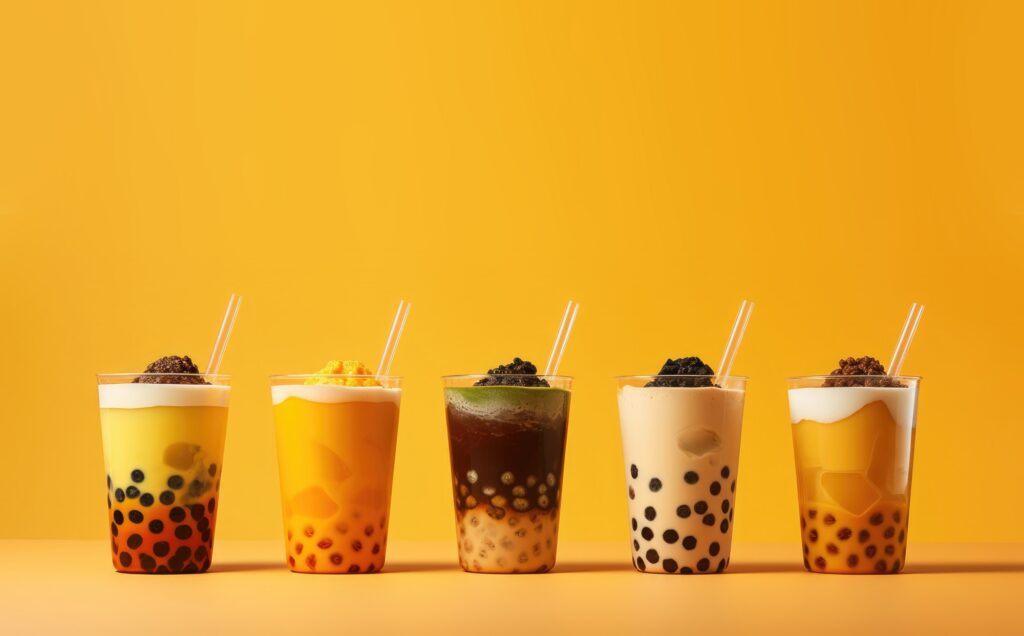
Boba tea is part drink, part dessert, and part texture experience.
A typical cup might combine strong black tea, milk, ice, sweetener, and a generous scoop of chewy tapioca pearls. But walk into a modern boba shop and that classic combination is only the beginning.
You may find:
- Jasmine green tea with mango
- Brown sugar milk with warm tapioca pearls
- Taro milk tea
- Matcha with oat milk
- Passion fruit tea with popping boba
- Oolong topped with cheese foam
- Winter melon tea
- Strawberry milk with crystal boba
- Thai tea with pearls
- Fruit tea with aloe or jelly
Some drinks contain milk.
Some do not.
Some contain tapioca pearls.
Others use entirely different toppings.
And despite being commonly called boba tea, some modern boba-shop drinks contain no actual tea at all.
What connects this enormous category is a Taiwanese beverage tradition built around customizable drinks, contrasting textures, sweetness, ice, and toppings.
Modern bubble tea developed in Taiwan during the 1980s, although exactly who first combined tea with tapioca pearls remains disputed. From Taiwan, the drink spread throughout Asia and eventually around the world, becoming one of the most recognizable modern tea styles.
Here is everything you need to know about boba tea—from its Taiwanese origins and chewy tapioca pearls to popular flavors, toppings, caffeine, ordering terminology, and how to make a classic version at home.
🧋 What Is Boba Tea?
Boba tea is a broad category of Taiwanese-style beverages commonly combining some combination of:
- Tea
- Milk or creamer
- Sweetener
- Ice
- Fruit
- Flavoring
- Tapioca pearls
- Other chewy or jiggly toppings
The classic version is often called:
pearl milk tea.
It typically consists of:
tea + milk + sweetener + tapioca pearls.
But modern boba menus have expanded far beyond that formula.
You can now order drinks based on:
- Black tea
- Green tea
- Jasmine tea
- Oolong
- Matcha
- Fruit infusions
- Milk
- Yogurt
- Coffee
- Taro
- Chocolate
- Fresh fruit
and then customize them with an enormous range of toppings.
🫧 Boba Tea vs. Bubble Tea: What’s the Difference?
In everyday use, boba tea and bubble tea usually refer to the same general drink category.
Other common names include:
- Pearl milk tea
- Tapioca tea
- Boba milk tea
- Pearl tea
- Bubble milk tea
Naming varies by region.
In some places, boba primarily means the tapioca pearls themselves.
Someone might say:
“Add boba to my milk tea.”
In other places, “boba” refers to the entire category:
“Let’s go get boba.”
Both uses are common.
🫧 Why Is It Called Bubble Tea?
The “bubble” in bubble tea does not necessarily refer only to tapioca pearls.
Taiwan already had a tradition of vigorously shaken cold tea that developed a layer of foam or bubbles on top.
That shaken-tea culture helped set the stage for modern bubble tea.
Over time, chewy tapioca pearls became so closely associated with the drink that many people now assume the “bubbles” are the pearls.
Today the name is simply part of the beverage’s identity.
And despite the word bubble, traditional bubble tea is generally not carbonated.
⚫ What Is Boba?
Boba usually refers to the chewy tapioca pearls commonly found at the bottom of bubble tea.
Classic dark pearls are made primarily from:
tapioca starch.
Tapioca starch comes from:
cassava, a tropical root crop.
Manufacturers may combine tapioca starch with ingredients such as:
- Water
- Brown sugar
- Caramel coloring
- Other starches
depending on the product.
When cooked correctly, the pearls become:
- Soft
- Springy
- Chewy
- Slightly sticky
That texture is one of the defining features of boba tea.
🌱 Is Boba Made From Tapioca?
Traditional chewy boba pearls are primarily made from tapioca starch.
Tapioca comes from cassava, scientifically known as:
Manihot esculenta.
Cassava is native to South America but is now cultivated widely throughout tropical regions.
The starch extracted from the root has a particularly useful property:
When heated with water, it can form a stretchy, chewy texture.
That is what makes tapioca ideal for boba.
🤔 Is Cassava the Same as Taro?
No.
This is an easy point of confusion because both appear in bubble tea.
Cassava supplies the tapioca starch used to make traditional boba pearls.
Taro is a different plant entirely and is used as a popular flavor.
That means a Taro Boba Tea can contain:
- Taro in the drink
- Cassava-derived tapioca in the pearls
Two different plants are involved.
🇹🇼 Where Did Boba Tea Come From?
Modern bubble tea originated in:
Taiwan.
The drink emerged during the 1980s from Taiwan’s already vibrant tea-shop culture.
By then, cold shaken teas were increasingly popular, and chewy starch-based sweets had long been familiar in Taiwanese desserts.
Combining those traditions produced something new:
Tea you could both drink and chew.
That textural contrast became central to bubble tea’s appeal.
📜 Who Invented Bubble Tea?
There is no universally accepted answer.
Two Taiwanese tea businesses are especially associated with competing origin stories:
- Chun Shui Tang in Taichung
- Hanlin Tea Room in Tainan
Both have been credited with early versions of tea containing tapioca pearls.
Chun Shui Tang’s story centers on the development of cold shaken tea and an employee adding tapioca balls to a milk-tea drink.
Hanlin’s story involves its founder encountering tapioca balls traditionally served in syrup and deciding to add them to tea.
The competing claims eventually became the subject of a long legal dispute.
Rather than declaring one story conclusively correct, the safest historical conclusion is:
Modern bubble tea emerged from Taiwan’s tea-shop culture during the 1980s, and its precise inventor remains disputed.
That uncertainty does not diminish its Taiwanese origin.
🥤 What Was the Original Boba Tea Like?
Early versions were much simpler than today’s enormous boba-shop menus.
The familiar basic formula was:
- Tea
- Milk or creamer
- Sweetener
- Ice
- Tapioca pearls
Black tea was a common base.
Today, shops might offer dozens—or even hundreds—of combinations.
But a good classic milk tea still depends on those same basic elements:
strong tea + creaminess + sweetness + chew.
🌏 How Boba Became a Global Drink
Bubble tea spread beyond Taiwan to other parts of Asia and eventually to:
- North America
- Europe
- Australia
- Latin America
- Other regions worldwide
The drink’s adaptability helped tremendously.
A boba shop can combine Taiwanese beverage culture with locally popular flavors.
One market might emphasize:
- Brown sugar milk
while another embraces:
- Mango
- Strawberry
- Matcha
- Thai tea
- Taro
- Coffee
- Chocolate
The format is remarkably flexible.
Customers can change:
- Tea
- Milk
- Sweetness
- Ice
- Flavor
- Toppings
without abandoning the essential bubble-tea experience.
😋 What Does Boba Taste Like?
Plain tapioca pearls have a relatively mild flavor.
Their biggest attraction is texture.
Unsweetened pearls can taste:
- Mild
- Starchy
- Neutral
That is why freshly cooked boba is often soaked in:
- Brown sugar syrup
- Simple syrup
- Honey
- Another sweet syrup
The pearls then absorb some of that sweetness.
Brown sugar boba can taste:
- Caramel-like
- Molasses-like
- Deeply sweet
while still retaining its distinctive chewy texture.
🦷 What Should Boba Feel Like?
Good tapioca pearls should be pleasantly chewy.
They should not be:
- Rock-hard in the center
- Mushy
- Falling apart
- Rubbery enough to be exhausting to chew
Taiwanese food culture sometimes uses the expression QQ for an appealingly springy, bouncy, chewy texture.
That texture is a major part of boba’s identity.
A perfect pearl should offer resistance when you bite it but remain soft enough to chew comfortably.
🧋 What Is Classic Milk Tea?
Classic boba milk tea generally combines:
- Strong brewed tea
- Milk or creamer
- Sweetener
- Ice
- Tapioca pearls
Black tea is a particularly common base because its stronger flavor remains noticeable after adding:
- Milk
- Sugar
- Ice
Good milk tea should still taste like tea.
If the drink tastes only like sugar and milk, the tea base may simply be too weak.
🫖 Best Teas for Boba
Many teas work beautifully in bubble tea.
Black Tea
Classic and robust.
Good with:
- Milk
- Brown sugar
- Tapioca pearls
Jasmine Green Tea
Floral and refreshing.
Excellent in:
- Fruit tea
- Milk tea
- Mango drinks
- Peach drinks
Oolong
More complex and aromatic.
Depending on the style, oolong may taste:
- Floral
- Roasted
- Creamy
- Fruity
- Nutty
Matcha
Earthy, vegetal, and concentrated.
Works particularly well with:
- Milk
- Strawberry
- Brown sugar
Green Tea
Lighter than black tea and good for fruit-based drinks.
For a broader introduction, see our Tea Varieties guide.
🥛 Does Boba Tea Always Contain Milk?
No.
Bubble tea can broadly be divided into drinks such as:
Milk Tea
Tea mixed with dairy or non-dairy milk/creamer.
Fruit Tea
Tea mixed with fruit juice, purée, syrup, or fresh fruit.
Milk-Based Drinks
Drinks centered on milk and flavoring that may contain little or no brewed tea.
Tea-Forward Drinks
Higher-quality tea served cold with minimal additions but optional toppings.
So someone who does not enjoy creamy drinks can still find plenty of boba options.
🌱 Can Boba Tea Be Dairy-Free?
Absolutely.
Many drinks can be made with:
- Oat milk
- Soy milk
- Almond milk
- Coconut milk
Fruit teas are often naturally milk-free as well.
However, check individual ingredients.
A shop’s:
- Creamer
- Taro powder
- Pudding
- Cheese foam
- Flavor powder
may contain milk even when the liquid base is dairy-free.
If you have a milk allergy rather than simply avoiding dairy by preference, ask the shop specifically about ingredients and cross-contact.
🌱 Is Boba Vegan?
Plain tapioca pearls can be vegan because their chewiness comes from starch rather than gelatin.
But you cannot assume every boba-shop ingredient is vegan.
Check:
- Pearl ingredients
- Sweeteners
- Creamers
- Milk
- Puddings
- Jellies
- Foam toppings
- Flavor powders
Some toppings may contain dairy, gelatin, honey, or other animal-derived ingredients.
⚫ Black Boba vs. Clear Tapioca Pearls
Tapioca pearls do not naturally need to be black.
Traditional tapioca starch is light in color.
Darker pearls may get their color from ingredients such as:
- Brown sugar
- Caramel coloring
Light or translucent pearls are also available.
The color itself does not determine quality.
Texture and freshness matter much more.
🟤 What Is Brown Sugar Boba?
Brown sugar boba became especially popular because of its rich flavor and dramatic appearance.
Cooked tapioca pearls are coated or soaked in a concentrated brown sugar syrup.
The warm syrup can create streaks along the glass, sometimes called a:
tiger stripe effect.
The final drink often combines:
- Brown sugar pearls
- Milk
- Ice
and may or may not contain actual tea.
That distinction matters if you are checking caffeine.
For a homemade tea-based version, see Boba Milk Tea with Brown Sugar Syrup.
💜 What Is Taro Boba?
Taro boba is one of the most recognizable bubble-tea flavors.
Taro is a starchy tropical corm with a mild flavor that can taste:
- Nutty
- Vanilla-like
- Sweet
- Creamy
- Slightly earthy
A taro drink may be made from:
- Fresh cooked taro
- Taro powder
- Taro flavoring
- A combination
The familiar vivid purple color is not always produced by taro alone.
For a deeper look, see Taro Boba Tea Guide: Flavor, Ingredients, Caffeine & How It’s Made.
🍵 What Is Matcha Boba?
Matcha boba usually combines:
- Matcha powder
- Milk
- Sweetener
- Tapioca pearls
- Ice
Matcha is powdered green tea, so the entire tea leaf is suspended in the beverage rather than simply steeped and removed.
Its flavor is:
- Grassy
- Vegetal
- Earthy
- Umami-rich
- Slightly bitter
Sweet milk and boba soften that bitterness considerably.
Matcha boba does contain caffeine.
🌸 What Is Jasmine Milk Tea?
Jasmine milk tea usually uses jasmine-scented green tea as the base.
It is:
- Floral
- Fresh
- Light
- Slightly grassy
compared with stronger black milk tea.
Jasmine also pairs particularly well with:
- Mango
- Peach
- Lychee
- Strawberry
- Honey
It is a good choice if you want milk tea that feels lighter and more aromatic.
🥭 What Is Fruit Boba Tea?
Fruit tea typically combines:
- Tea
- Fruit flavor
- Sweetener
- Ice
with optional toppings.
Popular flavors include:
- Mango
- Passion fruit
- Peach
- Lychee
- Strawberry
- Pineapple
- Lemon
- Grapefruit
- Kumquat
Fruit teas are usually lighter than milk teas and can be particularly refreshing in hot weather.
They can contain caffeine if the base is:
- Green tea
- Jasmine tea
- Black tea
- Oolong
Even though the drink tastes primarily fruity.
🧃 Does Every Boba Drink Contain Tea?
No.
This is one of the biggest misconceptions.
Some bubble-tea-shop drinks contain no Camellia sinensis tea at all.
Examples can include:
- Brown sugar milk
- Some taro drinks
- Fresh milk drinks
- Smoothies
- Slushes
- Yogurt drinks
- Fruit drinks
Menus may still place them under the broader boba category.
If you specifically want tea—or specifically want to avoid caffeine—ask what the drink’s base actually contains.
⚡ Does Boba Tea Have Caffeine?
It depends entirely on the drink.
A boba beverage made with:
- Black tea
- Green tea
- Jasmine green tea
- Oolong
- Matcha
will ordinarily contain caffeine.
A beverage based only on:
- Milk
- Taro flavor
- Fruit
- Herbal infusion
may be caffeine-free, assuming none of the other ingredients contain caffeine.
Chocolate and coffee-based versions may contain caffeine for completely different reasons.
So:
Boba does not determine caffeine content. The beverage base does.
🧋 Do Tapioca Pearls Contain Caffeine?
Plain tapioca pearls do not naturally contain caffeine.
They are primarily starch.
If a cup of boba contains caffeine, it usually comes from:
- Tea
- Coffee
- Matcha
- Chocolate
- Another caffeinated ingredient
not from the tapioca itself.
🍬 Is Boba Tea Sweet?
Usually.
Sweetness is a central feature of many bubble-tea drinks.
But modern shops often allow customers to choose levels such as:
- 0%
- 25%
- 50%
- 75%
- 100%
The exact meaning varies by shop.
If you are new to boba, 50% sweetness is often a useful starting point, particularly if you are also ordering sweet tapioca pearls.
Remember that toppings may add sweetness even when you reduce the syrup in the drink itself.
🧊 What Does “Ice Level” Mean?
Many boba shops also let you customize ice.
Options may include:
- Regular ice
- Less ice
- Light ice
- No ice
Less ice does not necessarily mean the shop will replace all that space with extra tea or milk.
Policies differ.
Also remember that ice performs a useful function:
It keeps the drink cold and slightly dilutes a concentrated tea-and-syrup mixture as it melts.
🥤 How to Order Boba for the First Time
A boba menu can feel overwhelming.
You generally need to choose four things:
- Drink
- Sweetness
- Ice
- Topping
For your first order, try:
Classic black milk tea + tapioca pearls + 50% sweetness + regular or light ice.
That gives you the basic boba experience without adding too many competing flavors.
If you do not like milk tea, try:
Jasmine peach tea + boba or jelly.
⚫ What Are Tapioca Pearls?
Classic tapioca pearls are chewy starch balls.
Once cooked, they are usually soaked in a sweet syrup before being added to drinks.
Their job is partly flavor—but mostly texture.
A cup of boba tea alternates between:
- Drinking
- Chewing
- Drinking
- Chewing
That unusual combination is what made the beverage so distinctive.
For more specifically about the pearls, see The Magic of Boba Tea Pearls.
🫧 What Is Popping Boba?
Popping boba is not the same thing as tapioca boba.
Instead of being chewy all the way through, popping boba has:
- A thin outer membrane
- Liquid inside
When bitten, it bursts.
Common flavors include:
- Mango
- Strawberry
- Passion fruit
- Lychee
- Blueberry
Popping boba works particularly well in fruit teas and frozen drinks.
💎 What Is Crystal Boba?
Crystal boba is another alternative to traditional tapioca pearls.
Products vary, but they are often made using plant-derived gelling ingredients rather than classic tapioca starch.
Crystal boba is usually:
- More translucent
- Lighter
- Less deeply chewy
than traditional dark tapioca pearls.
Its flavor tends to be mild unless it has been sweetened or flavored.
🌿 What Is Grass Jelly?
Grass jelly is a dark, soft jelly used in drinks and desserts in parts of Asia.
Its flavor is:
- Mild
- Herbal
- Slightly bitter
It provides a softer texture than tapioca pearls.
Grass jelly pairs particularly well with:
- Milk tea
- Black tea
- Brown sugar drinks
🍮 What Is Pudding in Boba Tea?
Boba-shop pudding is generally a soft custard-like topping.
It adds:
- Creaminess
- Sweetness
- Silky texture
and is especially popular with:
- Milk tea
- Taro
- Brown sugar
- Thai tea
It may contain dairy and eggs, depending on the product.
🥥 What Is Coconut Jelly?
Coconut jelly is a firmer, chewy-jelly topping often added to:
- Fruit tea
- Milk tea
- Tropical drinks
It has a cleaner bite than tapioca pearls and usually remains pleasant longer in a cold beverage.
This can be a good topping for someone who finds traditional tapioca too dense.
🌱 What Is Aloe in Bubble Tea?
Some shops offer pieces of sweetened aloe vera in fruit teas.
The texture tends to be:
- Soft
- Juicy
- Slightly chewy
It works especially well with:
- Citrus
- Jasmine
- Passion fruit
- Peach
- Lychee
As with every commercial topping, the exact syrup and ingredient list vary by shop.
🧀 What Is Cheese Foam?
Cheese foam sounds unusual until you understand the idea.
It is generally a creamy, lightly salty topping made from some combination of:
- Cream cheese
- Milk
- Cream
- Sugar
- Salt
The foam sits on top of tea and creates a contrast between:
sweet tea + salty creamy topping.
Some people drink directly through the foam rather than using a straw so that every sip includes both layers.
🟠 What Is Taro Ball Topping?
Do not confuse taro balls with tapioca boba.
Taro balls are typically chewy pieces made with:
- Taro
- Starch
and sometimes sweet potato or other ingredients.
They may be:
- Purple
- White
- Yellow
- Orange
depending on the recipe.
They are common in Taiwanese desserts and can also appear as bubble-tea toppings.
🧋 Most Popular Boba Tea Flavors
There is no universal ranking, but familiar menu staples include:
- Classic milk tea
- Brown sugar milk tea
- Taro
- Matcha
- Thai tea
- Jasmine milk tea
- Mango
- Strawberry
- Passion fruit
- Peach
- Lychee
- Winter melon
- Honeydew
- Coconut
- Chocolate
Part of the fun is discovering which tea base and topping combination you prefer.
🟤 What Does Brown Sugar Milk Tea Taste Like?
Brown sugar contributes deeper flavors than plain white sugar.
You may notice:
- Molasses
- Caramel
- Toffee
When combined with fresh milk and chewy pearls, the result can taste more like dessert than conventional tea.
Some versions contain tea.
Some do not.
If caffeine matters to you, check before ordering.
💜 What Does Taro Boba Taste Like?
Taro boba tends to be:
- Creamy
- Mild
- Sweet
- Slightly nutty
- Vanilla-like
- Starchy
Fresh taro tastes more earthy and food-like.
Commercial taro powder often creates the sweeter, smoother, almost cake-like flavor many people recognize from boba shops.
🍵 What Does Matcha Boba Taste Like?
Matcha creates a much more tea-forward drink.
Expect:
- Earthiness
- Grassiness
- Mild bitterness
- Umami
Milk and sweetener soften the stronger notes.
If you like Matcha lattes, Matcha boba is a natural next step.
🍈 What Does Winter Melon Tea Taste Like?
Winter melon drinks are often made using a sweetened winter-melon syrup or concentrate.
The flavor can be:
- Sweet
- Caramel-like
- Mildly vegetal
rather than strongly melon-like.
Depending on the preparation, a winter melon drink may not contain true tea.
🌹 What Tea Base Should You Choose?
If you want:
Strong and classic: black tea
Light and floral: jasmine green tea
Complex and aromatic: oolong
Earthy and intense: Matcha
Refreshing and fruity: green or jasmine tea
Roasted: roasted oolong or Hojicha, when available
When the tea itself matters to you, ask the shop which tea it uses.
Better tea can make a dramatic difference.
🥛 Best Milk for Boba Tea
There is no single correct milk.
Dairy Milk
Neutral and creamy.
Oat Milk
Creamy, slightly sweet, and excellent with:
- Matcha
- Brown sugar
- Black tea
Soy Milk
Full-bodied and works well with strong tea.
Almond Milk
Lighter and nuttier.
Coconut Milk
Excellent with:
- Taro
- Mango
- Matcha
- Tropical fruit
Milk choice changes the drink noticeably, so it is worth experimenting.
🍯 Best Sweeteners for Homemade Boba
At home, you can use:
- Brown sugar syrup
- Simple syrup
- Honey
- Maple syrup
- Cane sugar syrup
Liquid sweetener is particularly convenient for iced drinks because it blends more easily than granulated sugar.
Brown sugar remains the classic pairing for tapioca pearls.
🧋 Easy Homemade Boba Milk Tea
You do not need commercial equipment to make a satisfying cup at home.
This version makes approximately:
2 servings.
Ingredients
- ⅓ cup dry quick-cooking tapioca pearls
- 2 cups strong brewed black tea
- ½–¾ cup milk or plant milk
- 3–4 tablespoons brown sugar syrup, divided
- Ice
For the Brown Sugar Syrup
- ¼ cup brown sugar
- ¼ cup water
🍯 Step 1: Make the Brown Sugar Syrup
Combine:
- ¼ cup brown sugar
- ¼ cup water
in a small saucepan.
Heat gently while stirring until the sugar dissolves.
Simmer briefly until slightly syrupy.
Remove from the heat.
The syrup will thicken somewhat as it cools.
⚫ Step 2: Cook the Tapioca Pearls
Bring a generous pot of water to a boil.
Add the tapioca pearls and cook according to the package directions.
This is important because boba products vary dramatically.
Some are ready in:
5 minutes.
Others can take:
20–30 minutes or longer.
Do not assume every pearl uses the same cooking time.
Stir periodically to prevent sticking.
Once pleasantly chewy, drain according to the package instructions.
🍯 Step 3: Sweeten the Warm Boba
Place the cooked pearls in a bowl.
Add enough brown sugar syrup to coat them generously.
Let them sit for:
10–15 minutes.
Warm pearls absorb the syrup and develop much more flavor than unsweetened boba.
🫖 Step 4: Brew Strong Tea
Boba milk tea needs a stronger tea base than an ordinary cup because you will dilute it with:
- Milk
- Sweetener
- Ice
Brew approximately:
2 cups strong black tea.
Use a robust black tea such as:
- Assam
- Ceylon
- Breakfast tea
Allow it to cool.
For more brewing guidance, see How to Brew Tea: Water Temperature, Steeping Times & Brewing Methods.
🥛 Step 5: Mix the Milk Tea
Combine the cooled tea with:
½–¾ cup milk
depending on how creamy you want it.
Add brown sugar syrup gradually.
Taste before adding more.
Remember that the boba itself is sweetened too.
🧊 Step 6: Assemble
Divide the syrup-soaked tapioca pearls between two tall glasses.
Add ice.
Pour in the milk tea.
Stir.
Serve with a wide boba straw.
📋 Basic Boba Milk Tea Recipe
Ingredients
- ⅓ cup dry quick-cooking tapioca pearls
- 2 cups strong brewed black tea
- ½–¾ cup milk or plant milk
- 3–4 tablespoons brown sugar syrup, or to taste
- Ice
Instructions
- Prepare the brown sugar syrup.
- Cook the tapioca pearls according to their package instructions.
- Drain the cooked pearls.
- Soak them in brown sugar syrup for 10–15 minutes.
- Brew strong black tea and allow it to cool.
- Stir milk into the tea.
- Sweeten to taste.
- Add boba to two glasses.
- Fill with ice.
- Add milk tea.
- Stir and serve with a wide straw.
⚫ The Most Important Boba Rule: Cook It Fresh
Tea can be prepared ahead.
Syrup can be prepared ahead.
Tapioca pearls are another story.
Cooked boba is at its best when freshly prepared.
As it sits, the texture deteriorates.
Pearls can become:
- Hard
- Stale
- Overly soft
- Gummy
Refrigeration is particularly troublesome because tapioca starch firms up as it gets cold.
If possible, cook only as much boba as you plan to use within a few hours.
❄️ Should You Refrigerate Cooked Boba?
Not if you are trying to preserve the ideal texture.
Cooked tapioca pearls tend to harden in the refrigerator.
That means the common advice to prepare a huge batch and keep it refrigerated for several days produces disappointing results.
For the best boba:
Cook it fresh and use it promptly.
Follow the storage instructions on the particular commercial product you buy.
♨️ Should Boba Be Warm or Cold?
Freshly cooked boba is often still warm when added to the glass.
That can be delicious.
You get:
warm chewy pearls + cold milk tea + ice.
The contrast is part of the experience.
You do not need to chill the pearls completely before assembling the drink.
🧊 Why Did My Boba Turn Hard?
The most common causes are:
- Refrigeration
- Sitting too long
- Undercooking
- Using old cooked pearls
Tapioca pearls are not an ideal make-ahead ingredient.
The easiest solution is:
Cook a fresh batch.
😖 Why Is My Boba Mushy?
Possible causes include:
- Overcooking
- Letting cooked pearls sit in hot water too long
- Using too much residual heat
- Storing them too long
Follow your specific package instructions rather than using one universal cooking time.
Different pearl sizes and formulations behave differently.
🫧 Why Are the Pearls Sticking Together?
Some sticking is normal because tapioca is starchy.
To reduce clumping:
- Use plenty of boiling water.
- Stir shortly after adding the pearls.
- Drain properly.
- Coat the cooked pearls in syrup.
Sweet syrup helps keep them pleasantly separated while adding flavor.
🍯 Why Doesn’t My Homemade Boba Taste Like the Shop?
Usually one of three things is missing:
Stronger Tea
Commercial milk tea often uses concentrated tea so the flavor survives dilution.
More Sweetener
Boba-shop drinks can be significantly sweeter than homemade tea.
Fresh Pearls
Freshly cooked, syrup-soaked pearls taste dramatically better than refrigerated leftovers.
You can adjust all three without needing specialized equipment.
🫖 Can You Make Boba Tea Ahead?
Partly.
You can prepare:
Tea: several hours ahead and refrigerate.
Brown sugar syrup: ahead and refrigerate in a clean sealed container.
But cook the:
Tapioca pearls close to serving time.
That gives you the best combination of convenience and texture.
🍓 How to Make Strawberry Boba
You can turn the basic drink fruity by adding:
- Strawberry purée
- Strawberry syrup
- Fresh strawberry pieces
A simple version combines:
- ½ cup strawberries
- 1–2 tablespoons sugar
Mash or blend them.
Layer with:
- Boba
- Milk
- Tea
or use them in a Matcha drink for the popular strawberry-Matcha combination.
🥭 How to Make Mango Boba Tea
For a refreshing version, combine:
- Jasmine green tea
- Mango purée
- Ice
- Sweetener
- Tapioca pearls
Milk is optional.
Mango works particularly well with jasmine because the floral tea complements the tropical fruit.
🍑 Peach Boba Tea
Peach also pairs beautifully with tea.
Try:
- Jasmine tea
- Peach purée or syrup
- Ice
- Boba
This can be made without milk for a lighter drink.
🍵 Matcha Boba at Home
Whisk Matcha separately rather than trying to stir dry Matcha directly into cold milk.
Combine:
- 1 teaspoon Matcha
- About 2 ounces warm water
Whisk until smooth.
Then add:
- Milk
- Sweetener
- Ice
- Tapioca pearls
Adjust the Matcha according to taste.
💜 Taro Boba at Home
Homemade taro boba can be made with:
- Cooked taro
- Milk
- Sugar
- Tea, optional
or with commercial taro powder.
Fresh taro must be thoroughly cooked before eating.
For the full ingredient and preparation discussion, see our Taro Boba Tea Guide.
🧋 What Is Tapioca Tea?
“Tapioca tea” is another name sometimes used for bubble tea or boba tea.
It is not a distinct botanical tea variety.
The term refers to the addition of tapioca pearls to the beverage.
That means:
tapioca tea = tea/drink with tapioca pearls
in ordinary usage.
It does not mean the tapioca itself has been brewed like tea leaves.
🥤 Do You Have to Use a Wide Straw?
If you want to drink the pearls through the straw:
yes.
Standard drinking straws are too narrow.
Boba straws have a much wider opening that allows the pearls and liquid to travel together.
Reusable versions are available in:
- Stainless steel
- Silicone
- Glass
- Durable plastic
You can also skip the straw and eat the pearls with a spoon.
⚠️ Boba & Choking Risk
Tapioca pearls are round, chewy food pieces.
They should be chewed carefully rather than swallowed whole.
Young children, people with swallowing difficulties, and anyone at elevated choking risk need particular caution.
Do not encourage:
- Gulping pearls
- Speed-drinking
- Swallowing boba whole
The fun of boba is the chew.
Take the time to chew it.
🧒 Is Boba Tea for Kids?
There are two separate considerations:
Caffeine
A tea-based bubble tea may contain caffeine.
Choking
The chewy pearls require careful chewing.
For younger children, a caffeine-free beverage without large chewy pearls may be the simpler choice.
Parents should consider the child’s age and chewing/swallowing ability rather than assuming every brightly colored boba drink is designed for children.
🍬 Is Boba Tea Healthy?
“Healthy” is too broad to be very useful here.
Boba tea can contain tea, milk, and fruit.
It can also contain substantial quantities of:
- Added sugar
- Syrup
- Sweetened creamer
- Sweet toppings
Tapioca pearls are primarily a starch-based topping.
So I would treat most sweetened boba drinks as:
an enjoyable beverage or dessert
rather than a wellness drink.
Tea itself contains interesting plant compounds.
That does not magically cancel a heavily sweetened drink’s other ingredients.
🥗 Can You Make Boba Tea Less Sweet?
Yes.
At a shop:
- Choose 25% or 50% sweetness.
- Skip extra syrup.
- Choose unsweetened tea.
- Use one topping instead of several.
At home:
- Sweeten the pearls but leave the tea less sweet.
- Use strong flavorful tea.
- Add fresh fruit instead of large amounts of syrup.
You do not need to eliminate sweetness completely.
Balance is the goal.
🍹 Is Fruit Boba Automatically Lower in Sugar?
No.
Fruit drinks can contain:
- Fruit syrup
- Fructose syrup
- Juice concentrate
- Added sugar
- Sweetened toppings
A fruit flavor does not automatically mean a lightly sweetened drink.
If sugar matters to you, ask for:
- Reduced sweetness
- Fresh fruit
- Unsweetened tea
where available.
🥛 Is Milk Tea a Source of Calcium?
It depends on the ingredients.
A drink made with actual dairy milk or a fortified plant milk can contribute nutrients found in that milk.
A drink prepared mainly with:
- Powdered creamer
- Syrup
- Water
may have a very different nutritional profile.
You cannot determine a bubble tea’s nutrition simply from the phrase “milk tea.”
🌿 Is Green Tea Boba Healthier?
Not automatically.
Green tea contains tea compounds that are widely studied.
But a green-tea boba drink can still contain:
- Large amounts of sugar
- Sweetened creamer
- Syrup
- Multiple toppings
Choose green tea because you enjoy its flavor—not because the word “green” turns the entire drink into a health product.
🧋 Boba Tea vs. Milk Tea
Milk tea is the broader beverage.
It simply means tea served with some form of milk or creamer.
Boba tea is the customizable Taiwanese-style beverage category often associated with toppings such as tapioca pearls.
So:
Boba milk tea is milk tea.
But:
Not every milk tea is boba tea.
A British cup of Assam with milk, for example, is milk tea but not bubble tea.
🧋 Boba Tea vs. Thai Tea
Thai iced tea is a distinct beverage tradition.
It commonly uses strongly brewed tea combined with:
- Sweetener
- Milk or evaporated milk
- Ice
A bubble-tea shop may serve Thai tea with boba, creating a crossover.
But Thai tea itself is not inherently boba tea.
🧋 Boba Tea vs. Chai
Likewise, masala chai and boba are different traditions.
Masala chai generally combines:
- Black tea
- Milk
- Sugar
- Spices
A shop can add tapioca pearls to chai, but that is a modern fusion rather than the defining traditional form of chai.
🌎 Is Boba Taiwanese?
Yes.
Modern bubble tea is strongly rooted in Taiwanese food and tea culture.
Its enormous global popularity has encouraged endless adaptation, but its Taiwanese origin should not be erased.
Boba is an example of how a local beverage tradition can evolve into an international category while retaining a clear cultural point of origin.
For more about global tea traditions, see Tea Culture & Regions.
🏪 How to Tell if a Boba Shop Takes Tea Seriously
Not every boba shop needs to be a specialty-tea tasting room.
But if tea quality matters to you, look for shops that tell you:
- What kind of tea they use
- Where it comes from
- When it is brewed
- Whether drinks are brewed fresh
- Which drinks actually contain tea
A menu that distinguishes between:
- Assam
- Jasmine
- Oolong
- Matcha
is more informative than one that simply says:
“tea.”
Freshly brewed tea gives the drink structure underneath all the milk, fruit, and toppings.
🧾 Read the Menu Carefully
Boba-shop names are not standardized.
A “taro milk tea” at one shop may contain:
- Black tea
- Fresh milk
- Fresh taro
while another might be:
- Taro powder
- Water
- Non-dairy creamer
Both may be sold under essentially the same name.
If something matters to you—especially:
- Caffeine
- Dairy
- Allergens
- Vegan ingredients
ask.
The drink’s name alone may not tell you enough.
❓ Frequently Asked Questions
What is boba tea?
Boba tea is a Taiwanese-style beverage category commonly combining tea, milk or fruit, sweetener, ice, and toppings such as chewy tapioca pearls.
Is boba tea the same as bubble tea?
Usually, yes. The terms are commonly used interchangeably.
What does boba mean?
Boba can refer specifically to the tapioca pearls or, more broadly, to bubble tea as a beverage category.
Where did boba tea originate?
Taiwan.
When was bubble tea invented?
Modern bubble tea developed during the 1980s.
Who invented bubble tea?
The exact inventor remains disputed. Chun Shui Tang in Taichung and Hanlin Tea Room in Tainan are both associated with prominent origin stories.
What is boba made from?
Classic boba pearls are primarily made from tapioca starch derived from cassava.
Is tapioca the same as taro?
No. Tapioca comes from cassava. Taro is a separate plant.
What does boba taste like?
Plain tapioca pearls are mild and starchy. They are usually sweetened with syrup, often brown sugar.
What texture should boba have?
Soft, springy, and pleasantly chewy.
Does boba contain gelatin?
Traditional tapioca pearls do not require gelatin. Check packaged products and other toppings individually if you have dietary restrictions.
Does boba tea have caffeine?
It can. The caffeine comes primarily from the tea or other caffeinated ingredients, not the tapioca pearls.
Do tapioca pearls contain caffeine?
No, not naturally.
Does taro boba contain caffeine?
Sometimes. It depends on whether the recipe contains a caffeinated tea base.
Does brown sugar milk contain caffeine?
Not necessarily. If it is simply brown sugar, milk, and pearls, it can be caffeine-free. Some versions contain tea.
Does Matcha boba have caffeine?
Yes. Matcha naturally contains caffeine.
Can bubble tea be dairy-free?
Yes. Fruit tea or drinks made with plant milk can be dairy-free, but individual toppings and powders should still be checked.
Is boba vegan?
Some boba is, but complete drinks and toppings vary. Check the specific ingredients.
Is boba gluten-free?
Plain tapioca is naturally gluten-free, but commercial products can contain additional ingredients or encounter cross-contact. Check the manufacturer or shop if medically necessary.
What is popping boba?
Popping boba consists of small liquid-filled spheres that burst when bitten. It is different from chewy tapioca pearls.
What is crystal boba?
Crystal boba is a translucent chewy topping made differently from traditional tapioca pearls.
What is grass jelly?
Grass jelly is a soft, dark herbal jelly commonly served in Asian drinks and desserts.
What is cheese foam?
A creamy, lightly salty foam served over tea.
What is the easiest boba flavor for beginners?
Classic black milk tea with tapioca pearls is an excellent starting point.
What sweetness should I order?
If you are unsure, try 50% sweetness. You can adjust next time.
What does 0% sugar mean at a boba shop?
Usually it means the shop does not add its standard sweetening syrup to the drink. Toppings, powders, fruit preparations, or milk ingredients may still contain sugar.
What tea is best for homemade boba?
Strong black tea is the easiest classic choice. Jasmine, oolong, Matcha, and green tea also work well.
Can I make boba tea without tea?
Yes. Brown sugar milk, some taro drinks, and fruit-based beverages may contain no true tea.
Can I make boba tea at home?
Yes. Brew strong tea, cook tapioca pearls, sweeten them with syrup, add milk or fruit, and serve over ice.
How long should I cook tapioca pearls?
Follow the package directions. Products vary dramatically, from quick-cooking pearls to versions requiring much longer cooking.
Should I refrigerate cooked boba?
Refrigeration usually damages the texture. Cooked tapioca pearls are best made fresh and eaten promptly.
How long does cooked boba stay chewy?
It is generally best within a few hours of cooking. Texture gradually declines as it sits.
Can you reheat hard boba?
Sometimes warming pearls in hot water or syrup can soften them temporarily, but freshly cooked pearls usually taste much better.
Can children drink boba tea?
Consider both caffeine and the choking risk presented by large chewy pearls. A caffeine-free drink without large pearls may be a better choice for young children.
Is boba tea a dessert?
It can reasonably be treated as one, particularly when heavily sweetened and topped with tapioca, pudding, or foam.
🧋 The Bottom Line: Boba Is About Tea, Texture & Choice
Bubble tea started with a wonderfully simple idea:
Take Taiwan’s evolving cold-tea culture, combine it with the country’s love of chewy starch-based sweets, and put them in the same cup.
The result transformed tea.
Suddenly the drink was not just about aroma and flavor.
It was about:
- Chewiness
- Temperature
- Creaminess
- Sweetness
- Color
- Customization
From that foundation came an extraordinary number of variations.
Black milk tea became brown sugar milk.
Jasmine tea met mango.
Matcha met strawberry.
Taro became purple café iconography.
Tapioca pearls were joined by grass jelly, pudding, popping boba, crystal boba, aloe, and cheese foam.
Yet underneath all those choices is a Taiwanese drink culture that deserves to be remembered.
If you are completely new to boba, start simply.
Order a black milk tea.
Choose half sweetness.
Add tapioca pearls.
Notice the contrast between cold tea and chewy boba.
Then start exploring.
Try jasmine.
Try oolong.
Try taro.
Try fruit tea.
Make brown sugar pearls at home.
Bubble tea rewards experimentation because there is no single perfect order.
The best boba drink is the combination of tea, sweetness, milk, ice, and texture that makes you want another sip—and another pearl.
🔗 Related Articles
- Boba Milk Tea with Brown Sugar Syrup
- Taro Boba Tea Guide: Flavor, Ingredients, Caffeine & How It’s Made
- The Magic of Boba Tea Pearls
- Tea Recipes: Hot Tea, Iced Tea, Lattes, Matcha, Chai & More
- Tea Varieties: A Guide to Black, Green, Oolong, Herbal Tea & More
- How to Brew Tea: Water Temperature, Steeping Times & Brewing Methods
- Tea Culture & Regions: Traditions, Terroir & Tea Around the World
📚 Sources & Further Reading
- National Geographic — The Story Behind Bubble Tea, Taiwan’s Iconic Drink
- Smithsonian Magazine — How to Tea-Taste Your Way Through Taiwan
- Encyclopaedia Britannica — Cassava
- Encyclopaedia Britannica — Tapioca
- U.S. Food and Drug Administration — Spilling the Beans: How Much Caffeine Is Too Much?
- USDA FoodData Central