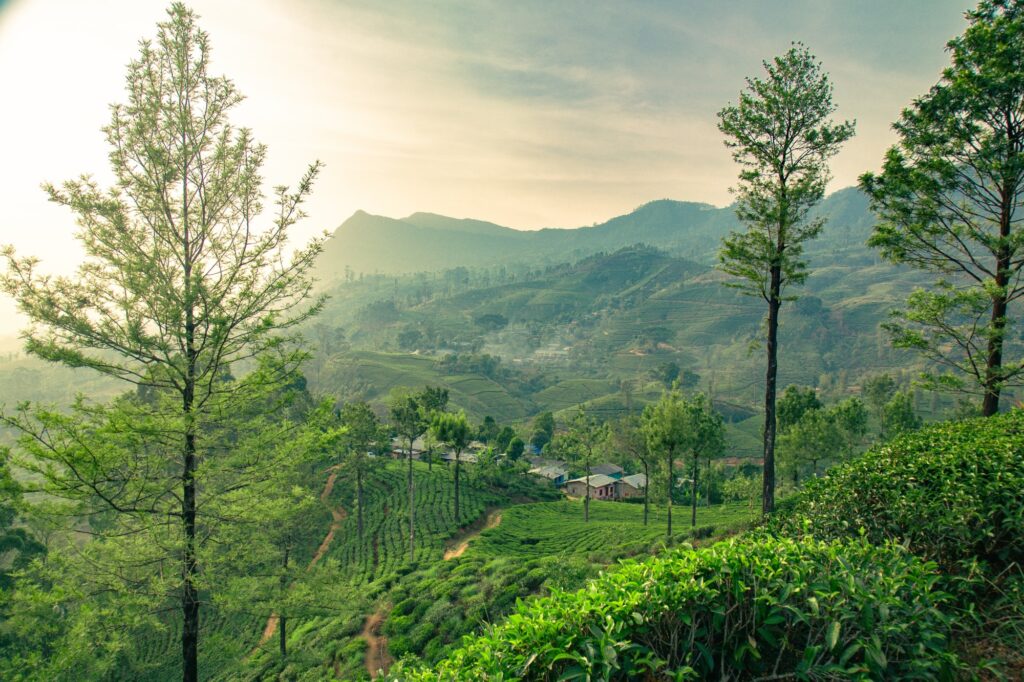
Every cup of tea has a place behind it.
The leaves may have grown on mist-covered mountains in China, rolling estates in Assam, volcanic slopes in Japan, highlands in Kenya, or cool hills in Sri Lanka. They may have been steamed, rolled, roasted, oxidized, fermented, blended with spices, whisked into a bowl, poured from a tiny clay pot, or served strong and sweet in a glass.
Tea is both an agricultural product and a cultural tradition. Climate, elevation, soil, rainfall, cultivar, harvest season, and processing all influence the flavor of the finished tea. At the same time, generations of growers and tea drinkers have created distinctive customs surrounding how tea is prepared, served, shared, and enjoyed.
Exploring tea by region is one of the best ways to understand just how diverse this seemingly simple drink can be.
From Chinese gongfu tea and Japanese matcha to Indian chai, Turkish tea glasses, British afternoon tea, and North African mint tea, this guide offers a starting point for exploring the world’s many tea cultures.
🌱 Where Does Tea Come From?
True tea comes from the Camellia sinensis plant.
Black tea, green tea, white tea, oolong, and dark teas such as pu-erh may look and taste remarkably different, but all begin with leaves from this same species.
Tea has ancient roots in Asia, particularly in the broad region encompassing southwestern China and neighboring areas. China developed an extraordinarily rich tea tradition over many centuries, and tea cultivation and tea-drinking practices later spread throughout Asia and eventually across much of the world.
Today, tea is grown commercially in countries ranging from China, India, Japan, and Sri Lanka to Kenya, Rwanda, Turkey, Argentina, and beyond.
If you would first like to understand how the major styles of tea differ, visit our Tea Varieties collection.
🏔️ What Is Tea Terroir?
Wine drinkers frequently use the word terroir, but the idea is equally useful when talking about tea.
Terroir describes how the environment in which a crop grows influences its character. For tea, this can include elevation, temperature, rainfall, sunlight, soil, surrounding vegetation, and seasonal weather.
A high-elevation garden may produce leaves that develop differently from tea grown in a warmer lowland environment. Two farms growing the same cultivar can still produce noticeably different teas because of their locations and processing choices.
Human decisions matter just as much. Harvest timing, leaf selection, oxidation, rolling, roasting, drying, aging, and blending all influence what eventually reaches your cup.
That is why origin can tell you quite a lot about a tea—but never the whole story.
Explore more individual growing areas in our Tea Regions collection.
🇨🇳 Tea Culture in China
China sits at the heart of tea history and remains home to an extraordinary variety of tea styles.
Chinese tea production encompasses green tea, white tea, black tea, oolong, yellow tea, and dark teas such as pu-erh. Famous tea-producing areas include Fujian, Yunnan, Zhejiang, Anhui, Guangdong, and many others.
Different provinces have developed their own specialties. Fujian is strongly associated with both white tea and important oolong traditions. Yunnan is famous for pu-erh as well as black teas. Zhejiang is closely connected with renowned green teas such as Longjing, or Dragon Well.
Tea culture in China is equally diverse. Tea may be brewed casually in a large mug, prepared in a gaiwan, or served through a more deliberate series of short infusions often described internationally as gongfu-style tea.
Rather than thinking of “Chinese tea” as one flavor or one tradition, it is better to view China as an enormous collection of tea cultures shaped by regional history.
Read more in Exploring the Enchanting Tea Regions of China.
🏺 Gongfu Tea
Gongfu tea preparation is particularly associated with parts of southern China and with teas such as oolong and pu-erh.
Instead of using a small quantity of leaves in a large pot for several minutes, gongfu brewing generally uses more leaf, less water, and a sequence of short infusions.
A gaiwan or small teapot may be used, along with small drinking cups and sometimes a serving pitcher.
The purpose is not merely to make strong tea. Repeated infusions allow the drinker to notice how aroma, texture, sweetness, roasting character, and other qualities change as the leaves gradually open.
You can learn more about the equipment involved in our Tea Gear & Accessories section.
🍃 Yunnan & Pu-erh
Yunnan in southwestern China is one of the world’s most historically important tea-growing areas.
It is especially associated with pu-erh and other dark teas. Some teas are compressed into cakes, bricks, or nests and can change considerably with age and storage.
Pu-erh can range from fresh and vibrant to earthy, woody, fruity, mineral, herbal, or deeply aged in character.
The region’s tea traditions also include large-leaf tea varieties and long histories of trade connecting tea-growing communities with areas across Asia.
Explore more in our Pu-erh Tea collection.
🇯🇵 Tea Culture in Japan
Japanese tea culture is especially associated with green tea.
Sencha is widely enjoyed, while gyokuro, bancha, hojicha, genmaicha, and matcha demonstrate just how varied Japanese tea can be.
One important difference between many Japanese and Chinese green teas is processing. Japanese green teas are commonly steamed soon after harvest to limit oxidation. This can contribute to vivid green color and fresh, vegetal, marine, or savory flavors.
Major tea-producing areas include Shizuoka, Kyoto, Kagoshima, Mie, Fukuoka, and others.
SereniTea Room explores several of these areas in our Tea Growing Regions in Japan guide.
🍵 Matcha & the Japanese Tea Ceremony
Matcha has become internationally popular in lattes, smoothies, desserts, and café drinks, but it also has a much deeper cultural history in Japan.
In Japanese tea practice, powdered tea is whisked with water rather than steeped and removed.
The highly developed tradition commonly known as chanoyu, often translated as the Japanese tea ceremony or “way of tea,” incorporates much more than preparing a beverage. Architecture, utensils, movement, seasonality, hospitality, ceramics, flowers, and aesthetics all become part of the experience.
You do not need to participate in a formal tea ceremony to appreciate matcha, but learning about its cultural background gives the tea greater context.
Explore our Matcha guides for more.
🇮🇳 Tea Culture in India
India is one of the world’s great tea-producing nations, but Indian tea cannot be reduced to a single style.
Assam produces powerful teas often associated with malty richness. Darjeeling is known for more aromatic and sometimes muscatel qualities. The Nilgiri hills of southern India produce fragrant teas used both as single-origin teas and in blends.
India is also home to one of the world’s best-known everyday tea preparations: masala chai.
Strong tea is commonly combined with milk, sweetener, and spices such as cardamom, ginger, cinnamon, cloves, or black pepper. Recipes vary tremendously between households, tea stalls, regions, and individual cooks.
Explore our Chai collection to discover more.
🌿 Assam
Assam lies in northeastern India along the Brahmaputra Valley and is one of the world’s best-known tea-growing areas.
The warm, humid conditions of the region support extensive tea cultivation, and Assam black tea is known especially for a strong, full-bodied, malty character.
Those qualities make Assam a common component in breakfast blends and a natural base for milk tea and chai.
Learn more in The Tea District of Assam: Exploring the Finest Brews and Serene Landscapes.
🏔️ Darjeeling
Darjeeling lies in the Himalayan foothills of northeastern India.
Its teas are often lighter and more aromatic than the bold black teas associated with Assam. Different harvest periods, known as flushes, can produce noticeably different flavor profiles.
A first-flush Darjeeling may taste fresh, floral, and lively, while later harvests can develop fuller fruit and muscatel characteristics.
Explore our Darjeeling Tea collection for more.
🇱🇰 Tea Culture in Sri Lanka
Sri Lankan tea is still widely known internationally as Ceylon tea, using the island’s former colonial name.
Commercial tea production expanded dramatically during the nineteenth century after disease devastated many of Sri Lanka’s coffee plantations. Tea eventually became one of the country’s defining agricultural exports.
Elevation is an important part of Sri Lankan tea identity. Tea is grown across several districts and at different heights, producing a broad range of styles rather than one uniform “Ceylon” flavor.
Some teas are brisk and bold, while higher-grown examples may be lighter, brighter, and more aromatic.
Explore The Finest Tea Areas in Sri Lanka for a closer look at the island’s tea regions.
🇹🇼 Tea Culture in Taiwan
Taiwan is particularly celebrated for oolong tea.
Mountainous landscapes, subtropical conditions, skilled processing, and a long tea-making tradition have helped create a remarkable range of styles.
Taiwanese oolongs may be light, green, floral, creamy, roasted, fruity, honeyed, or deeply aromatic.
Famous tea names associated with Taiwan include Dong Ding, Oriental Beauty, Baozhong, and high-mountain teas from growing areas at significant elevations.
Tea houses and repeated small-pot infusions are important parts of modern Taiwanese tea culture.
Taiwan also gave the world an entirely different tea phenomenon: bubble tea, which emerged in the late twentieth century and has since become an international favorite.
Explore our Oolong Tea and Boba Tea collections.
🇰🇪 Tea in Kenya
East Africa is enormously important to the modern tea industry, and Kenya is one of its best-known producers.
Tea is grown in highland areas where elevation, equatorial conditions, rainfall, and fertile soils support vigorous production.
Kenya is especially associated with strong black teas that are widely used in blends, although specialty producers also make orthodox black, green, purple, white, and other teas.
Smallholder farmers are an important part of Kenyan tea production, making tea not only a global commodity but also a significant rural livelihood.
Learn more in Discover the Pristine Tea Regions Grown in Kenya.
🇷🇼 Tea in Rwanda
Rwanda’s high elevations and abundant rainfall provide favorable conditions for tea cultivation.
Tea gardens are particularly associated with the country’s cooler upland landscapes, and Rwandan teas have gained growing recognition in international specialty tea markets as well as conventional black tea production.
For tea drinkers accustomed mainly to Asian origins, African single-origin teas offer an excellent opportunity to explore how another continent’s soils, elevation, cultivars, and processing shape the cup.
Continue with The Rich Tea Regions Grown in Rwanda.
🇺🇬 Tea in Uganda
Uganda is another East African tea producer, with cultivation concentrated particularly in areas where elevation, rainfall, and tropical conditions favor the tea plant.
Black tea dominates commercial production, although the country’s tea story is closely connected with regional agriculture, export markets, and local livelihoods.
Explore The Rich and Diverse Tea Regions Grown in Uganda for more.
🌍 Tea Across Africa
Kenya, Rwanda, and Uganda are only part of Africa’s tea story.
Tea is also grown commercially in countries including Malawi, Tanzania, Zimbabwe, Mozambique, and Ethiopia.
Much of African production historically entered large international blends rather than being marketed by individual garden or region. Specialty tea has gradually brought greater attention to specific origins, producers, cultivars, and processing techniques.
For tea drinkers, that creates an opportunity to taste African tea as something more specific than a background component in a breakfast blend.
Browse the full Tea Regions collection to explore more African origins.
🇹🇷 Turkish Tea Culture
Tea is woven deeply into everyday hospitality in Turkey.
Turkey’s principal tea-growing region lies around Rize on the humid Black Sea coast. Strong black tea is traditionally brewed using a stacked double-kettle system called a çaydanlık.
A concentrated tea is prepared in the upper pot, while hot water remains below. Each drinker can then adjust the strength by combining the tea concentrate with additional water.
Turkish tea is commonly served in small, tulip-shaped glasses, often with sugar.
Tea may accompany conversation at home, shopping, business meetings, meals, and social visits. Offering tea is an everyday expression of hospitality.
Explore our Rize Tea guide for more.
🇲🇦 Moroccan Mint Tea
In Morocco and across parts of North Africa, mint tea is strongly associated with hospitality.
A familiar version combines green tea—often gunpowder-style tea—with fresh mint and sugar. Preparation and serving can become part of the social experience, with tea poured from a height into small glasses.
The resulting drink is strong, aromatic, cooling, and sweet.
Like many tea traditions, Moroccan tea is not merely about thirst. Preparing and sharing it can signal welcome, generosity, and time set aside for guests.
🇬🇧 British Tea Culture
Tea became deeply embedded in British social life after arriving as an imported luxury.
Over time, it moved beyond aristocratic circles and became an everyday beverage consumed across social classes.
The British tradition also helped popularize practices such as serving black tea with milk, blending teas from several origins, and eventually the social ritual of afternoon tea.
Tea breaks, tea shops, tea rooms, tea and biscuits, and simply offering someone “a cup of tea” all became familiar parts of everyday culture.
For the entertaining side of this tradition, visit our Tea Parties & Afternoon Tea collection.
🇮🇪 Tea in Ireland
Ireland has its own strong everyday tea culture.
Robust black tea blends served with milk are common, and tea is deeply tied to hospitality and ordinary home life.
Rather than being reserved primarily for formal occasions, tea can accompany breakfast, conversation, visitors, work breaks, and evening relaxation.
This is a useful reminder that tea culture does not always mean ceremony. Sometimes its greatest cultural importance comes from becoming so ordinary that it is woven almost invisibly into daily routines.
🇷🇺 Russian Tea & the Samovar
The samovar is one of the most recognizable objects associated with Russian tea culture.
Traditionally, a strong tea concentrate could be prepared in a small pot and diluted with hot water from the samovar according to taste.
Tea might be served with sugar, preserves, lemon, or sweets and shared during extended conversation.
While modern tea preparation no longer depends on the traditional charcoal-heated samovar, the object remains an enduring symbol of hospitality and social tea drinking.
🏔️ Tibetan Butter Tea
Tea traditions can also evolve in ways very different from the sweet or floral cups familiar to many Western drinkers.
In Tibet and Himalayan regions, butter tea traditionally combines tea with butter and salt, producing a rich, savory drink suited to local foodways and climate.
The result illustrates an important lesson in studying tea culture: there is no universal idea of how tea “should” taste.
What feels unusual in one culture may be an everyday comfort in another.
🇺🇸 Tea Culture in the United States
American tea culture has developed along several different paths.
The Boston Tea Party occupies an important place in the country’s political history, but modern everyday tea culture is perhaps even more strongly associated with iced tea.
In the American South, sweet tea became a particularly recognizable regional drink, usually made with black tea, chilled, and served over ice with generous sweetening.
Specialty loose-leaf tea, matcha, chai, bubble tea, kombucha, herbal infusions, and afternoon tea have all expanded the modern American tea landscape.
Rather than following one dominant tradition, American tea culture has increasingly become a meeting place for tea practices and flavors from around the world.
Explore our Tea Recipes for ways to enjoy tea hot or cold.
🇿🇦 Rooibos & South Africa
Rooibos is commonly called tea, but it does not come from Camellia sinensis.
It is made from Aspalathus linearis, a plant native to South Africa’s Cederberg region.
Its naturally caffeine-free infusion can have mellow, woody, honeyed, and slightly nutty characteristics.
Rooibos is an excellent example of how the international idea of “tea” has expanded to include many infusions that do not come from the traditional tea plant.
Explore our Rooibos Tea collection.
🌎 Yerba Mate in South America
Yerba mate is another culturally important drink that is often grouped alongside tea even though it comes from a different plant.
Made from Ilex paraguariensis, mate is especially associated with Argentina, Uruguay, Paraguay, and southern Brazil.
It is traditionally consumed from a vessel through a filtered metal straw known as a bombilla.
Sharing mate can be highly social, with the same vessel traditionally passed among participants.
Unlike most herbal infusions, yerba mate naturally contains caffeine.
Explore our Yerba Mate guides for more.
🌿 Why the Same Tea Tastes Different From Different Places
Place influences tea, but it works together with many other factors.
Two green teas may come from different countries and taste completely unlike one another because of:
- Cultivar
- Elevation
- Climate
- Harvest season
- Shading
- Plucking standard
- Steaming or pan-firing
- Rolling
- Oxidation
- Roasting
- Storage
Even neighboring farms can produce noticeably different tea.
This is part of what makes origin-focused tea so interesting. Instead of thinking only in broad labels such as “black tea” or “green tea,” you can begin asking where the tea was grown, when it was harvested, and how it was made.
🍂 Harvest Seasons & Tea Flavor
Tea can change with the seasons.
Darjeeling is one of the most famous examples, with distinct first, second, and later flushes.
Japanese shincha, or new tea, celebrates the fresh early harvest.
Other regions also distinguish teas according to harvest periods, weather, and leaf maturity.
Seasonal changes matter because a tea plant does not produce identical leaves throughout the year. Temperature, rainfall, sunlight, growth rate, and the stage of the plant all influence the material available to the tea maker.
Learning the harvest season can therefore add another layer to understanding a tea’s flavor.
👩🌾 The People Behind the Tea
It is easy to talk about tea in romantic language—misty mountains, ancient gardens, and beautiful teapots—but every cup also reflects human labor.
Tea cultivation can involve nursery work, pruning, plucking, transporting leaves, factory processing, sorting, tasting, grading, packing, and exporting.
Millions of people around the world depend on tea as a source of livelihood.
When exploring tea regions, it is worth looking beyond flavor notes to learn about producers, working conditions, smallholder farming, sustainability, and how value is distributed through the tea supply chain.
Tea culture is ultimately about people as much as plants.
🌱 Sustainability & the Future of Tea
Tea-growing regions face many of the same pressures affecting agriculture around the world.
Changing temperatures, irregular rainfall, drought, extreme weather, soil health, pests, and economic pressures can all affect tea producers.
Sustainable tea production therefore involves more than simply using a particular farming label. Water management, biodiversity, soil protection, fair livelihoods, responsible agrochemical use, resilient cultivars, and long-term economic stability all matter.
For tea drinkers, learning where tea comes from makes these issues much less abstract.
A cup of tea begins long before the kettle boils.
🗺️ How to Explore Tea by Region at Home
You do not need to travel around the world to begin understanding regional tea.
Try putting together a small tasting.
For example, compare:
- Chinese green tea with Japanese green tea
- Assam with Darjeeling
- Chinese oolong with Taiwanese oolong
- Kenyan black tea with Sri Lankan black tea
- Young pu-erh with aged pu-erh
Brew the teas in similar conditions and taste them without milk or sweetener first.
Notice aroma, body, bitterness, astringency, sweetness, texture, finish, and the flavors that appear as the tea cools.
You may discover that origin becomes much easier to understand once you can taste the differences side by side.
✈️ Tea Travel & Tea Tourism
For travelers who love tea, tea-growing regions can offer another way to understand a destination.
Tea gardens, museums, factories, historic tea houses, markets, ceremonies, and tastings can reveal connections between landscape and everyday culture that are easy to miss otherwise.
Regions such as Uji and Shizuoka in Japan, Darjeeling and Assam in India, Sri Lanka’s central highlands, China’s historic tea areas, and East African tea-growing districts all have their own stories.
When visiting working tea gardens, remember that they are agricultural workplaces rather than simply scenic attractions. Responsible tourism means respecting workers, local communities, rules, and the realities of the industry alongside enjoying the landscape.
🫖 Every Tea Has a Story
Tea becomes much more interesting when you stop seeing it simply as something inside a bag.
A cup of Assam carries the landscape of northeastern India. Matcha connects with centuries of Japanese tea practice. Pu-erh reflects Yunnan’s distinctive tea history. Kenyan black tea represents one of Africa’s major agricultural industries. Turkish tea carries its own traditions of hospitality and service.
None of these cultures is frozen in the past. Tea traditions continually evolve as people travel, migrate, experiment, create new drinks, and reinterpret older customs.
Bubble tea travels from Taiwan around the world. Matcha appears in modern cafés. Chai inspires new variations far beyond India. Iced tea becomes part of American regional identity.
Tea has always traveled.
Following those journeys—through farms, trade routes, kitchens, tea rooms, and family traditions—is one of the most rewarding ways to understand what is really in your cup.
🔗 Explore More of SereniTea Room
- Tea Regions
- Tea Varieties
- Tea Growing Regions in Japan
- Exploring the Enchanting Tea Regions of China
- The Tea District of Assam
- The Finest Tea Areas in Sri Lanka
- Discover the Pristine Tea Regions Grown in Kenya
- The Rich Tea Regions Grown in Rwanda
- The Rich and Diverse Tea Regions Grown in Uganda
- Rize Tea
- Tea Parties & Afternoon Tea
- Tea Gear & Accessories