You do not need a cabinet full of specialized equipment to make a good cup of tea. At its simplest, tea requires little more than fresh water, tea leaves or a tea bag, something to heat the water, and a cup.
The right tea gear can, however, make brewing easier, more consistent, and more enjoyable. A roomy infuser gives loose leaves space to expand. A temperature-controlled kettle takes some of the guesswork out of brewing delicate green tea. A favorite mug can turn an everyday cup into a ritual, while a beautiful teapot or tea set can make an afternoon gathering feel special.
This guide explores the most useful tea accessories, explains what each one does, and helps you decide which pieces are genuinely worth adding to your tea cupboard.
Whether you are putting together your first simple tea setup or gradually building a collection of teaware, start with the tools that match the way you actually drink tea.
🫖 What Tea Equipment Do You Really Need?
A beginner does not need much.
For most everyday tea drinkers, the basic setup is:
- A kettle
- A mug or teacup
- Tea
- An infuser if you use loose-leaf tea
- A timer or clock
That is enough to brew black, green, white, oolong, rooibos, and most herbal teas.
Everything beyond those basics should solve a particular problem or make tea more enjoyable for you. If you regularly make an entire pot for several people, a teapot becomes useful. If you drink tea at work, an infuser bottle may make sense. If you prepare matcha frequently, a whisk and bowl are worthwhile.
Tea accessories should support your habits rather than create clutter.
For help with the actual brewing process, visit our How to Brew Tea guides.
🔥 Tea Kettles
A kettle has one primary job: heat water.
That sounds simple, but there are several kinds to choose from, including stovetop kettles, basic electric kettles, and variable-temperature electric kettles.
A traditional stovetop kettle is straightforward and often durable. Many whistle when the water reaches a boil, making them especially convenient if you tend to wander away from the kitchen.
Electric kettles heat water without requiring a stovetop and are popular because of their speed and convenience.
Variable-temperature kettles allow you to select a target temperature rather than heating every batch of water to boiling. This is particularly useful if you frequently prepare green, white, matcha, or oolong teas.
You do not need variable temperature control to make good tea, but it can make consistent brewing easier.
Browse our Tea Accessories section for more tea kettle guides and ideas.
🌡️ Is a Variable-Temperature Kettle Worth It?
For someone who drinks mostly black tea or herbal infusions, a basic kettle may be all you ever need.
If you regularly switch between black, green, white, and oolong teas, however, temperature control becomes considerably more useful.
Green tea may taste better at a lower temperature than a strong breakfast tea, while different oolongs may fall somewhere in between. Instead of boiling the water and estimating how long to let it cool, a variable-temperature kettle lets you choose the desired range directly.
Useful features can include:
- Multiple temperature settings
- Temperature display
- Keep-warm function
- Comfortable handle
- Easy-to-read water level
- Automatic shutoff
- Boil-dry protection
Do not assume that the kettle with the most buttons is automatically the best. Reliability and ease of use matter more than features you will rarely touch.
🫖 Teapots
A teapot is useful when you want to make several cups at once or turn brewing into a more deliberate ritual.
Teapots come in ceramic, porcelain, glass, cast iron, clay, stainless steel, and other materials. Each has practical advantages as well as a different look and feel.
Porcelain and glazed ceramic pots are versatile because they do not readily retain the flavor of one particular tea. Glass pots let you watch the leaves unfurl and make it easy to judge color. Traditional unglazed clay pots require more specialized care and may gradually absorb some of the character of the tea brewed inside them.
When choosing a teapot, think about capacity before appearance.
A beautiful six-cup pot may be impractical if you nearly always drink tea alone, while a tiny pot may become frustrating when you regularly serve several guests.
🏺 Ceramic vs. Porcelain Teapots
Ceramic and porcelain are among the easiest teapot materials for everyday use.
Glazed ceramic tends to retain heat well and comes in almost every style imaginable, from rustic stoneware to colorful decorative pots.
Porcelain is often lighter and has long been associated with traditional tea service. Because its glazed surface is relatively neutral, it works with almost any tea.
Either can be an excellent all-purpose choice.
When shopping, check that the lid fits securely, the handle feels comfortable when the pot is full, and the spout pours cleanly without excessive dripping.
Function matters just as much as appearance.
🔎 Glass Teapots
Glass teapots are especially appealing for teas with large leaves, flowering teas, and colorful herbal blends.
Because you can see through the pot, you can watch leaves open and monitor the strength of the infusion visually.
Glass is also generally neutral in flavor and easy to switch between different types of tea.
The tradeoff is heat retention. Thin glass can lose heat more quickly than heavier ceramic, although insulated and thicker glass designs may perform differently.
If you enjoy seeing the brewing process, glass is hard to beat.
🍃 Loose-Leaf Tea Infusers
For many loose-leaf tea drinkers, a good infuser is the single most useful accessory after the kettle.
The main thing to look for is space.
Tea leaves expand as they absorb water. A tiny mesh ball may be adequate for finely cut tea, but tightly packed whole leaves cannot circulate and open as freely.
Large basket infusers fit inside a mug or teapot and give the leaves considerably more room.
They are also easy to remove when the steeping time is finished, which helps prevent tea from becoming overly strong.
If you are building a minimalist tea setup, a large stainless-steel basket infuser is one of the most versatile pieces of equipment you can own.
🥄 Tea Strainers vs. Tea Infusers
Tea strainers and tea infusers perform related jobs, but they are not exactly the same.
An infuser holds the leaves while they brew.
A strainer usually catches loose leaves as already-brewed tea is poured from a pot into a cup.
A basket placed inside a mug is therefore an infuser. A small mesh sieve positioned over a cup while you pour from a teapot is a strainer.
Some teapots include their own removable infuser baskets, combining both the brewing vessel and filtration system in one piece.
Choose whichever arrangement feels easiest for the way you normally prepare tea.
🫙 Infuser Bottles & Travel Tea Gear
Tea does not have to stay at home.
Tea infuser bottles combine a drinking bottle with a built-in compartment or strainer for loose tea. Depending on the design, the leaves may sit directly in the water or remain in a separate chamber.
They are useful for commuting, work, travel, and outdoor activities, particularly if you prefer loose-leaf tea over bags.
When choosing one, consider:
- Leak resistance
- Ease of cleaning
- Infuser size
- Heat resistance
- Insulation
- Capacity
- Whether the leaves can easily be separated from the water
SereniTea Room already has a guide to choosing tea infuser bottles in our Tea Accessories collection.
For travel gear, simplicity is valuable. A bottle with many small seals and hard-to-reach components can become annoying to clean even if it looks clever.
☕ Tea Cups & Mugs
The cup does not change the tea as dramatically as temperature or steeping time, but it strongly affects the experience of drinking it.
A large ceramic mug is practical for everyday use. A delicate porcelain cup can make afternoon tea feel more ceremonial. Small cups work beautifully for tasting sessions and gongfu-style brewing.
SereniTea Room has a separate Tea Cups and Mugs collection exploring different styles.
When choosing a daily tea mug, prioritize comfort.
Think about the handle, rim, capacity, weight, and whether it keeps tea warm long enough for the way you drink.
The best mug is often simply the one you reach for every morning.
🍵 Choosing a Tea Cup
Tea cups vary widely among different cultures and traditions.
Western-style teacups frequently include handles and saucers. Chinese and Japanese cups may be smaller and handleless. Matcha is traditionally whisked in and drunk from a bowl rather than an ordinary cup.
There is no requirement to match a specific cup to every tea you own.
If you want one versatile option, glazed ceramic or porcelain works for almost everything.
Collectors, however, may enjoy choosing cups for specific teas or occasions.
Explore our Tea Cups and Mugs collection for more.
🍵 Matcha Tools
You can make matcha with surprisingly little equipment, but traditional matcha tools make the process easier and more enjoyable.
The most recognizable is the chasen, a bamboo whisk designed to suspend matcha powder in water and create a fine foam.
Other traditional tools include:
- Chawan — matcha bowl
- Chashaku — bamboo scoop
- Fine sieve
- Whisk holder
A sieve is particularly useful because matcha powder clumps easily. Sifting it before adding water creates a smoother drink.
You do not need a complete ceremonial set to make a matcha latte at home. A bowl, small sieve, and whisk can be enough.
If matcha is something you prepare frequently, however, a proper bamboo whisk is a worthwhile addition.
Explore our Matcha guides for more.
🏺 Gaiwans
A gaiwan is a traditional Chinese brewing vessel consisting of a bowl, lid, and saucer.
It is particularly useful for brewing loose-leaf tea in a style involving multiple short infusions.
The leaves remain in the bowl while the lid is positioned to hold them back as tea is poured into a cup or serving pitcher.
Gaiwans are commonly associated with oolong, pu-erh, white tea, and other Chinese teas, although they are remarkably versatile.
There is a small learning curve. The vessel can become hot, and pouring gracefully takes practice.
Once comfortable with it, however, a gaiwan is one of the simplest and most adaptable tools for exploring high-quality loose-leaf tea.
🫖 Gongfu Tea Gear
Gongfu-style brewing typically uses a relatively high proportion of tea leaves to water and a series of short infusions.
A basic setup might include:
- Gaiwan or small teapot
- Small cups
- Serving pitcher
- Tea tray
- Strainer
Additional tools can be added, but they are not essential to begin.
If you are curious about gongfu brewing, start with a gaiwan and a couple of small cups rather than buying an elaborate set immediately.
The tea itself matters much more than decorative accessories.
🌿 Yerba Mate Gourds & Bombillas
Yerba mate has its own distinctive drinking equipment.
Traditionally, mate is prepared in a small vessel commonly called a gourd and drunk through a filtered straw called a bombilla.
The bombilla acts as both straw and strainer, allowing liquid to pass through while holding back most of the yerba mate leaves.
Traditional gourds may require particular preparation and maintenance, while modern versions are also available in materials such as ceramic, glass, stainless steel, and silicone.
Explore the Yerba Mate collection and our broader Tea Accessories section for more on this distinctive tea tradition.
🌡️ Tea Thermometers
A tea thermometer is useful but optional.
It can be helpful when you are learning how different water temperatures affect green, white, and oolong teas, especially if your kettle does not have temperature controls.
Once you become familiar with your kettle and favorite teas, you may find yourself using the thermometer less often.
For precision-minded tea drinkers, however, it is an inexpensive way to make brewing more repeatable.
⏱️ Tea Timers
Oversteeping is one of the easiest ways to turn an enjoyable tea unpleasantly bitter.
Fortunately, you do not need specialized tea equipment to prevent it.
Your phone timer works perfectly well.
A kitchen timer, smart speaker, watch, or small hourglass can do the same thing.
Dedicated tea timers can be charming, but this is definitely an accessory you should buy because you enjoy it rather than because tea requires it.
⚖️ Tea Scales
A digital scale is useful for people who want consistent results from loose-leaf tea.
Volume measurements such as teaspoons can be surprisingly inconsistent because tea leaves vary tremendously in size and shape.
A teaspoon of tightly rolled oolong may contain far more tea by weight than a teaspoon of large white tea leaves.
Weighing your tea solves that problem.
You do not need a scale for casual everyday brewing, but it becomes useful when experimenting with specialty teas or trying to reproduce a particularly good infusion.
🥄 Tea Scoops & Measuring Spoons
Tea scoops make portioning loose leaves easy and can also be beautiful pieces of teaware.
For ordinary brewing, a household teaspoon works well enough as a starting point.
Traditional tea cultures also use specialized scoops. For example, the bamboo chashaku is associated with matcha preparation.
SereniTea Room explores this subject further in our broader Tea Accessories collection.
If you want maximum brewing consistency, measure tea by weight rather than assuming every scoop contains the same amount.
🫗 Tea Makers
Tea makers range from simple brewing pitchers to automated machines that control temperature, steeping time, and sometimes even movement of the tea basket.
They can be convenient for people who make tea frequently and value automation.
At the same time, they are not necessary for producing excellent tea. A kettle, basket infuser, and mug can accomplish essentially the same fundamental task.
Before buying an automated tea maker, think about:
- How often you will use it
- Capacity
- Cleaning
- Counter space
- Temperature options
- Replacement parts
- Whether it can brew the types of tea you enjoy
SereniTea Room has already explored automatic options in our guide to tea makers.
🧊 Iced Tea Gear
Making iced tea does not require a special appliance.
A heat-safe pitcher, infuser, and refrigerator are usually enough.
If you make large batches frequently, you may appreciate a dedicated iced-tea pitcher with a built-in infuser. The removable basket lets you steep loose tea directly in the pitcher without needing to strain it afterward.
For cold brewing, make sure the container fits comfortably in your refrigerator and can be covered while the tea steeps.
Browse our Tea Recipes for more ideas about iced and cold tea drinks.
🧋 Bubble Tea Gear
Bubble tea has a few specialized accessories that can make home preparation easier.
The most obvious is the extra-wide straw required for tapioca pearls and many other toppings.
A cocktail shaker or tightly sealed jar can also help mix tea, milk, syrup, and ice.
You do not need an elaborate bubble-tea machine at home. A saucepan for the pearls, pitcher or shaker, glasses, and wide straws will handle most homemade recipes.
Visit our Boba Tea collection for more.
🗄️ Tea Storage Containers
Tea gradually loses aroma and flavor when exposed to unfavorable storage conditions.
For most tea, the primary enemies are:
- Moisture
- Heat
- Light
- Air
- Strong odors
An opaque, tightly sealed container stored in a cool cupboard is a practical solution for most loose tea.
Avoid storing tea beside strongly scented spices, coffee, or other foods whose aromas could transfer.
Clear glass jars may look beautiful on an open shelf, but constant exposure to light is not ideal for long-term storage.
Use attractive containers if you enjoy them—just consider keeping them inside a dark cupboard.
📦 Tea Organizers
Tea organizers are especially useful for people who keep individually wrapped tea bags or sachets.
Drawer organizers, divided boxes, baskets, and small cabinets can prevent tea from disappearing into the back of a pantry.
Loose tea is usually better kept in sealed containers rather than open organizer compartments.
Organization also helps you see what you already own. That makes it easier to use older tea before buying yet another box.
Our Tea Accessories section includes more ideas for organizing a tea collection.
🧺 Tea Trays
A tea tray can be purely decorative or highly practical.
For an ordinary afternoon tea, a tray makes it easier to carry teapots, cups, milk, sugar, and treats together.
Traditional gongfu tea trays serve another purpose by catching water used during repeated rinsing and brewing.
Choose the style that fits your routine.
A simple wooden tray may be all you need for serving tea in the living room, while someone deeply interested in gongfu preparation may eventually want a purpose-built draining tray.
🧶 Tea Cozies
A tea cozy is an insulated cover placed around a teapot to help keep its contents warm.
It is a wonderfully simple accessory, particularly if you like making a full pot and slowly drinking it over an hour.
Tea cozies also offer plenty of room for personality. They can be knitted, quilted, minimalist, floral, whimsical, or traditional.
They are especially useful during colder weather or leisurely afternoon teas.
Browse more cozy tea accessories in our Accessories collection.
🍽️ Tea Sets
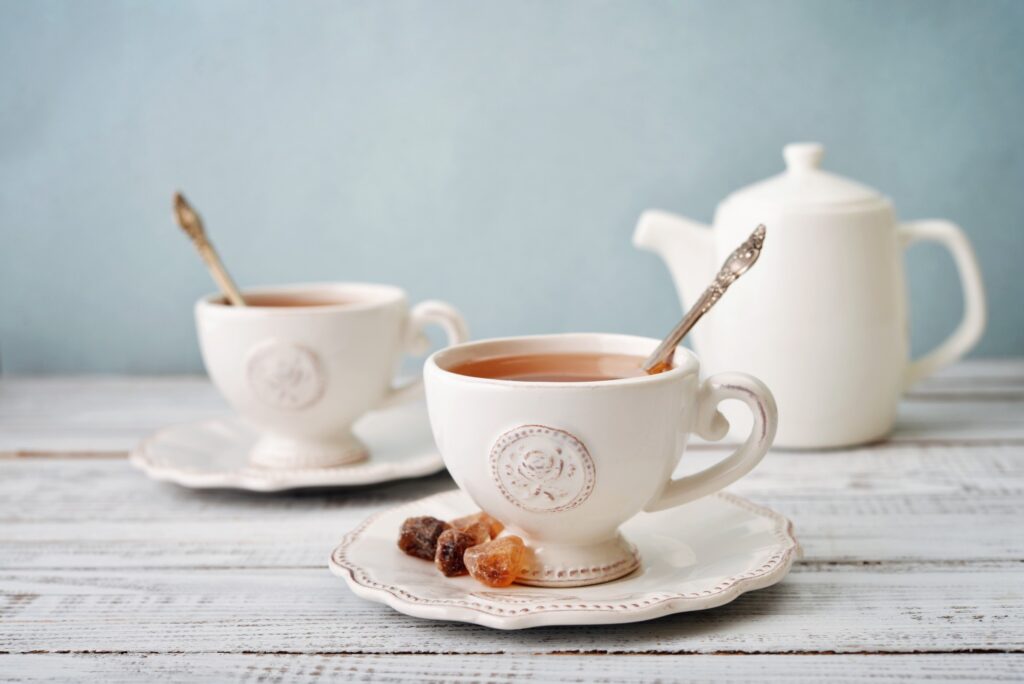
A tea set can range from a simple matching pot and cups to a complete service with saucers, milk jug, sugar bowl, and serving pieces.
For everyday tea, matching pieces are completely unnecessary.
For entertaining, however, a coordinated tea set can create a beautiful table with very little additional decorating.
Vintage and mismatched sets can be equally appealing. In fact, collecting individual cups and saucers from thrift stores, antique shops, or family collections can produce a tea table with much more personality than a perfectly matched modern set.
If you enjoy entertaining, explore our Tea Parties & Afternoon Tea collection for ways to use your teaware.
🎀 Accessories for Afternoon Tea
Afternoon tea involves more serving equipment than an ordinary cup at home, but even here you do not need everything at once.
Useful items might include:
- Teapot
- Cups and saucers
- Milk pitcher
- Sugar bowl
- Serving plates
- Cake stand
- Small spoons
- Napkins
- Tea strainer
A three-tier stand is attractive but optional. Ordinary plates, cake stands, and platters can create an equally inviting spread.
Use what you own before purchasing equipment solely for one gathering.
🥛 Milk Jugs & Sugar Bowls
Milk jugs and sugar bowls are small details that can make a tea table feel more complete.
They are most useful when several people are serving themselves, because guests can adjust each cup to their own taste.
For everyday tea at home, of course, pouring milk straight from the refrigerator works just as well.
This is a good example of the distinction between necessary gear and enjoyable teaware.
Some accessories improve brewing. Others simply make tea feel more special.
Both are legitimate reasons to own something—as long as you know which one you are buying.
🧼 Cleaning Tea Gear
Good tea gear should be easy enough to clean that you actually want to use it.
Remove wet tea leaves promptly rather than allowing them to sit in an infuser or teapot for hours.
Wash equipment according to its material and the manufacturer’s instructions. Glazed ceramic, glass, and stainless-steel items are generally straightforward, while unglazed clay and traditional natural gourds may require different care.
Fine mesh infusers deserve particular attention because tiny pieces of tea can become trapped in them.
When comparing products, always consider cleaning before purchasing. A clever device with numerous narrow tubes, silicone gaskets, and inaccessible corners may be less appealing after a month of daily use.
🎁 Tea Accessories as Gifts
Tea gear makes a natural gift because there are options at almost every price point.
For someone just discovering tea, consider a simple basket infuser, attractive mug, and assortment of teas.
For an experienced tea drinker, something related to their favorite brewing style will usually be more useful than a generic tea gift basket.
Ideas include:
- Ceramic mug
- Basket infuser
- Teapot
- Matcha whisk
- Tea storage tin
- Tea cozy
- Travel infuser bottle
- Gaiwan
- Tea tray
- Tea tasting cups
If you are uncertain, consumable tea is often safer than specialized equipment. Tea enthusiasts can be surprisingly particular about their favorite teaware.
💵 Building a Tea Setup on a Budget
A good tea setup can be extremely inexpensive.
Begin with a basic kettle, favorite mug, and basket infuser.
Those three pieces can handle most loose-leaf teas.
You can add a teapot later if you find yourself regularly brewing for several people. Buy a matcha whisk only if you begin making matcha frequently. Try gongfu brewing before investing in a large set of traditional tools.
Secondhand shops can be excellent sources for teapots, cups, trays, cake stands, and serving dishes.
There is no reason a satisfying tea ritual needs to become an expensive hobby.
🌱 A Minimalist Tea Setup
If you prefer to keep things simple, your entire everyday tea collection could consist of:
- One reliable kettle
- One large basket infuser
- One favorite mug
- One small teapot
- A few airtight tea containers
That setup covers an enormous range of tea.
The leaves themselves deserve more attention than the equipment surrounding them.
🍵 A Tea Enthusiast’s Setup
As your interest grows, you might eventually add:
- Temperature-controlled kettle
- Digital scale
- Several teapots
- Gaiwan
- Small tasting cups
- Matcha tools
- Tea tray
- Travel infuser
- Specialty storage containers
Build the collection gradually.
Buying equipment after discovering a need for it is far more useful than buying a large tea set because it looks like something a “serious” tea drinker should own.
🛒 What to Look for When Buying Tea Gear
Before purchasing any tea accessory, ask a few practical questions.
Will I use it regularly? A simple tool used every day is more valuable than an impressive device kept in a cupboard.
Is it easy to clean? Tea gear that is frustrating to maintain often stops being used.
Is it the right size? Match capacity to how much tea you actually make.
Does the material suit its purpose? Consider heat retention, durability, staining, odors, and fragility.
Can replacement parts be found? This matters particularly for electronic tea makers and products with removable seals or filters.
Does it make brewing easier or more enjoyable? Either reason can justify an accessory, but it helps to know what you expect from it.
☕ Start With the Tea, Not the Equipment
Beautiful teaware can make tea more enjoyable, but expensive gear cannot rescue poor tea or careless brewing.
Start with fresh tea and good-tasting water. Learn how temperature and steeping time affect the cup. Then add tools that solve genuine problems.
If green tea is consistently difficult to brew, a variable-temperature kettle may help. If loose leaves escape into your mug, get a better basket infuser. If you love hosting afternoon tea, invest in a teapot or serving pieces that you enjoy putting on the table.
The best tea equipment is not necessarily the most expensive or traditional.
It is the equipment that makes you want to brew another cup.
🔗 Explore More of SereniTea Room
- Tea Accessories
- Tea Cups & Mugs
- Brewing Techniques
- Tea Varieties
- Tea Recipes
- Tea Party Ideas
- Matcha
- Yerba Mate
- Brewing Perfection: A Tea Enthusiast’s Guide to the Best Tea Makers
- The Art of Tea Cups: Discover the World of Exquisite Designs and Unique Styles