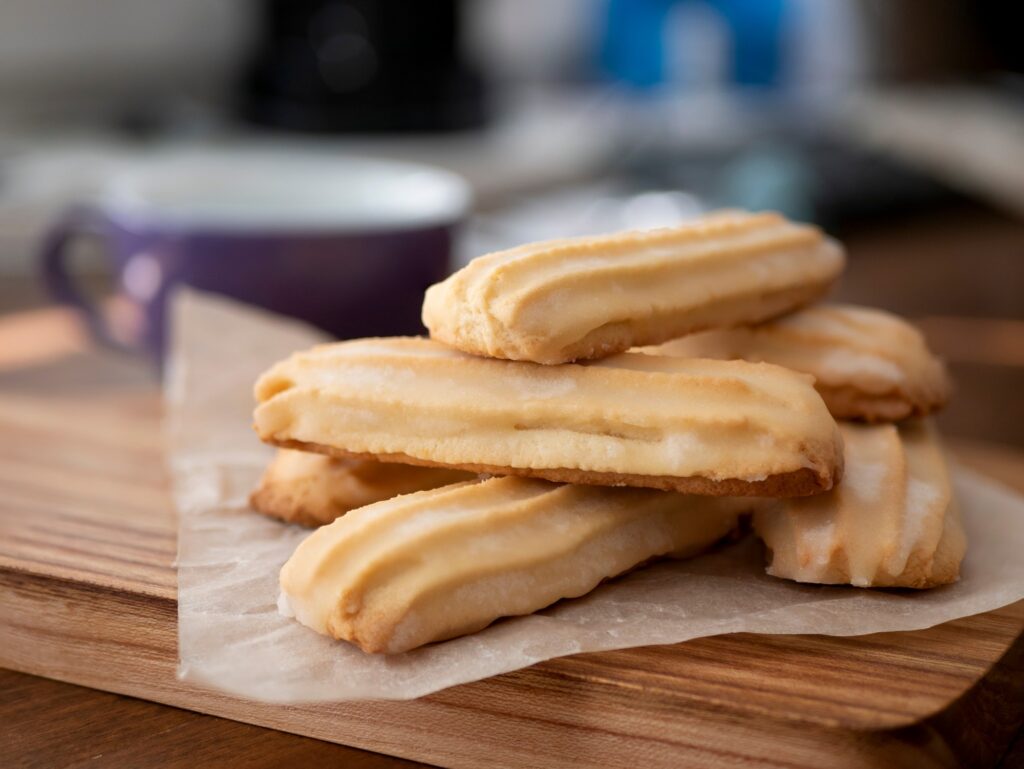
Viennese biscuits are delicate piped butter cookies with crisp ridges, a tender crumb, and the kind of rich buttery flavor that makes them particularly well suited to a pot of tea.
They look elegant enough for afternoon tea, but the dough itself is remarkably simple: butter, powdered sugar, flour, cornstarch, and vanilla.
The distinctive appearance comes from piping the soft dough through a large star tip before baking. You can make little swirls, rosettes, S-shapes, or classic finger-shaped biscuits, then leave them plain, dust them with powdered sugar, dip the ends in chocolate, or sandwich two together with raspberry jam and vanilla buttercream.
The most important part is getting the dough texture right. It needs to be soft enough to pipe without fighting the pastry bag, but firm enough that the ridges remain visible in the oven.
This recipe uses a small amount of cornstarch to create that especially delicate, short texture associated with Viennese-style biscuits.
🍪 Viennese Biscuits at a Glance
Yield: About 20–24 individual biscuits
Prep time: 20 minutes
Optional chilling: 10–15 minutes
Bake time: 12–15 minutes
Oven: 350°F
Texture: Buttery, tender and lightly crisp
Flavor: Vanilla and butter
Best piping tip: Large open-star nozzle
Best for: Afternoon tea, holidays, showers and cookie trays
If you sandwich the biscuits in pairs, this recipe makes approximately 10–12 sandwich biscuits.
🧈 Ingredients
- 1 cup plus 2 tablespoons unsalted butter, very soft
- 1/2 cup powdered sugar
- 1 teaspoon vanilla extract
- 1 3/4 cups all-purpose flour
- 1/4 cup cornstarch
- 1/4 teaspoon fine salt
Optional Chocolate-Dipped Finish
- 4 ounces dark, milk or white chocolate
Optional Jam & Buttercream Filling
- 1/4 cup seedless raspberry or strawberry jam
- 4 tablespoons unsalted butter, softened
- 3/4 cup powdered sugar
- 1/2 teaspoon vanilla extract
Optional Finishing Touches
- Powdered sugar
- Finely chopped pistachios
- Sprinkles
- Melted chocolate
🧈 Start With Very Soft Butter
For most cookie recipes, “softened butter” means cool room-temperature butter that still holds its shape.
Viennese biscuits are a little different.
Because the dough must pass through a piping bag and star nozzle, the butter needs to be very soft, though not melted.
It should give easily when pressed with a finger.
If the butter is too cold, the finished dough will be extremely difficult to pipe.
If it is melted, the biscuits may spread too much and lose their ridges.
You are looking for the middle ground: soft, creamy, and completely pliable.
🥣 Step 1: Beat the Butter & Sugar
Place the softened butter and powdered sugar in a large mixing bowl.
Beat with an electric mixer for approximately:
3–5 minutes
until pale, smooth, and fluffy.
This step incorporates air and helps create the biscuit’s delicate texture.
Scrape down the sides and bottom of the bowl once or twice so no dense pockets of butter remain.
🌼 Step 2: Add the Vanilla
Beat in:
1 teaspoon vanilla extract.
You can use vanilla bean paste instead if you prefer visible vanilla flecks.
Avoid adding large quantities of liquid flavoring because additional liquid can change the consistency of the piped dough.
🌾 Step 3: Mix the Flour & Cornstarch
In a separate bowl, whisk together:
- All-purpose flour
- Cornstarch
- Salt
Cornstarch helps reduce gluten development and contributes to the tender, almost melt-away texture.
🥄 Step 4: Make the Biscuit Dough
Add the dry ingredients gradually to the butter mixture.
Mix on low speed just until incorporated.
Do not continue beating for several minutes after the flour disappears.
The finished dough should be:
- Very soft
- Smooth
- Thick
- Pipeable
- Not runny
When pressed with a spoon, it should move easily.
⚠️ Don’t Refrigerate the Dough Before Piping
Unlike cut-out sugar cookies, Viennese biscuit dough generally needs to remain soft enough to squeeze through a star nozzle.
If you refrigerate the whole bowl first, piping can become extremely difficult.
Pipe the shapes first.
Then, if necessary, chill the tray briefly before baking.
🎂 Step 5: Prepare the Piping Bag
Fit a sturdy piping bag with a:
large open-star nozzle.
A disposable bag works, but use a strong one.
The dough is thicker than frosting, and a very thin piping bag can split under pressure.
Fill the bag only about halfway.
A half-full bag is much easier to control than one packed to the top.
🌟 Step 6: Pipe the Biscuits
Line two baking sheets with parchment paper.
Pipe the dough into your chosen shape.
Good options include:
- 2-inch rosettes
- Small swirls
- S-shapes
- Short fingers
- Horseshoes
Leave about:
1 1/2–2 inches
between the biscuits.
Try to keep the shapes similar in size so they bake evenly.
🌹 How to Pipe Viennese Swirls
Hold the piping bag vertically over the parchment.
Apply steady pressure and pipe the dough in a tight spiral approximately:
2 inches across.
Stop squeezing before lifting the bag.
That creates a cleaner finish.
The dough’s star-shaped ridges should remain clearly visible.
☝️ How to Make Viennese Fingers
Instead of swirls, pipe straight strips approximately:
2 1/2–3 inches long.
Keep them reasonably thick.
After baking and cooling, dip one or both ends in chocolate.
Viennese fingers are particularly easy to serve alongside tea because they are neat, simple, and easy to pick up.
❄️ Step 7: Chill the Piped Biscuits if Needed
If your kitchen is warm or the piped biscuits already look extremely soft, place the baking sheets in the refrigerator for:
10–15 minutes.
This isn’t always necessary.
However, briefly chilling the already-piped biscuits can help the ridges hold their definition during baking.
Do not chill them until rock-hard.
🔥 Step 8: Bake
Preheat the oven to:
350°F.
Bake the biscuits for:
12–15 minutes
or until they are:
- Set
- Pale golden
- Slightly deeper in color around the edges
Avoid baking them until dark brown.
Part of the appeal of Viennese biscuits is their delicate texture and pale buttery appearance.
🧊 Step 9: Cool Carefully
Leave the biscuits on the baking sheet for:
5 minutes.
Freshly baked Viennese biscuits are delicate and may crumble if moved immediately.
After five minutes, transfer them carefully to a wire rack.
Allow them to cool completely before:
- Dipping in chocolate
- Filling
- Dusting with sugar
They firm considerably as they cool.
🍫 Chocolate-Dipped Viennese Biscuits
Once the biscuits are completely cool, melt:
4 ounces chocolate.
Use:
- Dark chocolate
- Milk chocolate
- White chocolate
Dip approximately one-third of each biscuit into the melted chocolate.
Allow excess chocolate to drip away.
Place on parchment paper until set.
For finger-shaped biscuits, dipping one end creates a particularly classic appearance.
🍫 How to Melt Chocolate
Microwave the chocolate in short bursts of:
15–20 seconds,
stirring between each one.
Stop heating while a few small pieces remain and continue stirring until smooth.
This helps prevent scorching.
You can also melt chocolate gently over a bowl set above barely simmering water.
Keep water and steam out of the chocolate.
🍓 Raspberry Jam Viennese Biscuits
For a simple sandwich cookie, spread the flat side of one biscuit with:
about 1 teaspoon seedless raspberry jam.
Top with a second biscuit.
Press very gently.
These biscuits are delicate and do not need much pressure.
Raspberry provides a pleasant tart contrast to all that butter.
🍓 Strawberry Jam Version
Seedless strawberry jam works just as well.
The result is slightly sweeter and less tart than raspberry.
Other good fillings include:
- Apricot preserves
- Blackcurrant jam
- Cherry preserves
- Lemon curd
Use fillings sparingly so they do not squeeze out around the edges.
🧁 Vanilla Buttercream Filling
For a richer sandwich biscuit, beat:
- 4 tablespoons softened butter
- 3/4 cup powdered sugar
- 1/2 teaspoon vanilla
until light and fluffy.
Pipe or spread a small amount onto one biscuit.
Add a little raspberry jam to another biscuit.
Sandwich the two together.
This produces something closer to the familiar Viennese whirl style.
🍓 Jam & Buttercream Viennese Whirls
To make approximately 10–12 filled whirls:
- Turn half of the cooled biscuits upside down.
- Spread each with a small amount of raspberry jam.
- Pipe vanilla buttercream onto the other half.
- Carefully sandwich the pairs together.
- Dust lightly with powdered sugar.
These are richer than plain Viennese biscuits, so one filled whirl is usually plenty alongside a cup of tea.
🇦🇹 Are Viennese Biscuits Really From Vienna?
The terminology is a little messier than the name suggests.
There is a broader Central European tradition of delicate piped butter biscuits, including cookies often known in German as Spritzgebäck, while British baking has developed the familiar Viennese whirl: piped butter biscuits commonly sandwiched with jam and buttercream.
So it is safer not to claim that today’s exact jam-filled Viennese whirl recipe originated in a particular Viennese café.
What unites these styles is the technique:
soft buttery dough piped into decorative shapes before baking.
For tea time, that’s really the important part.
🧈 Why Use Powdered Sugar?
Powdered sugar dissolves readily into the butter and helps create a particularly fine texture.
Granulated sugar can produce:
- More noticeable crystals
- Greater crunch
- A coarser crumb
That is not necessarily bad in other cookies, but Viennese biscuits are prized for being especially delicate.
Powdered sugar helps produce that effect.
🌾 Why Add Cornstarch?
Cornstarch helps create a short, tender biscuit.
It dilutes some of the wheat flour’s gluten-forming potential.
The result is a cookie that feels:
- Delicate
- Crumbly
- Tender
- Almost melting
rather than chewy.
That makes it particularly appropriate for piped butter biscuits.
🧂 Why Add Salt?
Even sweet butter cookies benefit from a small amount of salt.
Salt helps:
- Balance sweetness
- Emphasize vanilla
- Make butter taste richer
If you use salted butter, you can omit the added salt.
🌼 Vanilla Viennese Biscuits
Vanilla is the simplest flavoring and probably the most versatile.
Use:
- Vanilla extract
- Vanilla bean paste
Either works.
Vanilla biscuits pair easily with nearly every black tea and many floral teas.
🍋 Lemon Viennese Biscuits
Add:
1 teaspoon finely grated lemon zest
to the butter and sugar.
Keep the vanilla if desired.
After baking, you can:
- Leave them plain
- Dip them in white chocolate
- Sandwich them with lemon curd
Lemon Viennese biscuits are especially good with Earl Grey.
🍊 Orange Viennese Biscuits
Add:
1 teaspoon finely grated orange zest
to the dough.
Dip the cooled biscuits in dark chocolate.
Orange and dark chocolate create a richer variation without changing the basic dough.
🌹 Rose Viennese Biscuits
Replace part of the vanilla with:
1/4–1/2 teaspoon food-grade rose water.
Start cautiously.
Rose water can become overpowering quickly.
Pair with raspberry jam for a particularly floral sandwich biscuit.
For tea pairing ideas, see our Rose Tea collection.
💜 Lavender Viennese Biscuits
Add:
1/2 teaspoon finely crushed culinary lavender
to the flour.
Keep the amount small.
Lavender should add a light aromatic note, not make the cookie taste like soap or perfume.
These work nicely with lemon zest as well.
Browse our Lavender Tea collection.
🍫 Chocolate Viennese Biscuits
For a chocolate version, replace:
2 tablespoons of the flour
with:
2 tablespoons unsweetened cocoa powder.
Sift the cocoa with the flour and cornstarch.
Chocolate dough can feel slightly firmer, so make sure your butter is especially soft.
Sandwich with:
- Vanilla buttercream
- Chocolate buttercream
- Raspberry jam
or dip the ends in melted white chocolate.
☕ Coffee Viennese Biscuits
Dissolve:
1 teaspoon instant espresso powder
in:
1 teaspoon hot water.
Cool.
Beat it into the butter along with the vanilla.
Because you are adding liquid, keep the amount very small.
Coffee-flavored biscuits pair beautifully with robust black tea.
🌰 Almond Viennese Biscuits
Add:
1/4 teaspoon almond extract
along with the vanilla.
Almond extract is strong, so a little goes a long way.
Dip in dark chocolate or sandwich with raspberry jam.
🌰 Pistachio Viennese Biscuits
Leave the dough vanilla-flavored.
After dipping in white or dark chocolate, sprinkle the wet chocolate with:
finely chopped pistachios.
Let set completely before storing.
The green pistachios make these especially attractive for a tea tray.
🍒 Jam Variations
Raspberry may be the most familiar filling, but the biscuit itself is neutral enough to work with many preserves.
Try:
- Strawberry
- Apricot
- Cherry
- Blackcurrant
- Blackberry
- Peach
Choose a relatively smooth jam.
Large fruit pieces make delicate biscuits harder to sandwich.
🍋 Lemon Curd Viennese Sandwiches
Pipe vanilla buttercream around the outer edge of one biscuit.
Spoon a small amount of lemon curd into the center.
Top with another biscuit.
The buttercream helps keep the curd from squeezing out.
These pair especially well with Earl Grey or Darjeeling.
🍫 Chocolate Ganache Filling
For a richer version, sandwich cooled biscuits with a small amount of chocolate ganache.
Use only a thin layer.
Viennese biscuits are delicate, and a very thick filling can overwhelm them.
☕ Best Tea Pairings for Viennese Biscuits
Their buttery vanilla flavor makes Viennese biscuits particularly easy to pair.
🫖 Earl Grey
Earl Grey is one of the best choices.
Bergamot contributes a fresh citrus aroma that cuts through the richness of butter.
This is especially good with:
- Vanilla biscuits
- Lemon biscuits
- Chocolate-dipped biscuits
Browse our Earl Grey Tea collection.
🖤 English Breakfast
A robust black tea provides enough structure to stand beside a rich butter cookie.
Adding a splash of milk works particularly well if the biscuits are:
- Plain
- Chocolate-dipped
- Filled with jam
Browse more in our Black Tea collection.
🌿 Darjeeling
Darjeeling can provide:
- Floral notes
- Fruitiness
- Muscatel character
depending on the tea and harvest.
Its lighter character works particularly well with plain vanilla biscuits rather than heavily chocolate-coated versions.
Explore our Darjeeling Tea collection.
🍃 Green Tea
A fresh green tea creates a light contrast to all that butter.
Green tea is especially nice with:
- Lemon Viennese biscuits
- Almond biscuits
- White-chocolate-dipped biscuits
Browse our Green Tea collection.
🌹 Rose Tea
Rose tea pairs beautifully with:
- Raspberry-filled Viennese whirls
- Rose-flavored biscuits
- White chocolate
Keep both the tea and cookies moderately floral so they do not compete.
🌼 Chamomile
For a caffeine-free pairing, chamomile works surprisingly well.
Its gentle apple-and-floral character suits:
- Vanilla biscuits
- Honey variations
- Lemon biscuits
See our Chamomile Tea Guide: Benefits, Brewing, Caffeine & Safety.
🫖 Viennese Biscuits for Afternoon Tea
These biscuits are particularly good on an afternoon-tea tray because they are:
- Small
- Neat
- Easy to portion
- Visually decorative
Serve them after the savory sandwiches and scones.
A mixed plate might include:
- Plain vanilla swirls
- Chocolate-dipped fingers
- Raspberry-and-buttercream whirls
That gives guests several options without requiring three completely different doughs.
Browse more ideas in our Tea Parties & Afternoon Tea collection.
💍 Viennese Biscuits for Bridal Showers
For a bridal shower, pipe small rosettes and decorate with:
- White chocolate
- Pistachios
- Powdered sugar
Or sandwich them with:
- Raspberry jam
- Pale vanilla buttercream
Their ridged piped shape already looks decorative, so they do not require elaborate icing.
🎄 Viennese Biscuits for the Holidays
Viennese fingers make an excellent holiday cookie.
Dip the ends in:
- Dark chocolate
- White chocolate
and add:
- Pistachios
- Crushed peppermint
- Holiday sprinkles
They can be prepared alongside more colorful cookies to bring a simple buttery option to the tray.
💕 Viennese Biscuits for Valentine’s Day
Pipe small rosettes and sandwich them with raspberry jam.
You can tint the vanilla buttercream:
- Pale pink
or simply allow the red jam to provide the color.
Serve them alongside Heart-Shaped Sugar Cookies for a Valentine’s afternoon tea.
📏 Why Did My Viennese Biscuits Spread?
Several things can cause spreading.
Butter Was Too Warm
You want soft butter, not melted butter.
Kitchen Was Very Warm
Chill the piped tray for 10–15 minutes before baking.
Dough Was Too Soft
Check that the flour was measured correctly.
Baking Sheet Was Warm
Always pipe onto a cool baking sheet.
Putting soft dough on a hot tray encourages the butter to melt immediately.
💪 Why Is the Dough Too Hard to Pipe?
This is probably the most common Viennese biscuit problem.
The butter may have been:
too cold.
Let the dough sit at room temperature for several minutes.
You can also knead the piping bag gently with warm hands.
Avoid adding several tablespoons of milk just to make the dough pipeable.
That can cause excess spreading.
🥄 What if the Dough Is Still Too Stiff?
First check that you measured the flour correctly.
If it is genuinely impossible to pipe after warming slightly, mix in:
1 teaspoon milk
and test again.
Add another teaspoon only if absolutely necessary.
Small adjustments are better than turning the dough into batter.
😕 Why Did My Star Ridges Disappear?
The dough probably became too warm before baking.
After piping, refrigerate the tray for:
10–15 minutes.
Also make sure you are using a sufficiently large star nozzle.
Tiny piping tips create thin ridges that disappear more easily.
🧈 Why Are My Biscuits Greasy?
Possible causes include:
- Butter was partially melted.
- Butter-to-flour ratio was altered.
- Cookies were placed on a hot baking sheet.
- Ingredients were measured inaccurately.
Allow butter to soften naturally rather than melting it in the microwave.
😖 Why Are My Biscuits Tough?
The dough may have been overmixed after adding flour.
Once the flour and cornstarch are incorporated, stop mixing.
These biscuits should be tender rather than chewy.
🏜️ Why Are My Biscuits Dry?
Possible causes include:
- Too much flour
- Overbaking
- Too little butter
- Cookies piped too thin
For best results, measure flour by weight if possible.
Otherwise, spoon flour lightly into measuring cups rather than packing it firmly.
🍪 Why Did My Biscuits Crumble?
Some crumbliness is normal.
That delicate texture is part of their appeal.
However, if they disintegrate completely:
- Let them cool longer before moving them.
- Check ingredient measurements.
- Avoid baking them until extremely dark and dry.
Fresh biscuits are much more fragile than cooled ones.
⏱️ How Do You Know When Viennese Biscuits Are Done?
Look for:
- Set centers
- Dry-looking surfaces
- Pale golden edges
They should not feel completely hard while still hot.
They crisp and firm as they cool.
🧊 Can You Make the Dough Ahead?
The dough is best piped shortly after mixing because refrigeration firms the butter and makes piping much harder.
If you need to work ahead, the better option is:
- Make the dough.
- Pipe the biscuits.
- Refrigerate the shaped biscuits.
Then bake later the same day.
❄️ Can You Freeze Unbaked Viennese Biscuits?
Yes.
Pipe the biscuits onto a parchment-lined tray.
Freeze until firm.
Transfer carefully to a freezer container.
Bake from frozen, adding a small amount of extra baking time as needed.
Watch for pale golden edges rather than relying entirely on the clock.
❄️ Can You Freeze Baked Viennese Biscuits?
Yes.
Plain, unfilled biscuits freeze best.
Allow them to cool completely.
Store in an airtight freezer container with parchment between layers.
For best quality, use within about:
2 months.
Thaw at room temperature before dipping or filling.
🫙 How to Store Viennese Biscuits
Plain biscuits can be kept in an airtight container at room temperature for approximately:
4–5 days.
Chocolate-dipped biscuits store similarly once the chocolate has fully set.
For filled versions, storage depends on the filling.
Jam-only biscuits can usually be kept cool for a short period, while buttercream-filled cookies are best stored according to the ingredients and temperature of your kitchen.
For the freshest texture, fill sandwich biscuits relatively close to serving time.
🍓 Why Fill Them Shortly Before Serving?
Jam gradually transfers moisture into the biscuit.
That softens the crisp, delicate texture.
Some people actually enjoy Viennese whirls after they have softened slightly, but if you want maximum contrast between crisp biscuit and creamy filling, assemble them closer to serving.
🎁 Can You Give Viennese Biscuits as Gifts?
Absolutely.
Chocolate-dipped fingers are particularly good for gifting because they are sturdier than filled whirls.
Pack completely cooled biscuits in:
- Cookie tins
- Rigid food-safe boxes
with parchment paper between layers.
Avoid squeezing delicate piped rosettes into soft bags where they can break.
🍪 Viennese Biscuits vs. Shortbread
Both are butter-rich cookies, but the method is different.
Shortbread dough is usually:
- Firmer
- Pressed or rolled
- Cut into shapes
Viennese biscuit dough is:
- Softer
- Whipped
- Piped through a nozzle
Viennese biscuits tend to feel lighter and more delicate because of the whipped butter and fine texture.
🍪 Viennese Biscuits vs. Spritz Cookies
They are closely related in spirit.
Both use a buttery dough shaped before baking.
Spritz cookies are often formed with a cookie press.
Viennese biscuits are usually piped through a star nozzle.
Recipes and terminology overlap considerably depending on country and baker.
The important thing for this recipe is the result:
a delicate piped butter cookie with crisp ridges and a tender crumb.
❤️ Simple Ingredients, Elegant Results
Viennese biscuits look like the kind of cookie that must require professional pastry skills.
They really don’t.
The ingredient list is short.
The dough comes together quickly.
And once you learn how soft the butter needs to be, piping becomes much easier.
Start with the basic vanilla version.
Pipe a tray of swirls or fingers.
Bake until the edges are just pale gold.
Then decide how elaborate you want to be.
Leave them plain for a simple tea biscuit.
Dip them in chocolate.
Add lemon zest.
Fill them with raspberry jam.
Or sandwich them with both jam and vanilla buttercream for a rich Viennese whirl.
Whichever version you choose, make a pot of tea before putting the biscuits on the table.
Their delicate buttery crumb is exactly the sort of thing that makes an ordinary cup of tea feel a little more like afternoon tea.
🔗 Related Articles
- Heart-Shaped Sugar Cookies: Easy Cut-Out Cookies for Tea Time
- Tea Recipes
- Food & Tea Pairings
- Tea Parties & Afternoon Tea
- Earl Grey Tea
- Black Tea
- Darjeeling Tea
- Green Tea
- Rose Tea
- Chamomile Tea Guide: Benefits, Brewing, Caffeine & Safety
📚 Sources & Further Reading