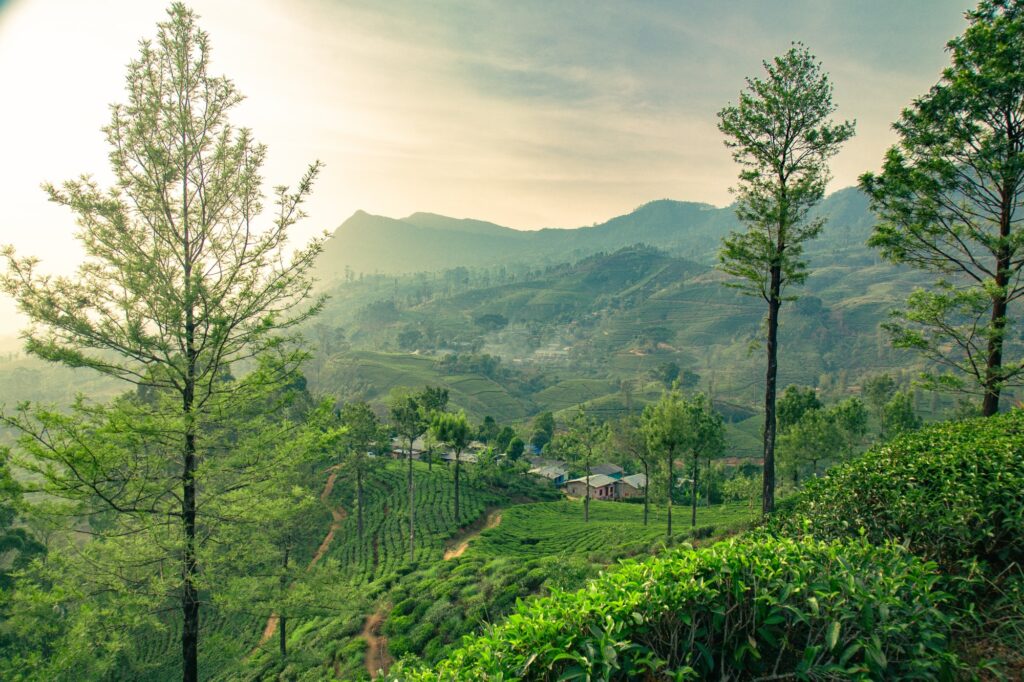
Nuwara Eliya is one of Sri Lanka’s most famous tea-growing regions and one of the clearest examples of how elevation can shape the character of tea.
Located high in Sri Lanka’s central mountains, Nuwara Eliya has the highest average elevation of the country’s major tea districts. Tea is grown at roughly 2,000 meters, or about 6,000 feet, above sea level, where cool temperatures, mountain winds, mist, and cold nights slow the growth of the tea leaves. The result is a style of Ceylon tea that is generally lighter, more fragrant, and more delicate than teas grown at lower elevations.
Nuwara Eliya tea is especially known for its pale golden liquor, refined fragrance, and clean, refreshing flavor. For tea drinkers who think of Ceylon tea only as strong breakfast tea, Nuwara Eliya can be a pleasant surprise.
⛰️ Where Is Nuwara Eliya?
Nuwara Eliya lies in the central highlands of Sri Lanka, surrounded by rugged mountains, valleys, forests, and tea estates.
The Sri Lanka Tea Board describes it as the most mountainous of Sri Lanka’s principal tea-growing districts and the one with the highest average elevation. Nights can be cold and occasionally frosty, while daytime temperatures remain much cooler than in the tropical lowlands.
This elevation is one of the most important reasons Nuwara Eliya tea tastes so different from the fuller, darker teas of low-grown regions such as Ruhuna and Sabaragamuwa.
🍵 What Does Nuwara Eliya Tea Taste Like?
Nuwara Eliya tea is usually described as delicate, fragrant, bright, and refined.
According to the Sri Lanka Tea Board, it produces the palest infusion of Sri Lanka’s major regional teas, with a light golden color and delicate fragrance.
Depending on the estate, season, and grade, you may notice flavors and aromas suggesting flowers, citrus, fresh herbs, light fruit, or gentle sweetness.
It is typically less heavy and malty than low-grown Ceylon tea and less powerful than many teas blended for traditional breakfast-style cups.
That makes Nuwara Eliya particularly appealing to people who enjoy aromatic black teas without excessive strength.
🌿 Why High Elevation Matters
Tea plants growing at high elevations develop more slowly because of cooler temperatures.
Slower growth can contribute to a more delicate balance of aroma and flavor compounds in the leaf.
Nuwara Eliya’s high plateau sits around 2,000 meters above sea level, and the region’s cold nights and drying mountain winds are considered important contributors to its distinctive tea character. Official geographical-indication documentation describes brewed Nuwara Eliya tea as light orange in color, distinctly fragrant, and delicate on the palate.
Elevation alone does not create great tea, but in combination with climate, soil, cultivar, harvest quality, and careful processing, it helps give Nuwara Eliya tea its recognizable style.
🌦️ Climate and the Quality Season
Although Nuwara Eliya receives rainfall throughout much of the year, it has a comparatively dry period from around February through April.
Cooler, drier conditions during parts of the year can slow leaf growth and intensify aromatic qualities.
As with other Sri Lankan regions, the flavor of tea can change through the seasons. Tea is harvested throughout much of the year, but particular weather conditions may produce especially fragrant or refined lots.
The concept of a “quality season” is important throughout Sri Lankan tea country because monsoon winds, rainfall, humidity, and temperature can shift considerably from one side of the mountains to another.
🌱 How Nuwara Eliya Tea Is Harvested
Nuwara Eliya tea is traditionally produced from tender young growth.
Sri Lanka Tea Board geographical-indication documentation notes that the tea is predominantly hand-picked, with skilled workers selecting tender leaves and buds.
Careful plucking is particularly important for high-quality whole-leaf tea.
The familiar standard of a bud and the youngest leaves provides tender material that responds well to traditional black tea processing and helps preserve aroma and refinement.
Harvesting quality can vary among producers, so regional origin alone does not guarantee an exceptional tea.
🫖 How Nuwara Eliya Tea Is Made
Most Nuwara Eliya tea is produced as orthodox black tea.
After harvesting, the leaves are typically withered to reduce moisture, rolled to bruise the leaf tissue, oxidized under controlled conditions, and then dried.
Oxidation changes the chemical composition of the leaves and produces the flavors, aromas, and color associated with black tea.
The dried tea is then sorted into grades according to leaf size and appearance.
The Sri Lanka Tea Board notes that tea sold under a regional designation must not only be grown within the defined region but also manufactured there.
This geographic requirement helps protect the meaning of the Nuwara Eliya name.
🍃 Orange Pekoe and Other Nuwara Eliya Tea Grades
Two grades specifically highlighted by the Sri Lanka Tea Board for Nuwara Eliya are Orange Pekoe, or OP, and Broken Orange Pekoe, or BOP.
Orange Pekoe generally consists of larger, relatively intact leaf pieces. When made well, it can produce a nuanced, aromatic cup that reveals the delicate character of high-grown tea.
Broken Orange Pekoe contains smaller leaf pieces. The increased surface area generally allows it to infuse more quickly and can give the cup a little more strength.
Tea grades describe leaf size and appearance rather than an absolute level of quality. A well-made BOP can be excellent, while an OP designation alone does not guarantee superior tea.
🏔️ Nuwara Eliya vs. Dimbula Tea
Nuwara Eliya and Dimbula are both important high-grown Ceylon tea regions, but they are not identical.
Dimbula teas are generally grown at approximately 1,100 to 1,600 meters, although estates in practice are often above 1,250 meters. The Sri Lanka Tea Board characterizes Dimbula tea as refreshingly mellow with a golden-orange liquor.
Nuwara Eliya sits higher on average and generally produces a paler, more delicate cup.
A Dimbula tea may offer a little more body, while Nuwara Eliya tends to emphasize fragrance and lightness.
Trying the two side by side is an excellent way to see how altitude and microclimate influence Ceylon tea.
🌸 Nuwara Eliya vs. Uda Pussellawa Tea
Uda Pussellawa lies close to Nuwara Eliya, so the two regional teas are frequently compared.
According to the Sri Lanka Tea Board, however, Uda Pussellawa produces a darker infusion with more strength and a distinctly tangy character.
Nuwara Eliya is generally lighter and more fragrant.
This comparison is especially useful because the regions are geographically close. It demonstrates that even neighboring tea districts can produce noticeably different teas because of differences in elevation, exposure, rainfall, and local terrain.
🌬️ Nuwara Eliya vs. Uva Tea
Uva lies on the eastern side of Sri Lanka’s central highlands and is strongly affected by monsoon winds.
During its important quality season, generally around July through September, dry winds crossing the mountains can contribute to an unusually aromatic tea.
Uva tea can be stronger and more distinctive, sometimes showing aromatic qualities described as woody, spicy, minty, or wintergreen-like.
Nuwara Eliya tends to be more delicate and floral.
Both are high-grown Ceylon teas, but the drinking experience can be dramatically different.
🏡 Tea Estates of Nuwara Eliya
Tea estates and factories are an important part of the Nuwara Eliya landscape.
The Sri Lanka Tea Board maintains an official list of registered estates and factories within the Nuwara Eliya agro-climatic region. These include names such as Pedro, Labookellie, Blue Field, Court Lodge, High Forest, Oliphant, and Concordia.
Individual estates can develop reputations for particular styles or seasonal lots, and tea enthusiasts may eventually begin shopping by estate rather than simply by regional name.
Estate teas can be especially interesting because they allow you to compare variations within the same broader terroir.
📍 Pedro Tea and the Nuwara Eliya Area
Pedro is one of the recognized estates and factories within the Nuwara Eliya regional designation.
The surrounding landscape has become closely associated with the image of Nuwara Eliya tea country: green slopes covered with carefully maintained tea bushes, cool mountain air, and clouds drifting over the hills.
For visitors to Sri Lanka, the Nuwara Eliya region is one of the most accessible places to combine tea tasting with visits to tea-growing landscapes.
However, estate access and tour availability can change, so current arrangements should always be checked before visiting.
🌿 Labookellie and Other Historic Tea Areas
Labookellie is another estate name included in the Sri Lanka Tea Board’s registered Nuwara Eliya list.
The numerous estates throughout the district demonstrate that Nuwara Eliya tea is not produced by a single plantation.
Instead, the regional designation covers tea grown and manufactured within the legally defined Nuwara Eliya agro-climatic area.
Differences in slope direction, elevation, soil, factory practices, and harvest timing can therefore create variation among individual estate teas even though they share the broader Nuwara Eliya character.
🗺️ What Does the Nuwara Eliya Name Guarantee?
“Nuwara Eliya Tea” is more than a loose marketing description.
Sri Lanka protects the names of its tea-growing regions through rules administered by the Sri Lanka Tea Board.
For tea to carry a particular regional designation, it must meet the geographic and manufacturing requirements established for that area. In the case of Nuwara Eliya, the tea must be grown and manufactured within the defined agro-climatic region.
This makes the regional name useful to tea buyers because it indicates a genuine relationship between the tea and a defined place.
☕ Should You Add Milk to Nuwara Eliya Tea?
You can, but Nuwara Eliya is often best appreciated without much milk.
Because it is lighter and more delicate than many Ceylon teas, a large quantity of milk can overwhelm its fragrance.
Try it first on its own.
If you prefer milk, use only a small amount and brew the tea slightly stronger.
By contrast, fuller-bodied teas from Kandy, Ruhuna, or Sabaragamuwa often stand up more easily to generous amounts of milk.
🍋 Does Nuwara Eliya Tea Work with Lemon?
Nuwara Eliya’s bright, fragrant character can pair very well with a small slice of lemon.
Its naturally light body makes it a good candidate for serving without milk, either plain or with citrus.
However, adding too much lemon can hide some of the delicate floral aromas.
A lightly brewed Nuwara Eliya tea can also make an elegant iced tea, particularly when you want something refreshing rather than heavily tannic.
🫖 How to Brew Nuwara Eliya Tea
For loose-leaf Nuwara Eliya black tea, begin with approximately 1 teaspoon of tea per 8 ounces of water.
Bring fresh water close to a full boil, then steep the tea for roughly 3 to 4 minutes.
Taste it at the shorter end of the range first.
Because one of Nuwara Eliya’s strengths is its delicate aroma, excessively long steeping can introduce astringency that masks some of its subtler qualities.
Large-leaf OP grades may benefit from a slightly longer infusion than smaller BOP grades.
Experimenting with both tea quantity and steeping time is usually better than relying on one rigid formula.
🍽️ Foods to Pair with Nuwara Eliya Tea
The light character of Nuwara Eliya tea works particularly well with delicate foods.
It can complement shortbread, butter cookies, scones, sponge cake, fruit tarts, cucumber sandwiches, and lightly sweet pastries.
Its bright character can also pair nicely with fresh berries and citrus desserts.
Strongly spiced or very rich foods may overwhelm the tea, so this is generally a better choice for lighter afternoon-tea fare than for heavy meals.
🛍️ How to Buy Nuwara Eliya Tea
When shopping, look first for a clear statement of Nuwara Eliya origin.
If possible, also look for the estate, grade, harvest information, and packing date.
Whole-leaf OP is a good choice if you want to experience the region’s more delicate side.
A BOP can be a better option if you prefer slightly more strength while retaining the typical regional character.
Avoid assuming that any tea labeled simply “Ceylon” comes from Nuwara Eliya. Ceylon tea can originate from any of Sri Lanka’s major tea-growing regions, each of which produces a different style.
🦁 Nuwara Eliya and the Ceylon Tea Lion Logo
The familiar Ceylon Tea Lion Logo is another useful indication when shopping for Sri Lankan tea.
The Sri Lanka Tea Board states that qualifying tea bearing the Lion Logo must be entirely Sri Lankan in origin and meet its applicable quality requirements.
The Lion Logo and a Nuwara Eliya regional designation communicate different things. The Lion Logo identifies qualifying pure Ceylon tea, while the regional name identifies tea connected specifically with the Nuwara Eliya growing area.
For someone exploring tea by terroir, the regional designation is particularly useful.
🌱 Why Nuwara Eliya Tea Is Worth Exploring
Nuwara Eliya offers a very different expression of Ceylon tea from the strong, dark style many drinkers encounter in commercial breakfast blends.
Its high elevation, cool climate, mountain terrain, and careful manufacture contribute to teas prized for their fragrance, brightness, and light golden color.
It is an especially useful tea for learning about terroir because its character becomes even clearer when compared with Dimbula, Uva, Kandy, Ruhuna, or Sabaragamuwa.
The contrast demonstrates one of the most fascinating things about Sri Lankan tea: a relatively small island can produce dramatically different cups simply by changing elevation, exposure, and location.
🌏 A Distinctive Corner of Sri Lankan Tea Country
Nuwara Eliya deserves its reputation as one of Sri Lanka’s classic tea regions.
Its cool mountain climate produces a style that is light rather than heavy, fragrant rather than aggressively malty, and golden rather than deeply red in the cup.
For anyone building a deeper understanding of Ceylon tea, Nuwara Eliya is an essential region to taste.
Once you compare it with teas from the rest of Sri Lanka, the idea of “Ceylon tea” begins to change. Instead of one flavor, it becomes a collection of regional styles shaped by mountains, monsoons, elevation, and generations of tea-making tradition.
🔗 Related Articles
📚 Sources & Further Reading
- Sri Lanka Tea Board — Nuwara Eliya
- Sri Lanka Tea Board — Tea Growing Regions
- Sri Lanka Tea Board — Nuwara Eliya Tea Geographical Indication Regulations
- Sri Lanka Tea Board — Dimbula
- Sri Lanka Tea Board — Uda Pussellawa
- Sri Lanka Tea Board — Uva