Making excellent tea does not necessarily require an expensive machine.
For many tea drinkers, a good variable-temperature kettle and a roomy infuser are all they will ever need. Others may appreciate an automatic tea maker that heats the water, controls the steeping time, removes the leaves, and keeps the finished tea warm. A household that makes cup after cup throughout the day may get more value from a large hot-water boiler, while someone making one mug at a desk may be happiest with a $30 bottom-dispensing infuser.
That is why choosing the “best tea maker” is more complicated than ranking a few appliances from first to last.
An automatic brewer, electric kettle, water boiler, and manual infuser solve different problems.
For this guide, I compared currently available products by what they actually do rather than pretending they are interchangeable. The strongest options include the premium Breville Tea Maker, precision-focused Fellow Corvo EKG Pro, versatile Cuisinart PerfecTemp, large-capacity Zojirushi Micom Water Boiler & Warmer, affordable automatic Adagio velociTEA, and simple Adagio ingenuiTEA 2.
This comparison is based on current manufacturer specifications and availability rather than claiming hands-on testing we have not performed.
Prices and availability change, so treat any pricing mentioned here as a snapshot rather than a permanent figure.
🫖 Best Tea Makers at a Glance
| Tea Maker | Type | Best For | Capacity | Standout Feature |
|---|---|---|---|---|
| Breville Tea Maker BTM800 | Fully automatic tea brewer | Tea enthusiasts wanting maximum automation | Up to 41 oz brewed tea | Automatically lowers and raises tea basket |
| Adagio velociTEA | Automatic brewer/kettle | Lower-cost automatic brewing | 8–40 oz | Tea presets and one-hour keep warm |
| Fellow Corvo EKG Pro | Precision electric kettle | Exact temperature control | 0.9 L / 30 oz | To-the-degree temperature control |
| Cuisinart PerfecTemp CPK-17P1 | Variable-temperature kettle | Families and everyday tea drinkers | 1.7 L | Six preset temperatures |
| Zojirushi Micom CD-WCC30/40 | Hot-water boiler and warmer | Heavy tea drinkers, families, offices | 3 or 4 L | Holds water at four temperatures |
| Adagio ingenuiTEA 2 | Manual bottom-dispensing infuser | Simple loose-leaf brewing | 16 oz | Dispenses directly into a mug |
🍵 Best Overall Automatic Tea Maker: Breville Tea Maker BTM800
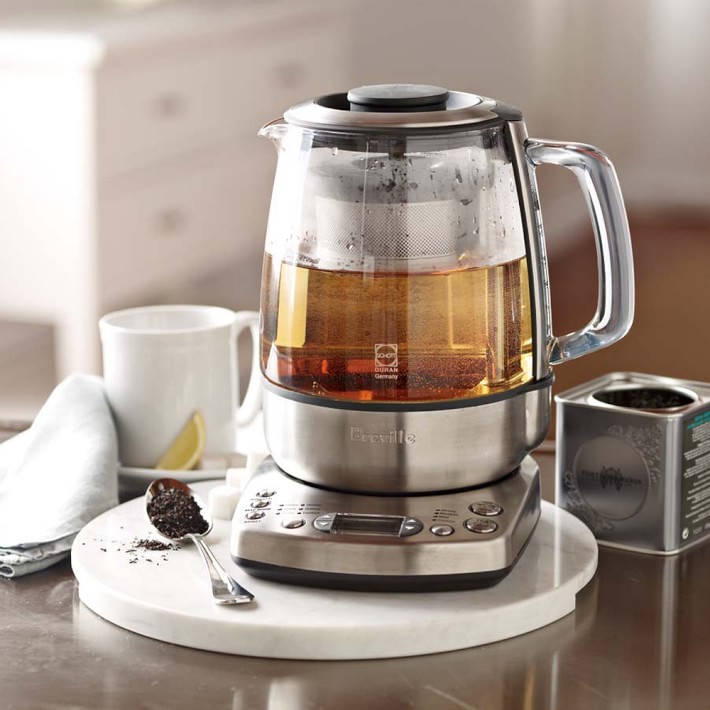
The Breville Tea Maker BTM800 is the most complete tea-brewing machine in this group.
This is not simply a kettle with an infuser basket sitting inside it.
The machine heats the water to the selected temperature and uses a motorized magnetic system to lower the tea basket into the water. When the programmed steeping time is finished, the basket rises again.
That solves one of the biggest problems in automatic tea brewing:
oversteeping.
If you make green tea and then get distracted by an email, telephone call, or breakfast, an ordinary infuser can stay in the water until the tea becomes unpleasantly strong.
The Breville removes the leaves automatically.
What It Does
The current U.S. model provides presets for:
- Green tea
- Black tea
- White tea
- Herbal tea
- Oolong tea
It also allows customization rather than forcing you to accept the presets.
The machine includes selectable tea strength and can automatically start at a programmed time.
After brewing, it can keep the tea warm for up to:
60 minutes.
The glass jug holds up to approximately:
41 ounces of tea
when brewing with the basket, while the vessel has a larger capacity when used only for hot water.
Why It Stands Out
The automatic basket is the real reason to buy this machine.
A less expensive electric kettle can heat water just as effectively.
What the Breville adds is:
temperature + timing + leaf removal
in one appliance.
That is genuinely useful if you regularly make:
- Loose-leaf green tea
- Oolong
- Black tea
- White tea
and want consistent results without manually watching a timer.
Who Should Buy It?
The Breville makes the most sense for someone who:
- Drinks loose-leaf tea every day.
- Frequently brews several cups at once.
- Wants automatic timing.
- Switches among multiple tea types.
- Values convenience enough to pay for it.
Who Should Skip It?
It may be excessive if you:
- Usually make one mug.
- Mostly use tea bags.
- Already own a good variable-temperature kettle.
- Prefer gongfu brewing.
- Have limited counter space.
The Breville is also much more expensive than a kettle-and-infuser combination.
So while it is the most capable automatic tea maker here, it is not automatically the best value for every tea drinker.
One Availability Note
As of this update, Breville still lists the BTM800 for sale in the United States.
The same model has been discontinued in some international Breville markets, so availability depends on where you live.
⚡ Best Value Automatic Brewer: Adagio velociTEA
The Adagio velociTEA occupies an interesting middle ground.
It provides more automation than a standard electric kettle but costs substantially less than the premium Breville.
The machine can make between:
8 and 40 ounces
of tea.
You place leaves in the infuser basket, add water, and select the appropriate tea setting.
The machine heats the water to a temperature suited to the selected tea and then circulates water through the infuser during brewing.
When the cycle finishes, it beeps and can keep the tea warm for:
one hour.
Why It Is Interesting
The velociTEA is useful for someone who wants:
- Preset tea temperatures
- Integrated infuser
- Automatic brewing
- Keep-warm function
without spending more than $300 on a tea appliance.
It can also heat water without tea, so it can replace a separate electric kettle for many households.
Where the Breville Still Wins
The Breville uses its automated moving basket to physically separate the leaves from the water after steeping.
The Adagio takes a simpler approach.
For enthusiasts who want unusually fine control over infusion timing, the Breville remains the more sophisticated machine.
But the velociTEA can be a much more approachable way to automate everyday loose-leaf tea.
Cleaning Matters
Like every machine that heats water repeatedly, the velociTEA requires descaling.
Hard-water mineral buildup can reduce performance over time.
Adagio specifically recommends regular descaling, particularly where mineral-rich water is used.
That maintenance requirement is not unique to this machine.
Electric kettles and automatic brewers generally benefit from routine scale removal.
🌡️ Best Precision Kettle for Tea: Fellow Corvo EKG Pro
The Fellow Corvo EKG Pro does not brew tea for you.
It heats water.
That distinction is important.
You will still need:
- Teapot
- Gaiwan
- Mug infuser
- Tea basket
or another brewing vessel.
But for someone who already owns tea ware they like, a high-quality variable-temperature kettle may be a better purchase than an automatic brewing machine.
Precise Temperature Control
The Corvo EKG Pro allows to-the-degree temperature adjustment rather than limiting you to a handful of preset tea buttons.
Its current specifications include control in increments as fine as:
0.5°F
and a temperature range broad enough for delicate tea through boiling water.
That makes it particularly attractive for tea drinkers who regularly brew:
- Gyokuro
- Sencha
- White tea
- Oolong
- Black tea
- Pu-erh
at substantially different temperatures.
Why Corvo Rather Than Stagg?
Fellow is famous for its Stagg gooseneck kettles.
Those are particularly useful for pour-over coffee because they intentionally pour slowly.
For ordinary tea, I prefer the concept of the Corvo.
Its wider spout is designed for faster everyday pouring, which generally makes more sense when you are filling:
- Teapots
- Gaiwans
- Infuser mugs
rather than controlling a slow coffee pour.
Corvo EKG Pro Features
The Pro model adds features such as:
- Scheduling
- Guide Mode
- Adjustable hold settings
- Altitude settings
- Temperature-unit customization
- Color display
- Firmware updates
These are conveniences rather than necessities.
Tea does not taste better because your kettle has Wi-Fi.
What matters most is that you can reliably choose the water temperature you want.
The Drawbacks
The Corvo’s principal disadvantages are:
Capacity and cost.
Its 0.9-liter capacity is smaller than the 1.7-liter Cuisinart.
That is fine for one or two tea drinkers but less convenient when serving a table.
You are also paying for:
- Design
- Fine temperature control
- Premium interface
- Additional programmable features
If you simply want 175°F water for green tea and boiling water for black tea, the Cuisinart can do the job for less.
💧 Best Everyday Variable-Temperature Kettle: Cuisinart PerfecTemp CPK-17P1
The Cuisinart PerfecTemp CPK-17P1 makes sense for the largest number of ordinary tea-drinking households.
It combines:
- 1.7-liter capacity
- 1500-watt heating
- Six temperature presets
- 30-minute keep warm
- Cordless kettle design
without requiring a premium automatic brewing system.
Why Variable Temperature Matters
Tea does not all benefit from the same water temperature.
Very hot water works beautifully for many:
- Black teas
- Herbal infusions
- Pu-erh teas
but can produce harsher results with delicate green tea.
The Cuisinart’s preset approach takes some of the guesswork out of that difference.
You press the appropriate temperature button rather than watching a thermometer.
For more detail about why water temperature matters, see How to Brew Tea: Water Temperature, Steeping Times & Brewing Methods.
Why It Is Better for Families
The 1.7-liter capacity is one of its strongest advantages.
Compared with a smaller 0.9-liter precision kettle, it makes more sense if you regularly prepare tea for:
- Several people
- A large teapot
- Multiple mugs
in one heating cycle.
What It Does Not Do
The Cuisinart does not automatically steep the tea.
It controls the water.
You still need to place your leaves in:
- A teapot
- Mug basket
- Infuser
and remove them when steeping is complete.
That may sound like a disadvantage.
For many tea drinkers, it is actually preferable because the kettle remains completely separate from the tea leaves and is easier to use for different beverages.
♨️ Best for All-Day Tea Drinking: Zojirushi Micom Water Boiler & Warmer
A Zojirushi water boiler solves a completely different problem.
Instead of repeatedly heating one kettle whenever you want tea, it heats a large quantity of water and keeps that water ready throughout the day.
The Zojirushi Micom CD-WCC series is available in:
3-liter and 4-liter capacities.
It offers four keep-warm temperatures:
- 160°F
- 175°F
- 195°F
- 208°F
That range covers many everyday tea needs.
Why Tea Drinkers Love Water Boilers
Imagine a household where several people drink:
- Green tea in the morning
- Oolong after lunch
- Black tea in the afternoon
- Herbal tea at night
Boiling a kettle again and again becomes repetitive.
A water boiler keeps a substantial reservoir ready.
You simply dispense what you need.
Excellent for Offices
This style of appliance is particularly useful in:
- Offices
- Shared kitchens
- Tea rooms
- Large households
because one machine can serve many cups throughout the day.
Quick Temp Mode
The Zojirushi also offers a Quick Temp function that can bring the water directly to selected lower keep-warm temperatures without first taking everything to a full boil.
That can save time and energy when you do not need boiling water.
The Trade-Off
A large water boiler occupies considerably more counter space than a kettle.
It also makes little sense for someone who drinks:
one cup every couple of days.
This is an appliance for people who use hot water frequently.
It Still Doesn’t Brew the Tea
Like the Fellow and Cuisinart, the Zojirushi handles the:
water
rather than the tea leaves.
You still need an infuser, teapot, or other brewing vessel.
🫗 Best Simple Loose-Leaf Infuser: Adagio ingenuiTEA 2
Not everyone needs electronics.
The Adagio ingenuiTEA 2 may be the simplest product in this comparison, and that is precisely its strength.
You place loose tea inside.
Add hot water.
Wait.
Then place the brewer on top of your cup.
A valve opens in the base and the brewed tea drains into the mug while the filter holds the leaves behind.
Lift the brewer from the mug and the valve closes.
Why It Works So Well
It solves several common loose-leaf frustrations:
- No separate strainer
- No tea ball
- No leaves floating in the cup
- No complicated pouring
- Easy leaf expansion
The 16-ounce capacity is ideal for a large mug or approximately two smaller cups.
Best for Beginners
This is one of the easiest ways to transition from tea bags to loose leaves.
There is almost no learning curve.
You still need a kettle to heat the water, but the brewing itself is extremely straightforward.
Dishwasher Safe
The current ingenuiTEA 2 uses Tritan construction and has a removable filter.
Adagio lists the unit as dishwasher safe.
That is useful because tea residue builds up quickly on clear brewing equipment.
Why You Might Not Want It
The brewer is plastic rather than glass or ceramic.
Some tea drinkers strongly prefer brewing only in:
- Glass
- Porcelain
- Ceramic
- Metal
If that is important to you, choose a different infuser.
But for inexpensive convenience, the concept is difficult to beat.
🆚 Automatic Tea Maker vs. Electric Kettle
This is the most important decision in the entire guide.
An automatic tea maker handles both:
water preparation + tea infusion.
A variable-temperature kettle handles only:
water preparation.
That sounds as though the automatic machine must be superior.
Not necessarily.
A kettle is generally:
- Simpler
- Easier to clean
- More versatile
- Less expensive
- Compatible with any teapot
An automatic brewer is more useful when you value:
- Timed steeping
- Automatic leaf separation
- Repeatability
- Larger batches
- Hands-off brewing
Neither design is inherently better.
It depends on the kind of tea drinker you are.
🫖 Electric Kettle vs. Hot-Water Boiler
These solve another two different problems.
Electric Kettle
Best when you want to heat a batch of fresh water quickly.
Hot-Water Boiler
Best when you want several liters of hot water available throughout the day.
Choose a kettle if you usually make tea:
- A few times per day
- One pot at a time
Choose a boiler if hot water is constantly being used in your home or workplace.
🍵 Electric Brewer vs. Manual Infuser
A manual brewer such as the ingenuiTEA costs a fraction of an automatic machine.
What do you give up?
Primarily:
- Automatic water heating
- Temperature control
- Automatic timing
- Keep-warm functions
What do you gain?
- Simplicity
- Easier cleaning
- Lower cost
- Very little counter space
There is a point at which automation becomes convenience.
There is also a point at which automation becomes another appliance to clean.
🌡️ How Important Is Temperature Control?
For someone drinking primarily:
- Tea bags
- Robust black tea
- Herbal tea
fine temperature control may not matter very much.
For someone drinking:
- Japanese green tea
- Delicate Chinese green tea
- White tea
- High-end oolong
it becomes much more useful.
Water temperature is one of the easiest brewing variables to control.
A variable-temperature kettle removes guesswork and makes it much easier to reproduce a good cup.
⏱️ How Important Is Automatic Steeping?
Automatic steeping is useful primarily because it prevents you from forgetting the leaves.
Tea can continue extracting:
- Bitterness
- Astringency
- Strong vegetal flavors
the longer leaves remain in the water.
An automatic machine that physically separates tea from water after the scheduled infusion has a genuine advantage here.
But a $10 kitchen timer can solve the same problem if you are willing to remove the infuser yourself.
🫖 Capacity: Bigger Isn’t Always Better
Tea makers range from one-cup infusers to multi-liter hot-water dispensers.
Before buying, think about how much tea you actually make.
For one person:
12–20 ounces
may be plenty.
For a couple:
24–40 ounces
is often convenient.
For families or guests:
1.5 liters or more
may make more sense.
For an office:
3–4 liters of ready hot water
can be extremely useful.
Buying a huge machine to make one mug creates unnecessary counter clutter.
🧼 Which Tea Maker Is Easiest to Clean?
In general:
kettle-only designs are easiest.
Tea leaves never enter the kettle, so you mainly need to deal with:
- Mineral scale
- Exterior cleaning
Automatic tea brewers require additional cleaning because tea touches:
- Basket
- Jug
- Lid
- Filters
Tea contains pigments and tannins that can leave visible staining.
The more parts that contact tea, the more cleaning you should expect.
🪨 What Is Descaling?
As water is repeatedly heated, minerals can accumulate inside kettles and machines.
The buildup is commonly called:
scale.
It is particularly noticeable in hard-water areas.
Signs include:
- White deposits
- Chalky film
- Slower heating
- Flakes in the vessel
Manufacturers commonly recommend periodic descaling.
Always follow the instructions for your appliance rather than assuming every machine should be cleaned the same way.
🧴 Don’t Use Abrasive Cleaners on Glass Tea Makers
Glass brewing vessels can develop brown tea staining over time.
Avoid attacking them with harsh abrasive pads unless the manufacturer specifically permits it.
Scratching a brewing surface is not an improvement.
Follow the manufacturer’s cleaning procedure and descale regularly rather than waiting until buildup becomes severe.
🥄 What About Traditional Teapots?
A traditional teapot is still a perfectly good tea maker.
In fact, for many people it is the best one.
A simple setup can consist of:
variable-temperature kettle + roomy teapot infuser.
That gives you:
- Accurate water temperature
- Plenty of room for leaves
- Easy separation after steeping
- No complicated electronics touching the tea
If you enjoy traditional brewing vessels, see Tea Sets Around the World: Styles, History & Cultural Traditions.
🍃 What About a Gaiwan?
Someone who primarily drinks:
- Chinese oolong
- Pu-erh
- White tea
may get more enjoyment from a $20–$40 gaiwan than from a $300 automatic brewer.
Gongfu-style tea involves:
- Small quantities of water
- More tea leaf
- Multiple short infusions
An automatic Western-style tea maker is not designed to replace that experience.
The “best” equipment depends on the brewing tradition.
🍵 What About Matcha?
None of these machines truly replaces the equipment used to make Matcha.
Matcha is not steeped and removed.
The powder is whisked into the water and consumed.
A traditional setup uses:
- Chawan
- Chasen
- Chashaku
A variable-temperature kettle can help heat the water accurately, but the automatic tea basket itself offers no advantage.
🌿 What About Herbal Tea?
Herbal infusions often tolerate or benefit from hotter water and longer steeping times.
If you primarily drink:
- Chamomile
- Peppermint
- Rooibos
- Hibiscus
you may not need extremely fine temperature control.
A simple kettle and infuser may be sufficient.
Automation becomes more useful when you regularly switch among teas with substantially different brewing requirements.
🏠 Best Tea Maker by Type of Tea Drinker
| You Are… | Best Fit |
|---|---|
| Serious loose-leaf drinker who loves automation | Breville Tea Maker |
| Wants automatic brewing for less money | Adagio velociTEA |
| Precision-focused tea enthusiast | Fellow Corvo EKG Pro |
| Everyday family tea drinker | Cuisinart PerfecTemp |
| Makes tea all day or shares hot water | Zojirushi Micom Water Boiler |
| New to loose-leaf tea | Adagio ingenuiTEA 2 |
| Gongfu tea enthusiast | Gaiwan + variable-temp kettle |
| Matcha drinker | Chawan + whisk + variable-temp kettle |
| Mostly tea bags | Basic electric kettle |
💰 How Much Should You Spend?
Tea equipment can range from:
under $20 to several hundred dollars.
The amount you spend should reflect how much functionality you actually need.
At the inexpensive end, a large basket infuser can improve loose-leaf tea dramatically.
Around the middle, a variable-temperature electric kettle gives you much better control.
At the premium end, automatic machines add:
- Timing
- Integrated brewing
- Automatic leaf management
- Scheduling
The tea itself does not know how expensive your machine was.
Good leaves, suitable water, proper temperature, and proper steeping time still matter more than luxury electronics.
🛒 What to Look for Before Buying a Tea Maker
Before choosing any model, compare its real brewing function, capacity, temperature range, ease of cleaning, keep-warm behavior, counter footprint, replacement parts, warranty, and whether tea leaves actually enter the machine.
A product called a “tea maker” may simply heat water.
Another may genuinely perform the infusion.
Knowing which one you are buying prevents disappointment.
🧩 Replacement Parts Matter
A tea maker can last much longer when the manufacturer sells replacement:
- Filters
- Baskets
- Bases
- Lids
- Cleaning supplies
This matters particularly with premium products.
A $300 appliance is a much better investment if a worn component can be replaced instead of forcing you to discard the entire machine.
⚠️ Check Voltage When Buying International Models
Electric tea appliances are designed for specific electrical systems.
Do not assume a model sold overseas can be plugged directly into a U.S. outlet—or vice versa.
Check:
- Voltage
- Frequency
- Plug type
- Manufacturer warranty region
before importing an electric kettle or tea brewer.
This is especially relevant because some tea-maker models are sold in certain countries but discontinued in others.
🏆 Which Tea Maker Is Best Overall?
If you specifically want a fully automatic loose-leaf tea machine, the:
Breville Tea Maker BTM800
is the strongest premium option in this comparison.
Its automatic basket provides functionality that an ordinary kettle simply does not.
But if I were recommending a setup to the largest number of tea drinkers, I would not automatically tell everyone to spend that much.
A combination such as:
Cuisinart PerfecTemp + good basket infuser
can make excellent tea for considerably less.
Someone who values fine temperature control may prefer the:
Fellow Corvo EKG Pro.
Someone who drinks tea continuously may get much more value from:
Zojirushi.
And someone just exploring loose leaf may need nothing more complicated than:
ingenuiTEA 2.
The best tea maker is the one whose features match the way you actually drink tea.
❓ Frequently Asked Questions
What is the best automatic tea maker?
The Breville Tea Maker BTM800 is one of the most fully automated current options in the U.S., with temperature presets, strength settings, automated basket movement, auto start, and keep warm.
Is the Breville Tea Maker still available?
Yes in the United States as of this update. Breville has discontinued it in some other regional markets, so availability varies by country.
Does an electric kettle make tea automatically?
Usually not. Most electric kettles heat water but require a separate teapot or infuser.
What is the difference between a tea maker and a kettle?
A true tea maker can perform or manage the infusion. A kettle primarily heats water.
Is a variable-temperature kettle worth it?
It can be very useful if you drink green, white, oolong, and black teas that benefit from different water temperatures.
Do I need exact one-degree control?
No. Fine control is appealing to enthusiasts, but a few well-chosen temperature presets are sufficient for most tea drinkers.
Which kettle is best for a family?
A larger variable-temperature kettle such as the 1.7-liter Cuisinart PerfecTemp is more practical than a smaller precision kettle when serving several people.
What is the best tea maker for one person?
A small kettle and 16-ounce infuser are often enough. The ingenuiTEA 2 is a simple example.
What is the best tea maker for an office?
A large Zojirushi water boiler can be particularly useful because it keeps several liters of hot water available.
Is Zojirushi a tea maker?
It is primarily a water boiler and warmer. You still steep the tea separately.
What is the best tea maker for green tea?
A variable-temperature kettle is especially useful because different green teas can benefit from lower water temperatures.
What is best for Gyokuro?
A precise kettle such as the Fellow Corvo EKG Pro is useful because Gyokuro can be brewed substantially cooler than many other teas.
What is best for black tea?
Black tea is forgiving. A standard variable-temperature kettle or automatic tea brewer both work well.
What is best for herbal tea?
A basic kettle and large infuser are generally sufficient.
What is best for Matcha?
Use a kettle for temperature control, then whisk Matcha separately in a bowl. An automatic steeping basket is unnecessary.
What is best for gongfu tea?
A variable-temperature kettle paired with a gaiwan or small teapot is generally more appropriate than an automatic large-batch brewer.
Do automatic tea makers prevent oversteeping?
Some do. The Breville automatically raises its tea basket after the programmed infusion.
Can I leave tea in a keep-warm machine all day?
Tea quality generally declines with prolonged heat. Keep-warm functions are useful for shorter periods, but freshly brewed tea usually tastes better.
How often should I descale an electric tea maker?
It depends on your water hardness and manufacturer recommendations. Hard-water areas generally require more frequent descaling.
Can I use vinegar to descale a tea maker?
Some manufacturers provide vinegar-based cleaning procedures, while others recommend proprietary products. Follow the instructions for your specific appliance.
Do expensive tea makers make better tea?
Not automatically. They primarily provide convenience, precision, and automation. Good tea leaves and appropriate brewing still matter more.
Is glass better than stainless steel for tea?
Neither is universally better. Glass lets you see the tea and is flavor-neutral; stainless steel is durable and less fragile.
Should I buy a kettle with an infuser built in?
It can be convenient, but a separate kettle and infuser are generally easier to clean and more flexible.
Can I brew tea directly in every electric kettle?
No. Only place tea leaves inside if the manufacturer specifically designed the appliance for brewing tea.
Are bottom-dispensing infusers good?
They are a very convenient way to brew loose leaf directly over a mug and give the leaves much more space than a small tea ball.
What size kettle should I buy?
Around 0.9 liters can work well for one or two people, while 1.5–1.7 liters is more practical for families or larger pots.
Do I need a keep-warm function?
Not necessarily, but it is helpful if you frequently return for another cup within 30–60 minutes.
Should I buy an automatic tea maker or spend the money on better tea?
For many beginners, better tea plus a good kettle and infuser will improve the experience more than buying a premium automated machine.
🫖 The Bottom Line: Buy for the Way You Actually Brew
The best tea maker is not necessarily the machine with the longest specification sheet.
Someone making one cup of loose-leaf tea before work does not need the same equipment as a family drinking tea all day.
A serious tea enthusiast who routinely switches between Gyokuro, oolong, Assam, and white tea may appreciate precise water control.
Someone who repeatedly forgets the infuser in the pot may genuinely benefit from an automatic brewer.
A busy office may value four liters of always-ready hot water more than any sophisticated steeping feature.
And someone trying loose-leaf tea for the first time may be happiest spending less than $30 on a simple bottom-dispensing brewer.
The current standouts each solve a different problem.
The Breville Tea Maker provides the most complete automation.
The Adagio velociTEA brings automatic brewing to a lower price tier.
The Fellow Corvo EKG Pro provides the finest temperature control.
The Cuisinart PerfecTemp gives everyday tea drinkers a useful combination of capacity, presets, and simplicity.
The Zojirushi Micom excels when hot water needs to be available all day.
And the ingenuiTEA 2 proves that making loose-leaf tea does not need to involve electronics at all.
Buy the machine that removes a real frustration from your tea routine.
If an appliance does not solve a problem you actually have, you probably do not need it.
🔗 Related Articles
- Choosing a Tea Kettle: Find the Perfect Companion for Your Tea Ritual
- Tea Sets Around the World: Styles, History & Cultural Traditions
- How to Brew Tea: Water Temperature, Steeping Times & Brewing Methods
- Best Water Temperature for Green Tea: Sencha, Matcha, Gyokuro & More
- Tea Varieties: A Guide to Black, Green, Oolong, Herbal Tea & More
- Accessories
📚 Sources & Further Reading
- Breville — The Tea Maker BTM800
- Breville — Tea Maker BTM800 Instruction Manual
- Fellow — Corvo EKG Pro Electric Kettle
- Fellow — Corvo EKG, Pro & Pro Studio Comparison
- Cuisinart — PerfecTemp Cordless Electric Kettle CPK-17P1
- Zojirushi — Micom Water Boiler & Warmer CD-WCC30/40
- Adagio Teas — velociTEA Tea Maker
- Adagio Teas — ingenuiTEA 2