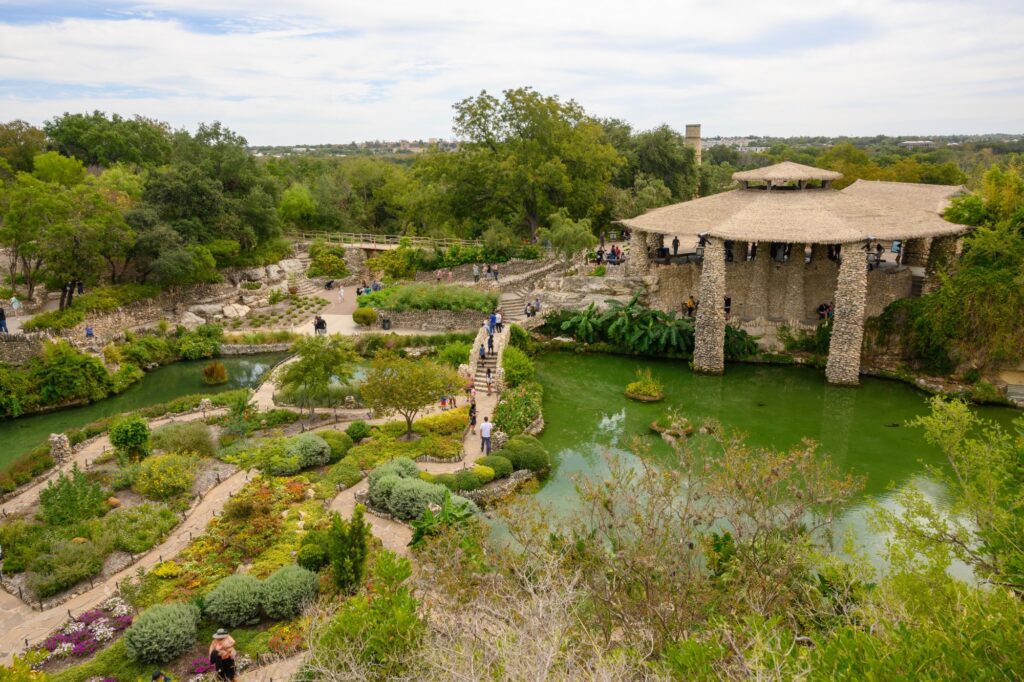
Hidden inside San Antonio’s Brackenridge Park is a landscape that feels surprisingly removed from the surrounding city. Stone bridges cross green koi ponds, winding paths pass through lush plantings, and a tall waterfall spills down the limestone walls of what was once an industrial quarry.
The Japanese Tea Garden in San Antonio is both a peaceful public garden and an unusual piece of local history. Long before visitors came here to photograph koi and flowering plants, the site was connected with San Antonio’s early cement industry. In the early 20th century, the abandoned quarry was transformed into a garden with water features, bridges, pathways, an island, and a pavilion.
More than a century later, the garden remains one of the city’s most distinctive free attractions.
If you’re planning a visit, this guide covers its history, the features worth looking for, when to go, accessibility, Jingu House, photography, and several details that can make your visit easier.
🌿 Japanese Tea Garden Visitor Information
The Japanese Tea Garden is located within Brackenridge Park at 3853 N. St. Mary’s Street, San Antonio, Texas 78212.
Current posted visitor information includes:
| Detail | Information |
|---|---|
| Admission | Free |
| Garden Hours | 7:00 a.m.–5:00 p.m. daily |
| Address | 3853 N. St. Mary’s St., San Antonio, TX 78212 |
| Parking | Parking available; designated accessible spaces |
| Pets | Leashed dogs are welcome |
| Photography | Personal photography allowed without a permit |
| Accessibility | Upper garden and pavilion accessible by ramp; lower garden requires stairs |
| Time to Allow | About 45–90 minutes for most visitors |
Hours, events, and access conditions can change, so it is worth checking the official garden information shortly before a trip.
🏞️ From Limestone Quarry to Japanese-Style Garden
One of the most interesting things about the Japanese Tea Garden is that its dramatic landscape was not originally a natural garden basin.
The site was part of a limestone quarry associated with San Antonio’s early cement industry. The Alamo Portland and Roman Cement Company began quarrying and producing cement in the area in the late 19th century before eventually moving its operations elsewhere in 1908.
What remained was a large quarry cut into the limestone.
Rather than leaving the abandoned industrial site unused, San Antonio Parks Commissioner Ray Lambert imagined converting it into something beautiful. By 1916, plans were underway to transform the quarry into a public garden.
Between 1917 and 1918, workers reshaped the former quarry into a landscape of paths, water, stone bridges, an island, and a pavilion. The early attraction was known as the Lily Pond, and local residents contributed flower bulbs while other organizations helped provide plants and infrastructure.
🌸 Why Is It Called the Japanese Tea Garden?
Japanese art and garden design had become increasingly fashionable in the United States during the late 19th and early 20th centuries, and Lambert envisioned the quarry transformation as San Antonio’s interpretation of a Japanese-style garden.
It is important, however, not to describe the garden as a completely authentic recreation of a traditional garden in Japan.
The City of San Antonio’s own planning documents characterize it as a distinctive hybrid: a combination of Japanese-inspired design, Texas materials, industrial remnants, and the ideas of people who shaped the site over time.
That combination is part of what makes the garden so unusual. Rather than hiding the old quarry, the design incorporated its limestone walls and dramatic changes in elevation into the landscape.
🏯 The Jingu Family and the Bamboo Room
The Japanese identity of the garden became more deeply connected with the Jingu family during the 1920s.
In 1926, Japanese-American artist Kimi Eizo Jingu and his wife, Miyoshi, moved into a stone residence at the garden with their family. The Jingus helped oversee the garden and opened the Bamboo Room, where visitors could purchase tea and light refreshments.
Historical records describe the family serving items that included green tea and green tea ice cream.
For years, the Jingu family became closely associated with the garden and its hospitality. Their presence helped turn the site from a landscaped attraction into a place where visitors could experience both the garden and tea service.
⚠️ The Garden During World War II
One of the garden’s most important historical chapters is also one of its most painful.
After the United States entered World War II, anti-Japanese prejudice intensified across the country. In 1942, the Jingu family was forced to leave the garden.
The site was renamed the Chinese Sunken Garden, and a Chinese-American family subsequently operated refreshments there. A distinctive entrance created by artist Dionicio Rodriguez dates from this period and reflects the wartime name change.
The garden eventually regained its Japanese identity, and in 1984 it was formally rededicated as the Japanese Tea Garden in a ceremony attended by members of the Jingu family and representatives of Japan.
🛠️ Restoring the Garden
By the late 20th and early 21st centuries, the garden required substantial rehabilitation.
A partnership involving the City of San Antonio and the San Antonio Parks Foundation led to a multi-phase restoration of the historic landscape.
Work included stabilization and restoration of the pavilion, repairs to ponds and the waterfall, improved water circulation and filtration, walkway improvements, wall repairs, and eventual rehabilitation of Jingu House.
The restored garden reopened to visitors in 2008, while work on Jingu House continued and was completed later.
💦 The 60-Foot Waterfall
The waterfall is the garden’s most dramatic feature.
Water spills roughly 60 feet down the limestone quarry wall, creating a backdrop that can be seen from several areas of the lower garden.
The exposed stone gives the waterfall an appearance unlike a typical landscaped water feature. You are looking at the walls of the old quarry as well as the garden created inside it.
The sound of the water also helps separate the lower garden psychologically from the traffic and activity outside.
It is understandably one of the most popular photography spots in the garden.
🐟 The Koi Ponds
The ponds form the visual heart of the garden.
Colorful koi move through the water beneath bridges and beside planted islands, while paths follow the edges of the ponds and provide different viewpoints.
Depending on the light, the water can reflect the surrounding limestone, plants, bridges, and pavilion.
Take some time here rather than simply walking through on the way to the waterfall. Some of the garden’s prettiest views come from watching how the ponds connect the different sections of the landscape.
The koi and aquatic plants also benefited from the modern restoration, which added a recirculation system designed to create a healthier aquatic environment.
🌉 The Stone Bridges
Stone bridges are another defining feature of the Japanese Tea Garden.
Some connect sections of the garden across the ponds, while others provide elevated viewpoints over the water and koi.
Their rustic stone construction works particularly well with the limestone quarry setting.
Instead of looking imported or detached from their surroundings, the bridges feel like part of the stone landscape itself.
They are beautiful photography locations, but they can also become congested when the garden is busy. If photographs are important to you, arriving early in the morning usually makes it easier to enjoy them without waiting for groups to pass.
🏯 The Pavilion
The upper pavilion overlooks much of the garden and provides one of the best broad views of the landscape.
From this level, you can appreciate the relationship between the old quarry walls, ponds, pathways, stone bridges, and plantings much more easily than from below.
The pavilion was one of the major structures addressed during the garden’s modern restoration.
It is also useful for visitors with limited mobility because the upper garden and pavilion area can be reached by an accessible ramp, even though the lower portion of the garden cannot be reached without using stairs.
🌺 Flowers and Plantings
The garden’s appearance changes with season and weather.
Flower beds, tropical-looking foliage, shrubs, trees, grasses, and aquatic plants soften the hard limestone walls and stone structures.
You do not have to visit during a single brief bloom season for the garden to be worthwhile. The San Antonio Parks Foundation describes it as having a year-round floral display, although individual plants naturally change throughout the seasons.
Spring can bring especially pleasant temperatures and fresh growth, while fall can be another comfortable time for exploring.
Summer visits are still beautiful, but San Antonio heat can make the exposed portions of the garden much less comfortable in the middle of the day.
🌅 Best Time to Visit
For most visitors, early morning is the best time to visit the Japanese Tea Garden.
The garden opens at 7:00 a.m., giving you an opportunity to arrive before the strongest heat and before many of the day’s visitors.
Early visits are especially useful if you want photographs of the bridges, waterfall, and ponds without large groups in the background.
Late afternoon can also be attractive, but remember that the garden currently closes at 5:00 p.m.
During summer, I would favor the earliest part of the day.
During cooler months, you have more flexibility.
⏱️ How Long Do You Need?
The Japanese Tea Garden is not an enormous botanical garden that requires an entire day.
For most visitors, 45 minutes to 1½ hours is comfortable.
You can make a fairly quick circuit in less time, but rushing misses much of the point.
Allow extra time if you want to:
- Take photographs
- Watch the koi
- Stop at Jingu House
- Read about the garden’s history
- Explore the upper and lower viewpoints
- Sit quietly and enjoy the setting
If you are combining the garden with other parts of Brackenridge Park, the surrounding area can easily occupy much more of your day.
♿ Accessibility
Accessibility is one area where visitors should plan ahead.
The upper garden, pavilion, and Jingu House are accessible by ramp.
However, the lower garden is accessible only by stairs. That means visitors who cannot use stairs will not be able to follow the complete lower path around the ponds and waterfall.
Designated accessible parking spaces are available in the garden parking lot.
The upper viewpoints still provide attractive views of the garden, but this limitation is important to know before arriving.
📸 Photography at the Japanese Tea Garden
The garden is one of San Antonio’s most photographed public spaces, and personal photography is welcome.
At present, the San Antonio Parks Foundation states that no photo permit is required.
There are restrictions, however. Drones, balloons, confetti, rose petals, large equipment, props, and wagons are among the items not permitted in the garden.
These rules help protect the landscape and keep narrow paths and bridges usable for other visitors.
If you simply want vacation photos, engagement snapshots, or pictures of the waterfall and koi, a phone or ordinary camera is the easiest approach.
🐕 Can You Bring a Dog?
Yes. The garden currently welcomes leashed dogs.
As with any popular public garden, keep your pet under control and away from the ponds, plantings, and other visitors.
If the day is hot, remember that stone and paved surfaces can become uncomfortable for paws, another reason an early visit can be preferable during summer.
🍵 Jingu House
Today’s Jingu House continues the site’s long association with refreshments, although visitors should not confuse it with a continuously operating traditional Japanese tea ceremony.
Jingu House functions as a café and restaurant overlooking the garden. Its current menu includes Japanese-inspired food and drinks along with tea and other refreshments.
Current posted hours are separate from the garden’s hours, so check the restaurant schedule if eating there is an important part of your visit.
This is a nice place to pause after walking through the lower garden, especially during warmer weather.
🍵 Is There a Japanese Tea Ceremony?
Do not plan a visit assuming that a formal Japanese tea ceremony is routinely performed for every visitor.
The garden celebrates Japanese-inspired design and the history of the Jingu family’s tearoom, and special cultural programs can occur. The garden’s educational app also includes material about the Japanese tea ceremony.
But an ordinary visit is primarily a garden experience, not an automatically scheduled chanoyu ceremony.
That distinction is worth making because older travel descriptions sometimes give the impression that formal tea ceremonies are a standard daily attraction.
📱 Try the Garden’s Interactive App
Visitors who want more historical context can use the Japanese Tea Garden’s augmented-reality experience.
The app includes a garden map, visual history, and several interactive AR features, including experiences connected with koi and Japanese tea culture.
It was developed partly to tell the garden’s complicated history without filling the landscape itself with extensive interpretive signs.
This can be particularly useful because much of the history—the quarry, Jingu family, wartime renaming, and later restoration—is not obvious simply from looking at the scenery.
🏛️ Look for the Garden’s Industrial Past
It is easy to become focused on flowers and koi and forget that the site began as an industrial landscape.
Look beyond the obvious garden features and notice the quarry walls and remnants associated with the area’s cement-making history.
Nearby historic structures include remnants connected with the old quarry operation.
This layering of industrial history and landscaped beauty is what distinguishes San Antonio’s Japanese Tea Garden from many purpose-built Japanese gardens elsewhere.
🚪 The Historic Entrance
The garden’s entrance deserves more than a passing glance.
Artist Dionicio Rodriguez, known for sculptural concrete work that imitates natural wood and stone, created the entrance associated with the site’s World War II-era identity.
The gate bears evidence of the period when the garden was called the Chinese Tea Garden.
Rather than removing that uncomfortable chapter entirely, the surviving entrance allows visitors to see how national events and anti-Japanese sentiment directly affected the site and the Jingu family.
🌳 Brackenridge Park
The Japanese Tea Garden sits within Brackenridge Park, one of San Antonio’s major historic public landscapes.
The larger park contains tree-lined areas along the San Antonio River and a collection of cultural and recreational attractions.
Because the Japanese Tea Garden is relatively compact, it is easy to pair it with additional time elsewhere in Brackenridge Park rather than treating it as an isolated destination.
The San Antonio Zoo is also immediately nearby, making the garden an easy addition to a longer day in this part of the city.
🎒 What to Bring
You do not need special equipment for a visit, but a few things can make it more comfortable.
Bring:
- Comfortable walking shoes
- Water
- Sunscreen
- A hat during hot weather
- A camera or phone
- Comfortable clothing suited to the season
The lower garden involves stairs, slopes, bridges, and outdoor surfaces, so practical footwear is more useful than dressing for a formal “tea garden.”
Despite the name, this is first and foremost an outdoor public garden.
🌦️ Visiting in Different Seasons
Spring
Spring is an excellent time to visit because temperatures can be comfortable and the plantings are active.
Summer
The garden remains open, but San Antonio can become extremely hot. Visit early, bring water, and take advantage of shade.
Fall
Fall can offer another comfortable window for walking and photography.
Winter
Winter may have fewer flowers than peak growing periods, but the quarry, waterfall, koi ponds, bridges, and historic structures remain worth seeing.
There is no single week when the garden suddenly becomes “the right” garden. Its appeal comes from the landscape itself as much as seasonal blooms.
💵 Is the Japanese Tea Garden Free?
Yes.
Admission to the Japanese Tea Garden is currently free.
That makes it particularly easy to add to a San Antonio itinerary, even if you only have an hour available.
The San Antonio Parks Foundation accepts donations that support the garden’s preservation and programming.
❤️ Is It Worth Visiting?
Yes—particularly if you enjoy gardens, photography, local history, architecture, or simply want a quieter break during a busy sightseeing day.
The Japanese Tea Garden is not huge, and you should not arrive expecting the scale of a major botanical garden.
Its appeal is more concentrated.
Within a relatively compact area you can see a dramatic quarry waterfall, koi ponds, stone bridges, a historic pavilion, industrial remnants, and a landscape with more than a century of complicated cultural history.
And because admission is free, it is one of the easiest places in San Antonio to visit without committing an entire day or a large portion of your travel budget.
❓ Frequently Asked Questions
Where is the Japanese Tea Garden in San Antonio?
It is located at 3853 N. St. Mary’s Street in Brackenridge Park, near the San Antonio Zoo.
Is the Japanese Tea Garden free?
Yes. Admission is currently free.
What are the Japanese Tea Garden’s hours?
The garden currently posts daily hours of 7:00 a.m. to 5:00 p.m. Check before traveling because hours can change.
How long should you spend at the Japanese Tea Garden?
Most visitors should allow approximately 45–90 minutes. Allow longer if you plan to eat at Jingu House or spend substantial time taking photographs.
Does the garden have koi?
Yes. Koi-filled ponds are among its most recognizable features.
Is there a waterfall?
Yes. The garden features a roughly 60-foot waterfall cascading down the old quarry wall.
Is the garden wheelchair accessible?
The upper garden, pavilion, and Jingu House are accessible by ramp. The lower garden requires stairs.
Can you bring dogs?
Yes. Leashed dogs are currently welcome.
Can you take pictures?
Yes. Personal photography is welcome, and the garden currently states that no photo permit is required. Restrictions apply to items such as drones, large props, and confetti.
Is there actually a tea house?
Yes. Jingu House operates as a café and restaurant at the garden.
Can you attend a Japanese tea ceremony there?
Do not assume a traditional tea ceremony is part of every visit. Cultural programming may be offered at particular times, but the everyday attraction is primarily the historic garden.
What is the best time to visit?
Early morning is an excellent choice, particularly during warmer months, because temperatures are cooler and the garden may be less crowded.
🌿 Final Thoughts
The Japanese Tea Garden in San Antonio is beautiful, but its history is what gives the landscape real depth.
What looks today like an established garden of koi ponds, bridges, flowers, and waterfalls began as an abandoned industrial quarry. Ray Lambert and the people who helped build the early garden turned that quarry into a public landscape. The Jingu family later gave it a deeper connection with Japanese culture and hospitality, only to be forced from their home during the anti-Japanese backlash of World War II.
Decades later, the garden reclaimed its Japanese name, underwent extensive restoration, and once again became one of San Antonio’s most loved public spaces.
Visit for the waterfall and koi.
Stay long enough to notice the quarry walls, historic entrance, pavilion, and Jingu House.
Those layers are what transform the Japanese Tea Garden from a pretty photography stop into one of the more interesting historical landscapes in San Antonio.
🔗 Related Articles
- Japanese Tea Garden San Francisco: Visitor Guide, History & Highlights
- The Tea House on Los Rios: Afternoon Tea, History & San Juan Capistrano
- Tea Gardens
- Matcha Recipes & Guides
📚 Sources & Further Reading
- San Antonio Parks Foundation — Japanese Tea Garden
- City of San Antonio — Historic Japanese Tea Garden
- Brackenridge Park Conservancy — Japanese Tea Garden
- Brackenridge Park Conservancy — History of Brackenridge Park
- San Antonio Parks Foundation — Japanese Tea Garden Restoration Project
- Jingu House — Japanese Tea Garden