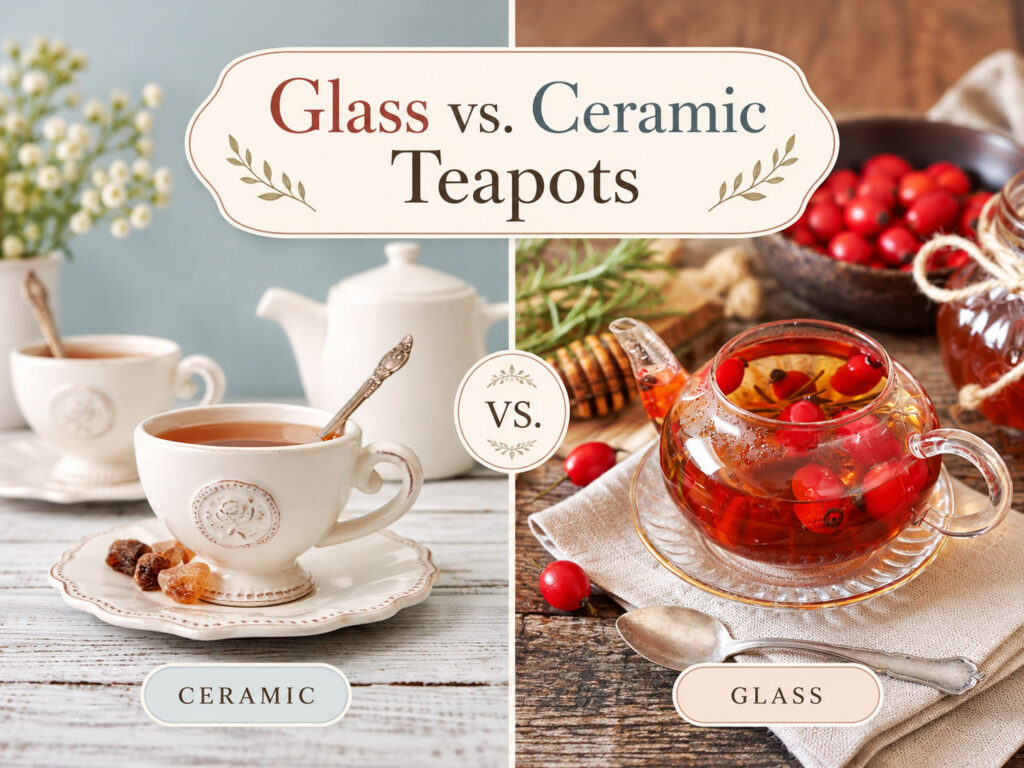
Choosing a teapot is about more than finding something attractive for your kitchen. The material can influence how quickly your tea cools, how easy the pot is to clean, and how enjoyable the brewing process feels. Two of the most popular choices are glass and ceramic, and each has its own advantages.
Glass teapots are especially appealing because they allow you to watch the tea as it brews. You can see delicate leaves unfold, follow the color of the infusion as it deepens, and enjoy the beautiful display created by flowering teas or colorful herbal blends.
Ceramic teapots offer a different experience. They’re often associated with traditional tea service, come in an enormous variety of designs, and can help maintain brewing temperatures, particularly when made from thick stoneware or porcelain.
But is one material actually better for making tea?
Glass teapots are an excellent choice for people who enjoy watching tea brew, while ceramic teapots are often better suited to those who prioritize heat retention and traditional tea service. However, the best option depends on the teapot’s construction, the varieties you drink, and how you prefer to prepare and serve your tea.
Neither material automatically produces better flavor, and a thoughtfully designed teapot can matter more than the material alone.
Understanding the differences will help you decide whether glass or ceramic is the better choice for your daily tea routine.
🫖 What’s the Difference Between Glass and Ceramic Teapots?
The main difference between glass and ceramic teapots is the material used to construct the brewing vessel.
Glass teapots are made from heat-resistant glass, frequently borosilicate glass, which is valued for its relatively low thermal expansion and ability to withstand temperature changes when used within its design limits.
Most are transparent, allowing you to see the leaves, water, and developing infusion.
Ceramic teapots are made from clay-based materials that have been shaped and fired at high temperatures. The category includes stoneware, porcelain, earthenware, and various traditional clay teapots.
Many ceramic teapots have a smooth glaze covering the interior and exterior. This creates a relatively nonporous surface that’s suitable for brewing different varieties of tea.
Others, particularly traditional unglazed clay teapots, are intentionally left without an interior glaze.
That distinction matters because unglazed clay may interact with tea differently and often requires specialized maintenance.
For this comparison, we’ll focus primarily on glass and ordinary glazed ceramic teapots, since these are the most common everyday choices.
Although both serve the same basic purpose, they offer different advantages in temperature management, appearance, durability, and cleaning.
🌡️ Glass vs. Ceramic Teapots: Which Keeps Tea Hotter?
Heat retention is one of the most important practical differences between glass and ceramic teapots.
A thick ceramic teapot often helps tea remain warm longer than a lightweight, thin-walled glass model.
This can be particularly useful when you’re brewing a larger pot of black tea to enjoy over breakfast or serving several people during afternoon tea.
Ceramic teapots, especially substantial stoneware models, have enough material to absorb and store a meaningful amount of heat.
Once warmed, the pot can help maintain the temperature of the tea inside.
However, there’s an important detail that sometimes gets overlooked.
A heavy ceramic teapot that starts at room temperature may absorb considerable heat from the brewing water.
This can lower the water temperature during the first part of steeping.
If you’re preparing a black tea that benefits from very hot water, preheating the teapot can help.
Simply add hot water to the empty pot, allow it to warm briefly, discard the water, and then begin brewing with fresh water at the appropriate temperature.
Glass teapots are often made with thinner walls, which generally means they have less thermal mass.
They may absorb less heat when initially filled, but they can also allow the infusion to cool relatively quickly.
However, this isn’t a universal rule.
A double-walled glass teapot may retain heat much better than a thin single-wall design.
Likewise, a lightweight porcelain teapot may behave differently from a heavy stoneware model.
The lid, shape, capacity, and surrounding room temperature also influence how quickly tea cools.
For everyday use, a substantial glazed ceramic teapot is often a good choice when heat retention is a priority.
If you prefer a glass teapot but want your tea to stay warm, consider an insulated design or transfer the finished infusion into an appropriate heat-retaining serving vessel.
For additional ideas, see our Tea Cozy Guide: What It Is, How It Works & How to Choose One.
🍃 Which Teapot Is Better for Green, White, Black, and Oolong Tea?
Different tea varieties respond differently to water temperature and brewing time, which can make the choice of teapot more meaningful.
However, it’s important to remember that the water temperature you use and the amount of time you steep the leaves generally have a greater influence on flavor than whether the pot is made from glass or glazed ceramic.
Green Tea
Glass teapots are especially appealing for green tea because many varieties have beautiful leaves that change appearance as they steep.
You can watch delicate leaves expand and see the color of the infusion develop.
This is particularly enjoyable with whole-leaf Chinese green teas, such as Longjing, or Japanese teas with attractive leaf structures.
Because many green teas benefit from moderately warm rather than boiling water, the somewhat faster cooling of a lightweight glass teapot may be perfectly acceptable.
However, that doesn’t mean glass is always better for green tea.
A small porcelain or glazed ceramic teapot can produce equally delicious results when the water temperature and steeping time are appropriate.
Some green teas are traditionally brewed using specialized ceramic teaware.
The ideal choice depends on how much you value visual presentation and how you prefer to brew.
White Tea
White tea is another excellent candidate for glass teapots.
Many white teas contain relatively large, loosely arranged leaves and buds that gradually open in hot water.
A transparent teapot makes this process easy to observe.
The pale golden or light amber color of the finished infusion can also look particularly attractive.
However, some white teas benefit from hotter brewing temperatures or longer infusions, depending on their processing, age, and leaf structure.
A preheated ceramic teapot may be useful when you want greater temperature stability.
For ordinary white tea brewing, either material can work extremely well.
Black Tea
Ceramic teapots are a traditional and practical choice for black tea.
Many black teas, including robust Assam, Ceylon, and breakfast blends, are commonly prepared with water at or near boiling.
A preheated ceramic teapot can help maintain the high temperatures used during brewing.
Its heat retention is also helpful when serving multiple cups.
However, there’s no reason you can’t make excellent black tea in a glass pot.
A heat-rated glass teapot with a suitable lid and infuser can produce a strong, flavorful infusion when used with the correct brewing temperature and time.
Ceramic simply offers certain practical advantages when you want to keep the finished tea warm.
Oolong Tea
Oolong is an especially diverse category, ranging from lightly oxidized, floral teas to darker, roasted varieties.
Delicate oolongs can look beautiful in a glass teapot because their tightly rolled or twisted leaves expand dramatically during brewing.
However, heavily roasted oolongs are often prepared with very hot water and may benefit from a well-preheated ceramic pot.
Traditional short-infusion brewing sometimes uses small porcelain or clay vessels that allow several concentrated infusions.
For this style, the teapot’s size, shape, and brewing method are often more important than its appearance.
A small glass pot may still be enjoyable, particularly if you like watching the leaves open during successive infusions.
Herbal and Flowering Teas
Glass is particularly well suited to flowering teas and colorful herbal infusions.
Flowering tea bundles are designed to open in hot water, revealing an arrangement of tea leaves and flowers.
A transparent pot allows you to enjoy the entire display.
Hibiscus, butterfly pea flower, chamomile, rose, and fruit blends can also create beautiful infusions.
However, many herbal ingredients benefit from near-boiling water and relatively long steeping times.
For those blends, a lidded ceramic teapot may provide better heat retention.
Choose glass when appearance is part of the experience, and ceramic when keeping the infusion hot is more important.
For detailed brewing guidance, see Best Water Temperature for Tea: A Complete Brewing Guide by Tea Type.
👀 Why Choose a Glass Teapot?
The greatest advantage of a glass teapot is its transparency.
Tea becomes a visual experience rather than something happening out of sight.
As the leaves absorb water, they begin to unfold and release color into the surrounding liquid.
Depending on the variety, you may see tightly rolled oolong leaves expand, pale white tea buds float gently through the water, or a flowering tea open into an intricate arrangement.
This is particularly enjoyable when serving tea to guests.
A glass teapot can become part of the presentation, allowing everyone at the table to appreciate the brewing process.
Glass also has a relatively neutral surface.
A clean, intact glass teapot doesn’t normally absorb noticeable aromas from one tea to the next, making it a versatile choice for households that enjoy many varieties.
You can brew peppermint tea in the morning, black tea after lunch, and a delicate white tea later without needing separate pots, provided you clean the vessel thoroughly between uses.
Another advantage is that the transparent walls make residue easy to see.
You can quickly check whether tea stains or mineral deposits have developed and whether leaves remain trapped near the spout.
However, the same transparency means fingerprints, water spots, and stains may be more noticeable.
Glass teapots also tend to have a lighter, more contemporary appearance that works particularly well with modern or minimalist kitchen styles.
Their main limitations involve breakability and heat retention.
Even borosilicate glass can crack or break if dropped, struck against a hard surface, or exposed to conditions beyond its manufacturer’s specifications.
For anyone who enjoys the appearance of tea while brewing, however, glass offers an experience that opaque ceramic cannot replicate.
🏺 Why Choose a Ceramic Teapot?
Ceramic teapots are exceptionally versatile, particularly for everyday brewing.
They come in a wide variety of sizes, shapes, colors, and decorative styles, making it easy to find one that complements your kitchen or tea table.
A simple white porcelain teapot can feel elegant and traditional, while a rustic stoneware model may be more suitable for a relaxed everyday tea routine.
One of ceramic’s greatest advantages is the way a substantial pot can help maintain warmth.
A preheated ceramic teapot is especially pleasant when serving several cups of black tea or enjoying a leisurely afternoon tea.
Ceramic also offers considerable choice in capacity.
You can find small pots designed for one person, medium-sized models for sharing, and large traditional teapots suitable for a family gathering.
Glazed ceramic interiors are usually easy to clean and don’t readily retain the flavors of previous infusions.
This makes them suitable for switching between black, green, white, oolong, and herbal teas.
However, ceramic teapots can be heavier than comparable glass models.
A large stoneware pot filled with hot tea may require more effort to lift and pour.
Handles, lids, and spouts also vary significantly in design quality.
Another consideration is the glaze.
A smooth, food-safe glaze helps protect the ceramic body and provides an appropriate surface for brewing.
However, not all pottery is glazed, and damaged or unsuitable glazes can create problems.
For everyday brewing, a well-made, food-safe glazed ceramic teapot is one of the most dependable all-purpose choices.
🍵 Do Glass and Ceramic Teapots Change the Taste of Tea?
A common belief is that the material of the teapot dramatically changes the flavor of the finished infusion.
In reality, the relationship is more subtle.
Clean, intact glass is generally nonporous and relatively inert under ordinary tea-brewing conditions.
A properly glazed ceramic teapot is also relatively nonporous and generally doesn’t contribute noticeable flavor to the tea.
This means that both materials can produce excellent results without changing the taste directly.
However, they may influence brewing conditions differently.
For example, a cold, heavy ceramic teapot can absorb heat from freshly poured water, reducing the effective brewing temperature.
A preheated ceramic teapot may maintain a warmer infusion during steeping.
A thin glass teapot may lose heat more quickly after filling, particularly in a cool room.
These temperature differences can influence extraction and therefore flavor.
However, the results aren’t necessarily better or worse.
A tea that benefits from very hot water may respond well to a preheated ceramic pot.
A delicate green tea may be perfectly comfortable in a glass teapot that cools a little more quickly.
The important distinction is between the material directly contributing flavor and the teapot changing the temperature conditions under which the tea brews.
There is also an exception involving unglazed clay.
Traditional unglazed clay teapots can absorb some tea compounds and aromas over time.
For this reason, some tea enthusiasts dedicate an unglazed clay pot to a particular tea family.
That specialized practice shouldn’t be confused with using ordinary glazed ceramic.
If you want a versatile teapot for several tea varieties, both glass and glazed ceramic are excellent choices.
🧽 Which Is Easier to Clean: Glass or Ceramic?
Both materials can be relatively easy to clean when the teapot has a smooth interior and is designed for ordinary household use.
Glass has the advantage of transparency.
You can easily see remaining tea leaves, brown staining, or cloudy mineral deposits.
This makes it easier to check whether the teapot has been thoroughly cleaned.
However, glass can also show water spots, fingerprints, and streaks more readily than an opaque ceramic pot.
Glazed ceramic often hides minor staining better, particularly when the interior is dark.
Light-colored ceramic interiors may develop noticeable brown rings after repeated use, especially with black tea.
For everyday care, many glass and glazed ceramic teapots can be washed with warm water and mild dish soap.
Use a soft sponge or cloth to avoid scratching the surface.
For stubborn tea stains, some manufacturers recommend baking soda dissolved in warm water.
FORLIFE, for example, provides similar stain-removal instructions for certain glass and high-fired ceramic teapots.
However, dishwasher compatibility varies by product.
Some ceramic teapots are dishwasher-safe, while glass models from the same manufacturer may be recommended for hand washing.
The infuser, lid, and pot may also have different instructions.
Always follow the care requirements for your particular teapot rather than assuming one material is universally easier to maintain.
💔 Which Teapot Is More Durable?
Neither glass nor ceramic is unbreakable.
Both materials can chip, crack, or shatter if dropped or struck against a hard surface.
However, their practical strengths differ.
Heat-resistant borosilicate glass is designed to tolerate temperature changes better than ordinary glass, which makes it especially useful for hot beverage equipment.
Still, its thin walls and delicate shapes can be vulnerable to impact.
A glass spout may chip if knocked against the sink, while a handle can break if the pot is dropped.
Ceramic teapots vary considerably in durability.
A thick stoneware pot may feel sturdy and substantial, while a fine porcelain model with a delicate spout can be surprisingly fragile.
Glaze chips are another concern.
If the interior coating becomes damaged, the teapot may no longer be suitable for continued food use, depending on its construction.
Thermal shock is important for both materials.
Even a teapot intended for hot water may crack when subjected to sudden, extreme temperature changes.
A particularly important safety point is that most ordinary teapots are not designed to sit directly on a stovetop or electric heating element.
Some specialized glass vessels are explicitly rated for direct heating, but many borosilicate glass teapots are not.
FORLIFE, for example, specifically instructs users not to place its Bell glass teapot or Curve ceramic teapot on a heating element.
Always check the manufacturer’s instructions before using any teapot to heat water.
For normal brewing, use a kettle to heat the water and pour it into the teapot.
Our How to Choose a Tea Kettle guide explains the difference between kettles and teapots.
🛍️ What Should You Look for When Choosing a Glass or Ceramic Teapot?
Once you’ve decided which material appeals to you, the design of the teapot becomes just as important.
A beautiful pot can still be frustrating if the handle is uncomfortable, the lid slips while pouring, or the spout drips onto the table.
Begin with capacity.
If you usually brew tea for yourself, a teapot holding approximately 12–20 fluid ounces may be sufficient.
For two people, a pot holding around 20–30 ounces can be more practical.
Larger pots may be useful when serving guests, although the ideal capacity depends on the size of your cups.
Remember that a larger teapot isn’t automatically better.
If you regularly make only one cup, a large pot can be awkward and may encourage you to prepare more tea than you need.
Next, consider the infuser.
A removable stainless-steel basket is particularly convenient because it lets you stop the infusion by lifting out the leaves.
Look for a basket large enough to allow whole leaves to expand.
A narrow infuser that crowds the leaves can make brewing less consistent.
The spout should pour smoothly without excessive dripping, and the handle should provide a secure grip when the teapot is full.
Lid design matters too.
A loose lid can shift unexpectedly during pouring, while a secure, properly fitted lid makes serving more comfortable.
Some modern teapots include silicone gaskets or specially designed lids.
Consider how easy these components will be to clean and replace.
Finally, check the product’s heat-resistance and care instructions.
A teapot should be clearly intended for preparing hot beverages, with food-safe materials and suitable maintenance guidance.
🏡 Which Teapot Is Better for Everyday Use?
For many households, glazed ceramic is a particularly practical everyday choice.
It’s versatile, available in many capacities, and suitable for a wide range of teas.
A simple ceramic teapot with a removable infuser can serve black tea at breakfast, green tea in the afternoon, and herbal blends in the evening.
Its ability to retain warmth is particularly useful if you like to pour several cups from the same pot.
However, glass can be just as practical, especially if you prefer smaller brewing sessions or enjoy watching the infusion develop.
A well-designed glass teapot with a removable basket is easy to use, visually appealing, and suitable for many varieties.
If you’re choosing your first teapot and don’t have a strong preference, consider how you normally drink tea.
Do you prepare a large pot and return for a second cup later?
A preheated ceramic teapot may suit that routine.
Do you enjoy brewing loose-leaf green tea, flowering tea, or colorful herbal blends while watching the leaves move through the water?
Glass may offer more enjoyment.
Do you switch frequently between many tea varieties?
Either glass or glazed ceramic can work well because both are relatively flavor-neutral when properly cleaned.
The better choice is the one that fits your habits rather than the one that seems more traditional or expensive.
🍵 Is Glass or Ceramic Better for Loose-Leaf Tea?
Both glass and ceramic teapots are excellent for loose-leaf tea.
The most important consideration is whether the leaves have enough room to expand and whether the brewing method allows you to control steeping time.
Whole tea leaves can expand considerably after they absorb hot water.
If they’re packed tightly into a small tea ball, they may not circulate as freely as they would inside a roomy basket or directly in the pot.
A large removable infuser can help, regardless of whether the surrounding teapot is glass or ceramic.
Glass offers the advantage of letting you see the leaves unfold.
This can be useful for observing the brewing process, although the color of the infusion isn’t always a reliable indication of the ideal steeping time.
A very dark tea may become strongly colored quickly, while some delicate teas remain pale even when they’re fully brewed.
Using a timer and following the producer’s instructions provides a more dependable starting point.
Ceramic provides the same opportunities for successful extraction when the basket is appropriately sized.
For traditional brewing methods involving several short infusions, a small ceramic or glass pot may be more suitable than a large Western-style teapot.
Ultimately, the quality of the tea, water temperature, leaf quantity, and steeping time matter more than the appearance of the vessel.
❓ Frequently Asked Questions
Is a glass or ceramic teapot better?
Neither is universally better. Glass is especially appealing for watching tea brew and displaying flowering teas, while ceramic is often preferred for its traditional appearance and heat retention. Both can produce excellent tea when used correctly.
Do ceramic teapots keep tea hotter than glass?
Many substantial ceramic teapots retain heat better than thin, single-wall glass models. However, the result depends on wall thickness, overall mass, lid design, insulation, and whether the teapot was preheated. Double-walled glass and lightweight ceramic designs can behave differently.
Are glass teapots good for green tea?
Yes. Glass teapots are particularly attractive for green tea because you can watch the leaves unfurl and observe the color of the infusion. However, glazed ceramic and porcelain can make equally delicious green tea when the brewing temperature and time are appropriate.
Are ceramic teapots better for black tea?
Ceramic is often a convenient choice for black tea because a preheated pot can help maintain the hot brewing temperatures many black teas require. However, glass can also produce excellent black tea when used with the right water temperature, leaf quantity, and steeping time.
Do glass teapots change the flavor of tea?
Clean, intact glass is generally nonporous and chemically stable under normal tea-brewing conditions, so it doesn’t typically contribute noticeable flavor. However, a teapot’s construction can influence water temperature, which may affect extraction and taste.
Do ceramic teapots absorb tea flavors?
Properly glazed ceramic teapots generally don’t absorb noticeable tea flavors during ordinary use. Traditional unglazed clay teapots are different because their porous interiors can interact with tea compounds and aromas over time.
Are glass teapots safe for boiling water?
Many heat-resistant glass teapots are designed to receive very hot water, but you should follow the manufacturer’s specific limits. Some recommend allowing boiling water to cool briefly before pouring it into the pot. Never assume all glass teapots tolerate identical temperatures or sudden temperature changes.
Can you put a glass teapot on the stove?
Only if the manufacturer explicitly states that the exact teapot is designed for direct stovetop heating. Borosilicate glass alone doesn’t guarantee stovetop compatibility. Many glass teapot manufacturers specifically prohibit placing their products on a heating element.
Can you put a ceramic teapot on the stove?
Most ordinary ceramic and porcelain teapots are designed for steeping and serving tea rather than direct heating. Placing one on a stovetop can cause cracking or other damage. Use a separate kettle unless the teapot is specifically rated for direct heat.
Are glass teapots fragile?
Glass teapots can be vulnerable to chips and breakage, particularly around delicate spouts and handles. Borosilicate glass offers good resistance to thermal shock when used within its specifications, but it can still break from impact or improper handling.
Do ceramic teapots break easily?
Ceramic durability depends on the construction. Thick stoneware models can be relatively sturdy, while fine porcelain teapots may have delicate handles and spouts. Both can chip or crack if dropped or exposed to unsuitable temperature changes.
Which is easier to clean, glass or ceramic?
Both can be easy to clean when they have smooth, intact surfaces. Glass makes stains and leftover leaves more visible, while glazed ceramic often hides minor discoloration better. Cleaning requirements depend on the manufacturer’s instructions and any decorative or removable components.
Are glass teapots dishwasher-safe?
Some are, but others require hand washing. Different components of the same teapot may also have different care requirements. Check the manufacturer’s instructions before putting the pot, lid, or infuser into the dishwasher.
What size teapot should I buy?
Choose a capacity suited to the number of people you usually serve. Approximately 12–20 ounces may work for one person, while 20–30 ounces is often convenient for two. Larger pots are useful for gatherings, but you don’t need extra capacity if you normally brew small amounts.
Which teapot is best for flowering tea?
A transparent glass teapot is generally the most enjoyable choice for flowering tea because it allows you to watch the tea bundle open and display its flowers. A wide pot provides room for the arrangement to expand.
Is porcelain considered ceramic?
Yes. Porcelain is a type of ceramic made from particular clay materials and fired at high temperatures. Other ceramic categories include stoneware and earthenware. Their weight, porosity, strength, and heat retention can differ.
Can you use the same glass or ceramic teapot for different teas?
Yes. Both glass and properly glazed ceramic are generally suitable for switching between different tea varieties, provided they’re cleaned thoroughly between uses. Traditional unglazed clay teapots may be better dedicated to particular kinds of tea.
Are expensive teapots better than inexpensive ones?
Not necessarily. A more expensive teapot may offer finer craftsmanship, decorative detail, or specialized materials, but price alone doesn’t guarantee better tea. Capacity, comfortable handling, safe construction, an effective spout, and an appropriate infuser are often more important.
🌸 Final Thoughts
Glass and ceramic teapots are both excellent choices, but they offer slightly different experiences.
Glass teapots are ideal for anyone who enjoys watching tea as it brews. Their transparent walls reveal the movement of whole leaves, the gradual development of color, and the beautiful display of flowering teas.
They’re also relatively flavor-neutral and easy to inspect for residue.
Ceramic teapots offer a more traditional appearance and can provide better heat retention, particularly when they’re made from substantial stoneware or porcelain and preheated before brewing.
This makes them especially appealing for black tea, serving several cups, and leisurely tea sessions.
However, the differences aren’t absolute.
A double-walled glass teapot may retain heat well, while a thin porcelain teapot may cool more quickly than expected.
Likewise, both materials can make delicious green, white, oolong, black, and herbal teas.
The teapot’s size, shape, infuser design, and construction can be just as important as the material itself.
If you want a versatile everyday teapot that keeps tea warm while you enjoy several cups, glazed ceramic is an excellent starting choice.
If you love the visual side of tea brewing, particularly flowering teas and whole-leaf infusions, glass may be more satisfying.
And if you enjoy tea enough to own both, the two materials complement each other beautifully.
A ceramic pot can become your dependable choice for breakfast tea and sharing a warm afternoon pot, while a glass teapot can make delicate teas and colorful herbal blends feel like a special occasion.
Ultimately, the best teapot isn’t necessarily the one made from a particular material.
It’s the one that makes preparing and enjoying your favorite tea easier, more comfortable, and more pleasurable.
🔗 Related Articles
- How to Choose a Teapot: Materials, Sizes & Best Teapots for Every Tea
- Tea Gear & Accessories: Teapots, Kettles, Infusers, Cups & More
- Tea Gear: Essential Tools for Brewing Better Tea at Home
- Tea Cozy Guide: What It Is, How It Works & How to Choose One
- How to Choose a Tea Kettle: Electric vs. Stovetop, Materials & Features
- How to Brew Tea: Water Temperature, Steeping Times & Brewing Methods
- Best Water Temperature for Tea: A Complete Brewing Guide by Tea Type
- Tea Sets Around the World: Styles, History & Cultural Traditions
📚 Sources & Further Reading
- FORLIFE — Bell Glass Teapot With Basket Infuser: Materials and Care
- FORLIFE — Curve Ceramic Teapot With Infuser: Materials and Care
- FORLIFE — Fuji Glass Teapot With Filter Lid
- Nepal Hills Tea — Glass vs. Ceramic Teapot: Which One Should You Choose?
- Le Creuset — Care and Use Instructions for Stoneware