You do not need a cabinet full of specialized equipment to make excellent tea. At its simplest, tea requires only leaves, water, a vessel, and something to separate the leaves before drinking.
Still, the right tea gear can make brewing easier, more consistent, and more enjoyable.
A good kettle gives you better control over water temperature. A roomy infuser allows loose leaves to expand. A teapot makes brewing several cups at once simple. A small digital scale can help you repeat a favorite tea-to-water ratio without guessing.
Some tea tools are genuinely useful. Others are mostly optional.
The best approach is to build your collection gradually based on the kinds of tea you actually drink.
If you are new to tea, start with a kettle, a mug or teapot, and a good infuser. Everything else can come later.
🫖 What Tea Gear Do You Really Need?
For ordinary loose-leaf tea brewing, you can get started with just a few basics:
A kettle for heating water, a cup or teapot for brewing, and a strainer or infuser for separating the leaves.
Tea bags require even less equipment.
As your interest in tea grows, you may find that additional tools improve particular brewing styles. A temperature-controlled kettle is useful if you drink delicate green and white teas. A gaiwan works beautifully for repeated short infusions of oolong and pu-erh. A matcha whisk is essential if you regularly prepare traditional-style matcha.
There is no need to buy everything at once.
Good tea gear should solve a problem or make a brewing method easier—not simply take up space in the kitchen.
For a broader look at the brewing process itself, see our How to Brew Tea: Water Temperature, Steeping Times & Brewing Methods guide.
🔥 Tea Kettles
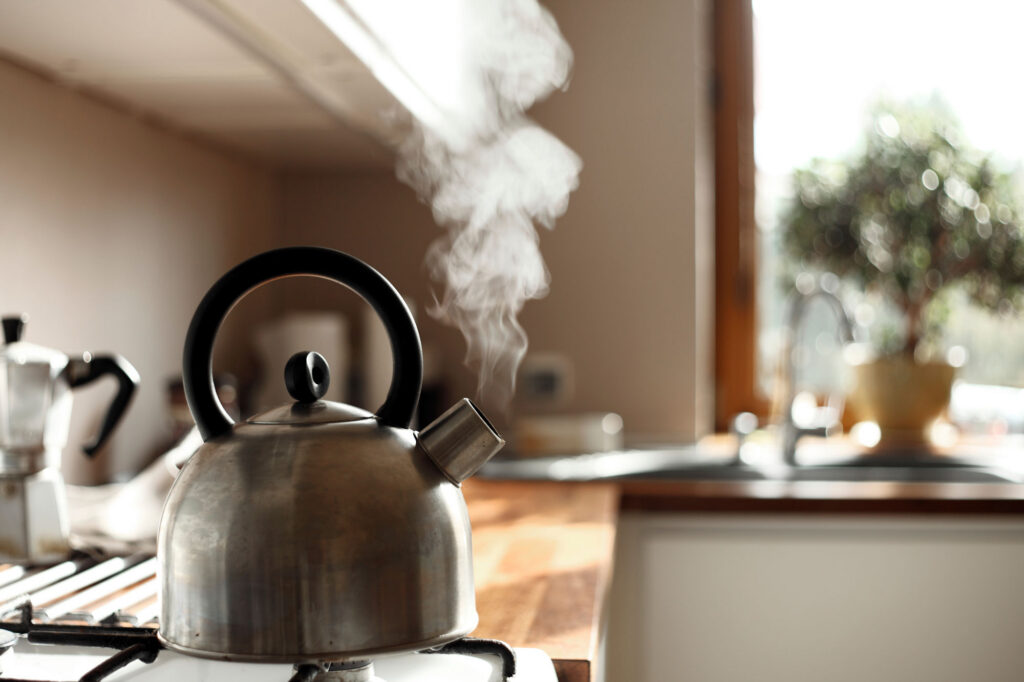
A kettle is probably the single most useful piece of tea equipment.
Its job is simple: heat water efficiently and make it easy to pour.
Both stovetop and electric kettles work well. The better choice depends largely on your routine.
Stovetop kettles are simple, durable, and require no electrical outlet near your brewing area. Electric kettles tend to heat water faster and are particularly convenient for people who make tea several times a day.
If you drink mostly black tea or herbal infusions, almost any dependable kettle can work.
If you regularly brew green, white, oolong, or other temperature-sensitive teas, a variable-temperature electric kettle can be especially helpful.
🌡️ Variable-Temperature Kettles
Different teas often taste best at different water temperatures.
Black tea usually tolerates water near the boil, while delicate green teas often taste smoother when brewed with cooler water.
A variable-temperature kettle allows you to select a target temperature instead of boiling water and waiting for it to cool.
This is not essential equipment, but it is one of the most useful upgrades for serious tea drinkers.
Temperature control also makes it easier to repeat a successful cup. Rather than estimating whether the water has cooled enough, you can use approximately the same conditions each time.
🫗 Gooseneck Kettles
Gooseneck kettles are best known for pour-over coffee, but they can also be useful for tea.
Their narrow curved spouts provide excellent pouring control, which can be helpful when filling small gaiwans or teapots.
For ordinary mug brewing, however, a gooseneck kettle is unnecessary.
Choose one if you also make pour-over coffee or simply enjoy the precision it provides. Otherwise, a standard kettle is perfectly adequate.
☕ Tea Mugs
Sometimes the simplest tea vessel is also the best.
A good mug works perfectly for everyday brewing, especially when paired with a basket-style infuser.
Wide mugs can be particularly convenient because they accommodate larger infusers and make it easy to remove the leaves after steeping.
Ceramic and porcelain mugs retain heat reasonably well and do not usually affect flavor.
Glass mugs allow you to see the color of the tea as it brews, which can be part of the enjoyment.
Double-walled glass cups are another option if you like the look of glass but want additional insulation.
🫖 Teapots
A teapot is useful when brewing several cups or when you want the ritual of serving tea from a pot.
Teapots come in many materials, including ceramic, porcelain, glass, cast iron, clay, and stainless steel.
The material can influence heat retention, durability, and maintenance.
For general-purpose use, glazed ceramic or porcelain teapots are among the easiest choices because they work with almost any tea and are simple to clean.
Glass teapots are excellent for watching leaves unfurl or brewing visually appealing flower and herbal teas.
Unglazed clay teapots require more consideration because the porous clay can absorb flavors over time. Many tea enthusiasts dedicate them to one tea category rather than switching constantly between strongly contrasting teas.
🏺 Ceramic and Porcelain Teapots
Ceramic and porcelain teapots are excellent all-purpose options.
Because their glazed interiors are relatively nonporous, they can usually be used for black tea in the morning, green tea in the afternoon, and herbal tea in the evening without retaining noticeable flavors.
They also come in a wide variety of sizes.
A small pot is useful if you usually brew for one or two people, while a larger pot makes more sense for family tea or entertaining.
Bigger is not always better. Tea left sitting in a large pot can continue extracting and become overly strong, so choose a capacity that roughly matches the amount you normally drink.
🪟 Glass Teapots
Glass teapots make tea brewing highly visual.
You can watch rolled oolong leaves open, observe herbal ingredients circulating through the water, and judge the developing color of the infusion.
Glass does not retain flavors, so it is also convenient for people who switch frequently between different teas.
The main disadvantage is heat retention. Thin glass usually loses heat more quickly than heavier ceramic.
Borosilicate glass is commonly used for tea ware because it is designed to tolerate significant temperature changes, although you should still follow the manufacturer’s instructions for safe use.
🍃 Tea Infusers
A tea infuser holds loose leaves while allowing water to circulate through them.
For most home tea drinkers, a large basket-style infuser is one of the most useful pieces of equipment you can own.
The key word is large.
Tea leaves often expand dramatically during brewing. If they are compressed inside a tiny infuser, water cannot circulate around them as freely.
A roomy basket allows the leaves to open and interact with the water.
This is generally preferable to small tea balls for whole-leaf teas.
For more on choosing and using infusers, see How to Use a Tea Strainer: Types, Tea Infusers & Brewing Tips.
⚪ Tea Balls
Tea balls are small mesh or perforated metal containers that open so you can add loose tea.
They are inexpensive, easy to find, and convenient.
Their main limitation is size.
Very small tea balls can crowd expanding leaves, particularly larger whole-leaf teas and rolled oolongs.
They tend to work better for smaller broken leaves or finely cut herbal blends.
If you like the convenience of a tea ball, choose one large enough to leave some empty space after adding the dry tea.
🥄 Tea Strainers
Traditional tea strainers are different from infusers.
Instead of holding the leaves during brewing, a strainer is placed over the cup while tea is poured from the pot.
The liquid passes through while the leaves remain behind.
This method gives the leaves plenty of room to circulate freely inside the teapot.
It works particularly well with teapots that do not have built-in filters.
Strainers can be made from stainless steel, mesh, or even decorative materials, although fine stainless-steel mesh is especially practical for everyday use.
🧺 Basket Infusers
If you buy only one loose-tea brewing accessory, a basket infuser is difficult to beat.
These large removable baskets sit inside a mug or teapot and provide plenty of room for the leaves.
Many include a lid that helps retain heat while brewing.
That lid can often be flipped upside down after steeping and used as a small tray for the wet infuser.
Basket infusers are inexpensive, compact, easy to clean, and compatible with many kinds of tea.
For everyday Western-style brewing, they may be the most versatile option available.
⚖️ Digital Tea Scales
A digital scale is not essential, but it makes brewing much more consistent.
Tea leaves vary enormously in density.
A teaspoon of tightly rolled tea can weigh much more than a teaspoon of large, fluffy leaves.
Measuring by weight eliminates that variation.
A small scale capable of measuring in grams is sufficient for most tea brewing.
For example, you might discover that you prefer 3 grams of one oolong per cup but only 2 grams of a particular black tea.
Once you know the amount, recreating the cup becomes simple.
Our Tea Brewing & Ratios guide explains why measuring tea by weight can be more reliable than relying solely on teaspoons.
🥄 Tea Measuring Spoons
If you do not want to weigh every serving, a tea measuring spoon is perfectly reasonable.
The traditional guideline of roughly one teaspoon of tea per cup remains useful for many teas.
Just remember that volume measurements are approximate.
Large white tea leaves may barely fit into a teaspoon, while fine black tea particles can pack densely into the same space.
Use measuring spoons as convenient starting points rather than rigid rules.
⏱️ Tea Timers
Tea can change dramatically in a minute or two.
A delicate tea that tastes sweet and balanced after three minutes may become noticeably more astringent after five.
A timer removes the guesswork.
You certainly do not need a specialized tea timer. A phone timer, kitchen timer, smartwatch, or voice assistant works just as well.
The value is not in the tool itself. It is simply in remembering how long the tea has been brewing.
🌡️ Tea Thermometers
Before variable-temperature kettles became common, tea thermometers were especially useful.
They are still a practical low-cost option if you already own a basic kettle.
Heat the water, insert the thermometer, and wait until it reaches the appropriate range for your tea.
A thermometer can also help you learn how quickly water cools in your own kitchen.
Eventually, you may become comfortable estimating temperatures without measuring them every time.
🏮 Gaiwans
A gaiwan is a traditional Chinese brewing vessel consisting of a bowl, lid, and saucer.
It is commonly used for brewing relatively large quantities of leaf with smaller amounts of water and short infusion times.
Gaiwans work especially well for oolong, pu-erh, white tea, and many Chinese green and black teas.
They also allow you to observe and smell the tea leaves closely between infusions.
Using a gaiwan takes slightly more practice than brewing with a basket infuser, particularly when learning how to hold the lid and pour without burning your fingers.
Once learned, however, the method is remarkably simple.
🍶 Small Gongfu Teapots
Another option for gongfu-style brewing is a small teapot.
These are often much smaller than Western teapots and are designed for repeated short infusions.
Porcelain and glazed ceramic versions are versatile.
Unglazed clay pots are more specialized because their porous surfaces may gradually absorb characteristics of the teas brewed inside them.
Some tea drinkers eventually dedicate individual clay pots to particular tea families.
That level of specialization is entirely optional. A simple porcelain gaiwan can accomplish most of the same basic brewing tasks.
🍵 Matcha Bowls
Matcha requires somewhat different gear because the powdered tea is whisked directly into water instead of being steeped and removed.
A traditional matcha bowl, or chawan, is wide enough to provide space for vigorous whisking.
You do not absolutely need a traditional bowl. A wide cereal bowl can work when you are beginning.
However, the shape of a proper matcha bowl makes whisking easier and adds to the experience of preparing matcha.
🎋 Bamboo Matcha Whisks
The bamboo matcha whisk, called a chasen, is designed to suspend matcha powder evenly in water and create a layer of fine foam.
While you can technically mix matcha with other tools, a chasen remains one of the most effective methods.
Before using one, soften the bamboo tines briefly in warm water.
Whisk the matcha briskly using a rapid back-and-forth motion rather than stirring slowly in circles.
Afterward, rinse the whisk with clean water and allow it to dry thoroughly.
🥄 Matcha Scoops and Sifters
A bamboo matcha scoop, or chashaku, is traditionally used to portion matcha powder.
It is attractive and enjoyable to use but not essential. A measuring spoon can substitute easily.
A fine-mesh sifter is arguably more useful.
Matcha tends to form small clumps, and sifting the powder before adding water can produce a smoother drink and make whisking easier.
A small kitchen sieve works perfectly well.
🧊 Iced Tea Pitchers
If you regularly make iced tea, a dedicated pitcher can make preparation easier.
Some include removable infuser baskets so tea can be brewed directly inside the pitcher.
Others are designed primarily for cold brewing.
Glass pitchers are easy to clean and do not retain flavors, while lightweight plastic pitchers may be more convenient for outdoor use.
The most important feature is simply enough capacity for the amount of tea you normally prepare.
For cold brew, choose a pitcher with a lid so the tea can steep safely in the refrigerator.
🧳 Travel Tea Infusers
Loose-leaf tea does not have to stay at home.
Travel mugs with built-in infusers allow you to brew tea at work, on the road, or while traveling.
The best designs make it possible to separate the leaves from the water once the desired steeping time has been reached.
Otherwise, the tea may continue brewing for a long time and become overly strong.
A removable basket is often simpler than designs where the leaves remain permanently submerged at the bottom.
🫙 Tea Storage Containers
Tea gear is not limited to brewing equipment.
Proper storage helps protect tea from some of its greatest enemies: air, moisture, heat, light, and strong odors.
Opaque airtight containers are generally excellent choices.
Metal tea tins are traditional and practical.
Dark glass can also work, although clear glass containers should ideally be kept inside a cupboard rather than exposed to sunlight.
Avoid storing tea beside spices, coffee, or other strongly aromatic foods, since dry tea leaves can absorb surrounding odors.
🗄️ Tea Organizers
A tea organizer is optional, but it can be surprisingly useful if your collection starts growing.
Divided boxes work especially well for individually wrapped tea bags.
Loose-leaf tea usually stores better in sealed tins or containers rather than open compartments.
Keeping your teas organized also makes it easier to see what you already have.
Otherwise, collecting tea can quickly turn into discovering four half-finished packages of Earl Grey hiding in different cabinets.
🧼 Tea Cleaning Brushes
Most tea equipment can be cleaned with ordinary dishwashing tools, but narrow teapot spouts and travel infusers sometimes benefit from a small cleaning brush.
Bottle brushes and narrow straw brushes can reach areas that sponges cannot.
Always follow the care instructions for your specific teaware.
Glazed ceramic, glass, and stainless steel are generally easy to clean, while unglazed clay teapots may require gentler treatment and are often rinsed without soap.
🧻 Tea Towels and Trays
A tea towel is one of those pieces of equipment you may not think about until you start brewing frequently.
Small spills are inevitable.
A dedicated absorbent towel keeps the brewing area tidy and provides a convenient place to rest damp teaware.
A tea tray is similarly optional but helpful, particularly for gongfu brewing where repeated pouring can create more drips and spills than ordinary mug brewing.
Traditional gongfu trays may include drainage systems, although a simple waterproof tray works perfectly well for casual home use.
🧳 Tea Gear for Travel
Travel tea gear can be surprisingly minimal.
A few individually wrapped tea bags require almost no equipment at all.
Loose-leaf drinkers may prefer a compact infuser, reusable filter bags, or a travel brewer.
If you are staying somewhere with access to hot water, a lightweight infuser and favorite tea may be all you need.
Portable electric kettles are another option for frequent travelers, although voltage differences and hotel policies should always be considered before using electrical appliances away from home.
🌱 Reusable Tea Filters
Disposable tea bags are convenient, but reusable filters offer another option for loose tea.
Cotton, stainless steel, and fine-mesh baskets can all work.
Reusable cloth filters require particularly careful cleaning and thorough drying because damp fabric can develop odors or mildew.
For convenience and durability, stainless-steel basket infusers are often easier to maintain.
📄 Disposable Tea Filters
Disposable paper tea filters can be useful when traveling, entertaining, or brewing loose tea without an infuser.
You simply spoon loose tea inside, fold or close the filter, and steep it much like a tea bag.
They are particularly handy for blends containing very fine ingredients that might slip through a coarse strainer.
Make sure the filter is large enough for the leaves to expand instead of packing it tightly.
🎁 Tea Sets
A coordinated tea set can be beautiful, but matching pieces are not required for good tea.
A traditional set might include a teapot, cups, saucers, sugar bowl, and milk pitcher.
Other tea traditions use entirely different arrangements.
Choose tea ware based on how you actually drink tea.
Someone who enjoys afternoon tea parties may love a full porcelain set. Someone who drinks oolong alone every evening might get much more use from a gaiwan and two small cups.
Function comes first. The beauty is a bonus.
💰 How Much Should You Spend on Tea Gear?
Tea equipment exists at nearly every price point.
Fortunately, expensive gear is not required for good tea.
A basic electric kettle, inexpensive basket infuser, and ordinary ceramic mug can produce excellent results.
If you want to upgrade gradually, put money toward equipment that genuinely improves your brewing.
A good variable-temperature kettle is often more useful than a decorative teapot you rarely use.
Likewise, an inexpensive scale may improve consistency more than an elaborate tea set.
Buy according to your habits rather than assuming premium equipment automatically creates premium tea.
🌿 Best Tea Gear for Beginners
A beginner tea setup can remain wonderfully simple.
Start with a dependable kettle, a large basket infuser, and a favorite mug.
If you want greater consistency, add a small digital scale and a timer.
That is enough equipment to explore black tea, green tea, white tea, oolong, herbal infusions, rooibos, and many other styles.
As you discover which teas you enjoy most, you can decide whether specialized equipment such as a gaiwan, matcha whisk, iced tea brewer, or temperature-controlled kettle would genuinely add something to your routine.
🍵 Build a Tea Setup That Fits the Way You Drink
There is no single perfect tea setup.
Someone who drinks breakfast tea with milk needs different equipment from someone who spends an afternoon brewing several infusions of aged pu-erh.
The best tea gear is the equipment you actually use.
Start with the essentials. Learn how tea quantity, temperature, and steeping time affect the cup. Then add tools when they solve a real brewing need.
A kettle, infuser, mug, and good tea can take you surprisingly far.
Everything beyond that is an opportunity to make the process a little easier, a little more precise, or simply a little more enjoyable.
🔗 Related Articles
- How to Brew Tea: Water Temperature, Steeping Times & Brewing Methods
- How to Use a Tea Strainer: Types, Tea Infusers & Brewing Tips
- How to Brew Tea Bags: Water Temperature, Steep Time & Easy Tips
📚 Sources & Further Reading
- UK Tea & Infusions Association — Make a Perfect Brew
- Japanese Tea Association
- Tea Association of the U.S.A.