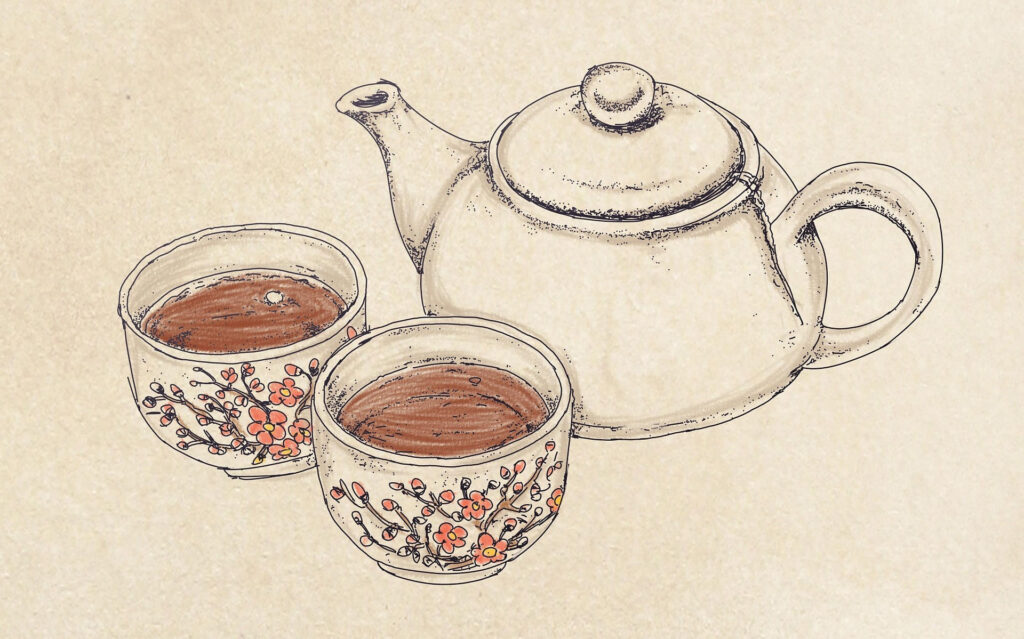
How much do you really know about tea?
You may know the difference between black tea and green tea, but can you name the plant they both come from? Do you know where bubble tea originated, what gives Earl Grey its distinctive aroma, or what was actually thrown into Boston Harbor during the Boston Tea Party?
Tea has thousands of years of history, dozens of regional traditions, and an astonishing variety of processing and brewing methods. That gives us plenty of material for a good trivia game.
This collection includes 50 tea questions and answers ranging from easy beginner questions to trickier facts about tea history, geography, brewing, equipment, and culture.
Use them for an afternoon tea party, family game night, tea club, classroom activity, or simply to test your own tea knowledge.
🍃 Tea Basics
1. What plant are black, green, white, and oolong tea made from?
Answer: Camellia sinensis.
Although these teas can taste dramatically different, they all come from the same general tea plant. Their differences are largely created by cultivar, growing conditions, harvesting, and processing.
Learn more in our Tea Varieties guide.
2. Is peppermint tea a true tea?
Answer: No.
Peppermint tea is an herbal infusion rather than a true tea because it is made from peppermint leaves instead of Camellia sinensis.
3. What is another word for an herbal tea or herbal infusion?
Answer: A tisane.
Chamomile, peppermint, hibiscus, rooibos, and many other drinks commonly called “tea” are technically tisanes.
4. Which is generally more oxidized: green tea or black tea?
Answer: Black tea.
Green tea processing is designed to limit oxidation, while black tea undergoes much more extensive oxidation before drying.
Explore our Black Tea and Green Tea guides to compare them.
5. Which type of tea is known for relatively minimal processing?
Answer: White tea.
White tea is generally withered and dried with less manipulation than many other traditional tea styles.
6. What type of tea falls between green and black tea in its degree of oxidation?
Answer: Oolong tea.
Oolongs vary tremendously. Some are lightly oxidized and floral, while others are darker, roasted, and much closer in appearance to black tea.
Explore our Oolong Tea collection.
7. What powdered green tea is whisked directly into water rather than strained out?
Answer: Matcha.
Because matcha consists of finely ground tea leaves, the powder remains in the finished drink.
Visit our Matcha section for more.
8. Which country is most closely associated with matcha culture today?
Answer: Japan.
Powdered-tea traditions have older roots in China, but matcha developed into a particularly important part of Japanese tea culture.
9. What Japanese green tea is one of the country’s most widely consumed styles?
Answer: Sencha.
Sencha is generally produced from steamed tea leaves and can offer vegetal, grassy, sweet, and savory flavors depending on the tea and brewing method.
10. Pu-erh tea is particularly associated with which Chinese province?
Answer: Yunnan.
Pu-erh belongs to the family of teas known for microbial fermentation and aging processes and has a particularly strong association with Yunnan in southwestern China.
🌏 Tea Around the World
11. Darjeeling tea comes from which country?
Answer: India.
Darjeeling lies in the Himalayan foothills of the Indian state of West Bengal. Its teas are famous for their aromatic character and can be produced at elevations ranging from roughly 600 to 2,000 meters.
Explore our Darjeeling Tea collection.
12. Assam tea is named after a region in which country?
Answer: India.
Assam lies in northeastern India and is famous for strong, full-bodied black teas that often have a rich, malty character.
13. What country was once called Ceylon and still uses the name Ceylon for its tea?
Answer: Sri Lanka.
“Ceylon tea” remains a familiar term for tea produced in Sri Lanka even though the country officially adopted the name Sri Lanka in 1972.
14. Rize is the heart of the tea-growing industry in which country?
Answer: Türkiye.
Rize lies on Türkiye’s humid northeastern Black Sea coast and became the center of the country’s modern tea industry.
Read our complete Rize Tea guide.
15. Rooibos comes from which country?
Answer: South Africa.
Rooibos comes from Aspalathus linearis, a plant native to South Africa rather than the traditional tea plant.
That means Rooibos is naturally caffeine-free and technically an herbal infusion.
16. Yerba mate is traditionally associated with which part of the world?
Answer: South America.
Mate has particularly strong cultural traditions in countries including Argentina, Uruguay, Paraguay, and southern Brazil.
It is made from Ilex paraguariensis, not Camellia sinensis.
17. Is yerba mate naturally caffeine-free?
Answer: No.
This is a good trick question. Although yerba mate is not true tea, it naturally contains caffeine.
18. What flower is commonly dried and brewed to make a tart, ruby-red herbal tea?
Answer: Hibiscus.
Hibiscus tea has a distinctive tart flavor that can resemble cranberry and is enjoyed both hot and iced.
Explore our Hibiscus Tea collection.
19. Does decaffeinated tea necessarily contain absolutely zero caffeine?
Answer: No.
Decaffeination removes most of the caffeine, but small amounts can remain. “Decaffeinated” should not automatically be interpreted as identical to naturally caffeine-free.
20. Does the phrase “herbal tea” automatically mean caffeine-free?
Answer: No.
Many familiar herbal infusions, such as chamomile, peppermint, and rooibos, are naturally caffeine-free. But caffeinated plants such as yerba mate demonstrate why you should always check the actual ingredients.
🫖 Brewing & Tea Equipment
21. Which usually requires cooler brewing water: green tea or black tea?
Answer: Green tea.
Many green teas are best brewed with water well below boiling, while black teas generally tolerate hotter water.
Visit our How to Brew Tea section for more brewing guidance.
22. What can happen if tea leaves are steeped for too long?
Answer: The tea may become excessively bitter or astringent.
More time is not always better. Using the right amount of leaf and an appropriate steep time usually produces a more balanced cup than simply leaving the leaves in indefinitely.
23. Why should loose tea leaves have room to expand while brewing?
Answer: Water needs to circulate around the leaves.
Tea leaves often expand considerably as they absorb water, so an infuser that is too cramped can interfere with even extraction.
24. What is gongfu tea brewing?
Answer: A Chinese approach to tea preparation using relatively more leaf, smaller vessels, and multiple short infusions.
The method can reveal how a tea’s aroma and flavor change over successive steepings.
25. What is a gaiwan?
Answer: A traditional Chinese lidded brewing bowl.
A gaiwan generally consists of a bowl, lid, and saucer and can be used both to brew and drink tea.
26. What is a kyusu?
Answer: A Japanese teapot.
The term often brings to mind the familiar side-handled pots commonly used for Japanese green tea, although Japanese teapots come in different forms.
27. What is the bamboo whisk used to prepare matcha called?
Answer: A chasen.
Its many fine tines help suspend matcha powder in water and create the characteristic frothy surface.
28. What is the bowl traditionally used for preparing and drinking matcha called?
Answer: A chawan.
Matcha bowls come in many shapes and styles and play an important role in Japanese tea culture.
Explore more equipment in our Tea Gear & Accessories section.
🌿 Chai, Boba & Grain Tea
29. Masala chai is especially associated with which country?
Answer: India.
Masala chai combines tea—usually strong black tea—with milk, sweetener, and spices such as cardamom and ginger.
Try our Masala Chai Recipe.
30. What does the word “chai” mean?
Answer: Tea.
“Chai” is a word for tea in Hindi and several other languages. That is why “masala chai,” meaning spiced tea, is more precise than simply using “chai” to mean spices.
31. In which country did modern bubble tea emerge?
Answer: Taiwan.
Modern bubble tea developed in Taiwan during the 1980s, although competing businesses have made claims about exactly who invented the first pearl milk tea.
Read our Boba Tea Guide.
32. What are traditional boba pearls primarily made from?
Answer: Tapioca starch.
Tapioca comes from cassava and creates the characteristically chewy texture of boba pearls.
33. What is Japanese mugicha made from?
Answer: Roasted barley.
Mugicha is especially popular as a chilled summer drink in Japan.
34. What is the Korean name for roasted barley tea?
Answer: Boricha.
Like Japanese mugicha, boricha can be served hot or cold.
35. Is plain barley tea naturally caffeine-free?
Answer: Yes.
Because it is made from barley rather than Camellia sinensis, plain barley tea contains no natural tea caffeine.
There is an important catch: barley contains gluten, so barley tea should not be assumed safe for someone who must follow a gluten-free diet.
Read our Barley Tea guide.
🇹🇷 Tea Traditions
36. What distinctive shape is associated with traditional Turkish tea glasses?
Answer: A tulip or narrow-waisted shape.
The small clear glasses beautifully display the reddish-amber color of strong Turkish black tea.
37. What is the stacked Turkish double-kettle system called?
Answer: A çaydanlık.
Strong tea is prepared in the upper pot while hot water remains in the lower kettle. Drinkers can then dilute the concentrate according to their preferred strength.
38. In what year did UNESCO inscribe the culture of çay in Türkiye and Azerbaijan on its Representative List of the Intangible Cultural Heritage of Humanity?
Answer: 2022.
The UNESCO inscription highlights tea’s importance to hospitality, social interaction, and cultural identity in both countries.
39. In what year were China’s traditional tea-processing techniques and associated social practices added to UNESCO’s Representative List?
Answer: 2022.
UNESCO’s description recognizes six major categories within Chinese tea traditions: green, yellow, dark, white, oolong, and black tea.
🌸 Flavored & Roasted Teas
40. What citrus fruit gives Earl Grey its signature aroma?
Answer: Bergamot.
Bergamot is an aromatic citrus fruit whose oil provides the distinctive fragrance associated with Earl Grey Tea.
41. How does jasmine tea traditionally get its floral aroma?
Answer: Tea is scented with jasmine blossoms.
The flowers release their fragrance into the tea during carefully managed scenting processes.
Explore our Jasmine Tea collection.
42. What roasted grain is traditionally combined with green tea to make genmaicha?
Answer: Rice.
The toasted rice gives genmaicha its distinctive nutty, cereal-like aroma.
43. What is hojicha?
Answer: Roasted Japanese tea.
Roasting gives hojicha warm, woody, toasted flavors and distinguishes it from fresher-tasting Japanese green teas.
44. Which Chinese tea is famous for its smoky character?
Answer: Lapsang Souchong.
Smoky versions of this black tea are traditionally associated with aromas reminiscent of pine smoke, wood fires, and campfires.
📜 Tea History
45. Where was the tea destroyed during the Boston Tea Party grown?
Answer: China.
Despite the British East India Company’s later association with tea cultivation in India, the tea destroyed in Boston Harbor in 1773 had been produced in China.
46. How many chests of tea were destroyed during the Boston Tea Party?
Answer: 340 chests.
The tea came from three ships—the Beaver, Dartmouth, and Eleanor—and weighed more than 92,000 pounds in total.
47. On what date did the Boston Tea Party take place?
Answer: December 16, 1773.
The destruction of the East India Company’s tea became one of the defining events in the escalating conflict between Britain and its American colonies.
48. Are “afternoon tea” and “high tea” historically the same thing?
Answer: No.
Afternoon tea developed as a lighter meal featuring tea with foods such as sandwiches, cakes, and pastries. Historically, high tea referred more often to a substantial evening meal associated with working households and was eaten at a higher dining table.
Explore our Tea Parties & Afternoon Tea collection.
49. What does “first flush” mean on a tea label?
Answer: Tea made from the first major new growth harvested during a growing season.
The phrase is particularly familiar in places such as Darjeeling, where different seasonal harvests can produce noticeably different flavors.
50. What does “terroir” mean when people talk about tea?
Answer: The influence of place and growing environment on an agricultural product.
Climate, elevation, soil, rainfall, sun exposure, local plant material, and other environmental conditions can all contribute to the character of a tea.
This is why teas grown in Darjeeling, Assam, Rize, Taiwan, Japan, Sri Lanka, and Yunnan can taste remarkably different even when they ultimately come from the same tea species.
🏆 How Did You Do?
Give yourself one point for every correct answer.
0–10: Tea Beginner
You have plenty left to discover—and that may be the most enjoyable stage of learning about tea.
11–20: Tea Explorer
You know your way around a teapot and have probably sampled several different styles.
21–30: Tea Enthusiast
You know considerably more than the average tea drinker.
31–40: Tea Expert
Someone should probably let you choose the tea at the next gathering.
41–49: Tea Master
Very little gets past you.
50/50: SereniTea Scholar
Put the kettle on. You have earned it.
🎀 Turn It Into a Tea Party Game
This trivia collection is easy to use at an afternoon tea.
Have one person act as quizmaster and read each question without revealing the answer.
Guests can play individually or divide into teams.
For an easier game, choose questions from the first half of the collection. For tea enthusiasts, mix in the history, equipment, and regional questions toward the end.
You could even award a small tea-themed prize to the winner, such as a tea infuser, a packet of loose-leaf tea, or a pretty mug.
More importantly, trivia gives everyone something to talk about while the tea is brewing.
🫖 Keep Exploring the World of Tea
One of the pleasures of tea is realizing how large the subject becomes once you move beyond a simple bag in a mug.
The same Camellia sinensis plant can become white tea, green tea, oolong, black tea, dark tea, matcha, and countless regional specialties. Beyond true tea, there are roasted grain drinks, herbal infusions, mate, rooibos, chai, boba, and dozens of other drinking traditions.
Every cup has another question behind it.
And now you have at least 50 answers.
🔗 Related Articles
- Tea Varieties
- Tea Culture & Regions
- How to Brew Tea
- Tea Parties & Afternoon Tea
- Tea Gear & Accessories
- Tea Recipes
- Tea & Wellness
- Boba Tea Guide
- Barley Tea
- Rize Tea
- Masala Chai Recipe
📚 Sources & Further Reading
- UNESCO — Traditional Tea Processing Techniques and Associated Social Practices in China
- UNESCO — Culture of Çay: A Symbol of Identity, Hospitality and Social Interaction
- Tea Board India — Darjeeling
- Tea Board India
- Boston Tea Party Ships & Museum — Boston Tea Party Facts
- Boston Tea Party Ships & Museum — The Destruction of the Tea
- U.S. Food & Drug Administration — Gluten and Food Labeling