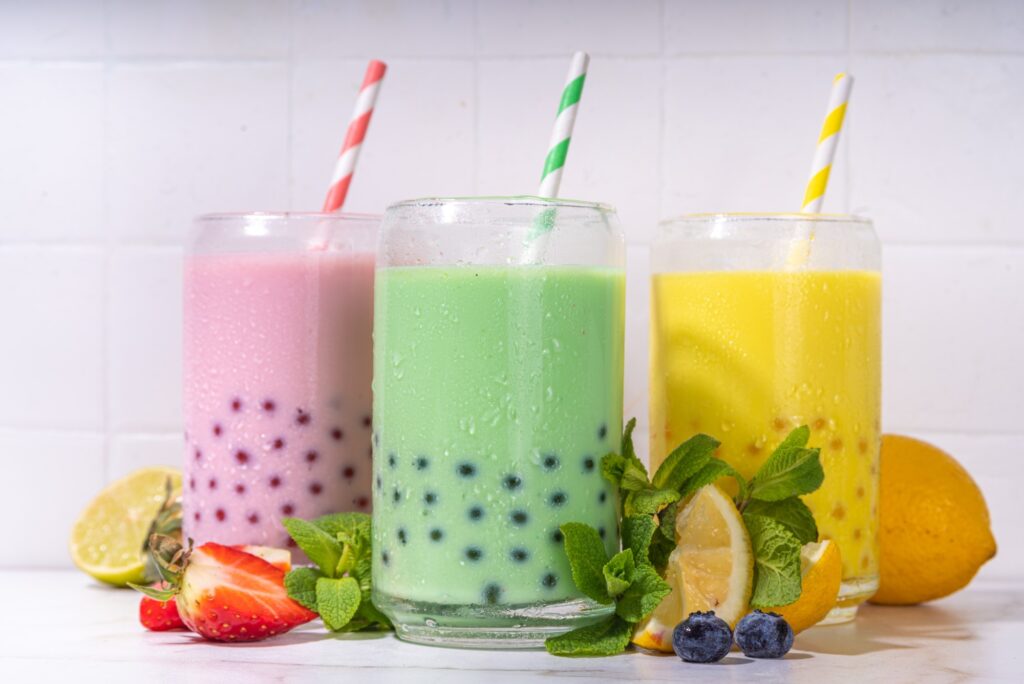
Boba pearls are the chewy little spheres that turn an ordinary glass of milk tea into something you can both drink and eat. They sit at the bottom of bubble tea, travel up an extra-wide straw, and provide the springy, pleasantly chewy texture that has become one of the drink’s defining features.
Although “boba” is sometimes used as another name for bubble tea itself, the word can also refer specifically to the tapioca pearls in the drink.
Classic boba pearls are made primarily from tapioca starch derived from cassava. Before cooking, they are hard and dry. After boiling, the starch hydrates and develops the soft, elastic chew associated with freshly prepared boba.
The basic idea is simple, but there is much more variation than you might expect. Boba can be black, golden, clear, miniature, quick-cooking, traditionally cooked, homemade, or soaked in brown sugar syrup. And despite the similar name, popping boba is something entirely different.
If you have ever wondered exactly what boba pearls are made from, why they are chewy, or how to keep them from becoming hard or mushy, this guide covers the pearls themselves from package to finished drink.
🧋 What Are Boba Pearls?
Boba pearls are small chewy balls most commonly served in Taiwanese-style bubble tea.
The classic version is a tapioca pearl, meaning its structure comes primarily from tapioca starch. Tapioca starch is extracted from the cassava root, a tropical root crop also known as yuca or manioc.
The pearls themselves are relatively mild in flavor. Much of the sweetness people associate with boba comes from what happens after cooking, when the pearls are soaked or coated in sugar syrup, honey, brown sugar, or another sweetener.
That is why two shops can use similar tapioca pearls but serve boba that tastes noticeably different.
The pearl provides the texture.
The syrup provides much of the flavor.
🌱 What Is Tapioca?
Tapioca is starch derived from cassava.
Cassava is a starchy tropical root cultivated in many parts of the world. Its extracted starch is used in numerous foods and can be processed into powders, flakes, granules, and pearls.
Large tapioca pearls are particularly familiar today because of bubble tea, although tapioca existed as a food ingredient long before bubble tea became popular.
When tapioca starch is combined with liquid and heated, the starch changes dramatically. This gelatinization process is what allows dry, hard pearls to become soft, translucent or darkened, and chewy after cooking.
🥔 Is Tapioca the Same as Cassava?
They are related, but they are not exactly the same thing.
Cassava is the root crop.
Tapioca is the starch extracted from that root.
Think of the relationship somewhat like corn and cornstarch. One is the original plant ingredient, while the other is a refined starch obtained from it.
When a package says “tapioca starch,” “cassava starch,” or sometimes “tapioca flour,” it is referring to starch obtained from cassava.
For boba, that starch is combined with liquid and other ingredients to create the dough or pearl structure.
🟤 What Are Black Boba Pearls Made From?
The familiar dark boba found in many milk teas usually contains tapioca starch along with water and ingredients that contribute sweetness or color.
Depending on the manufacturer, those ingredients may include:
- Brown sugar
- Caramel
- Coloring
- Additional starches
- Preservatives or texture-modifying ingredients
There is no single recipe used by every manufacturer.
That is why one brand of dry black pearls may look, cook, and taste noticeably different from another.
The dark color does not mean that all black boba is intensely flavored. Many pearls remain relatively mild until they are cooked and soaked in syrup.
🤎 What Is Brown Sugar Boba?
The phrase brown sugar boba can refer to more than one thing.
Sometimes it describes dark tapioca pearls made with brown sugar.
More commonly in a finished drink, it refers to freshly cooked tapioca pearls coated or soaked in a rich brown sugar syrup.
That syrup gives the pearls a glossy appearance and deep caramel or molasses-like sweetness.
In drinks such as brown sugar milk tea, extra syrup may also be streaked around the inside of the glass before the milk is added.
If you want to make a complete drink after mastering the pearls, see our Brown Sugar Boba Milk Tea Recipe.
⚪ What Are Clear Tapioca Pearls?
Not every tapioca pearl is black.
Traditional tapioca pearls can also be pale, white, or almost translucent after cooking.
These pearls generally have a neutral flavor unless they are sweetened after cooking.
The difference in color does not necessarily mean they are made from a completely different starch. The familiar black appearance of many modern boba pearls often comes from added sugar, caramel, or coloring rather than tapioca naturally being black.
Clear pearls can be especially useful when you want the color of the tea or dessert to remain the visual focus.
🟡 What Are Golden Boba Pearls?
Golden boba is another variation of tapioca pearl.
These pearls are generally amber or golden rather than dark brown or black.
Depending on the product, they may be made with a lighter-colored sweetener or formulation that creates a more translucent appearance.
The texture should still be recognizably boba-like: soft on the outside with a springy, chewy center.
Flavor varies by brand, so do not assume golden pearls will always taste a particular way based on color alone.
🔹 What Are Mini Boba Pearls?
Mini boba pearls are simply smaller tapioca pearls.
Their smaller size changes the drinking experience because several pearls can come through the straw at once.
They can also cook differently from full-size boba, so always check the package directions instead of using the same timing you would use for larger pearls.
Mini pearls work well in milk tea, fruit tea, desserts, and bowls where standard boba might feel too large.
⚡ What Are Quick-Cooking Boba Pearls?
Quick-cooking tapioca pearls are manufactured so they can be prepared much faster than traditional dry pearls.
Some can be ready in only a few minutes.
Other dried boba pearls may require a much longer combination of boiling, simmering, and resting.
This difference is extremely important when cooking boba at home.
There is no universal cooking time for tapioca pearls.
If your package says five minutes, follow those directions.
If another package says thirty minutes plus a resting period, follow those instead.
The specific product in your kitchen matters more than a generic recipe found online.
⏱️ Traditional vs. Quick-Cooking Pearls
| Type | Cooking Style | Best For |
|---|---|---|
| Quick-cooking boba | Usually several minutes | Fast homemade drinks |
| Traditional dried pearls | Longer boil and/or resting time | Classic chewy texture |
| Fresh boba | Very short storage life; preparation varies | Fresh café-style boba |
| Homemade pearls | Cook immediately or dry/freeze depending on recipe | Full control over ingredients |
Quick-cook pearls are wonderfully convenient, especially if you want one glass of bubble tea at home.
Traditional pearls require more patience but may give you greater control over the final chew.
Neither type is automatically better. What matters most is cooking the product correctly and serving it while the texture is still good.
💥 Is Popping Boba the Same as Tapioca Boba?
No.
Popping boba is not the same thing as tapioca pearls.
Classic tapioca boba is chewy and starch-based.
Popping boba has a thin outer membrane containing flavored liquid. When bitten, the shell breaks and the liquid “pops” into your mouth.
Popular flavors include:
- Mango
- Strawberry
- Passion fruit
- Lychee
- Blueberry
- Peach
The experience is completely different.
Choose tapioca pearls when you want chewiness.
Choose popping boba when you want a juicy burst of flavor.
Both can appear on a bubble-tea menu, but they should not be treated as interchangeable ingredients.
💎 What Is Crystal Boba?
Crystal boba is another topping that looks similar to tapioca pearls but may use different starches or gelling ingredients.
It is often lighter or translucent and tends to have a softer, more jelly-like chew than classic tapioca boba.
Ingredients vary among products, so check the package if you specifically want traditional tapioca pearls.
This is another reason the word “boba” can become confusing. On modern bubble-tea menus, it may be used broadly for several round toppings even though their ingredients and textures are different.
🌏 Where Did Boba Pearls Come From?
Tapioca itself has a much longer history than bubble tea.
Cassava originated in the Americas, and cassava starch eventually became widely used in Asia and other parts of the world.
Tapioca pearls and similar starch-based sweets were already familiar ingredients before bubble tea emerged.
The modern drink associated with boba developed in Taiwan during the 1980s, when chewy starch pearls began being paired with tea-based beverages. Exactly which shop first created the drink remains disputed, and several origin stories compete with one another.
What is not disputed is what happened afterward.
The combination of tea, milk or fruit, sweetness, ice, and chewy pearls became enormously popular and eventually spread around the world.
For the broader story of the beverage rather than just the pearls, see Bubble Tea: A Delightful Journey Through Pearls and Flavors.
🏭 How Are Boba Pearls Made?
At their simplest, tapioca pearls begin with tapioca starch and liquid.
A homemade version might use:
- Tapioca starch
- Water
- Brown sugar
The water and sugar are heated, tapioca starch is incorporated, and the mixture becomes a pliable dough.
That dough is then rolled into thin ropes, cut into tiny pieces, and shaped into individual balls.
The raw pearls may be dusted with additional tapioca starch so they do not stick together.
Commercial production follows the same broad principle but on a much larger scale. Manufacturers can also include additional starches, coloring, sweeteners, or ingredients that improve texture and shelf life.
🖐️ Why Homemade Boba Takes Time
The ingredients are uncomplicated.
Rolling dozens—or hundreds—of tiny balls is the time-consuming part.
Pearls need to be relatively similar in size so they cook evenly. If half the batch is tiny and the other half is twice as large, some pearls may be soft while others still have hard centers.
That is why packaged pearls are a perfectly reasonable choice for home bubble tea.
Making boba from scratch can be fun when you want the full experience, but store-bought dried pearls make far more sense when your real goal is simply to have a good milk tea.
🔥 What Happens When Tapioca Pearls Cook?
Dry tapioca pearls are hard because the starch structure has not yet absorbed enough water to create the soft texture associated with cooked boba.
During boiling, water and heat hydrate and gelatinize the starch.
The pearl gradually changes from hard and opaque to softer and more elastic.
Correctly cooked boba should have a satisfying chew throughout.
It should not have a hard, chalky core.
It should also not be so overcooked that the pearls lose their shape or turn into a sticky mass.
The perfect texture sits between those two extremes.
🍲 How to Cook Boba Pearls
The most important instruction is simple:
Read the package first.
Different brands can require dramatically different cooking times.
Once you know your manufacturer’s timing, the general process looks like this.
💧 Step 1: Use Plenty of Water
Bring a generous pot of water to a strong boil.
Tapioca pearls need enough water to move freely.
Trying to cook a large quantity of boba in a tiny saucepan can encourage sticking and make the water overly starchy.
A larger pot makes the process much easier.
🫧 Step 2: Add the Pearls to Boiling Water
Add the dry boba only after the water is boiling unless your package specifically instructs otherwise.
Stir gently immediately after adding them.
This keeps the pearls from settling onto the bottom of the pot and sticking together before their exteriors begin to cook.
Continue stirring periodically during the early stages.
⏱️ Step 3: Cook According to the Package
This is where recipes diverge.
Depending on the pearl, the directions may tell you to:
- Boil continuously
- Reduce to a simmer
- Cook covered
- Cook uncovered
- Boil and then rest
- Simmer for an extended period
Follow the package you actually purchased.
Do not assume a quick-cooking pearl needs the same treatment as a traditional dry pearl.
🛌 Step 4: Let Them Rest if Required
Some traditional boba instructions include a covered resting period after cooking.
During this time, residual heat continues moving through the pearl and helps finish the center.
Skipping the resting stage when your package requires one can leave the middle firmer than intended.
Quick-cooking boba may not require this step at all.
Again, the product directions win.
🥄 Step 5: Taste One Pearl
The best test is texture.
Carefully remove a pearl, cool it enough to taste safely, and bite into it.
A properly cooked pearl should be:
- Soft
- Springy
- Chewy
- Cooked through the center
If there is a hard or chalky center, it needs more cooking or resting.
If it collapses immediately and feels mushy, it has probably gone too far.
🚿 Step 6: Drain the Pearls
Once the boba reaches the texture you want, drain it.
Some products call for a brief rinse after cooking, while others are best transferred directly into sweet syrup.
Follow the package recommendation when one is provided.
If you rinse the pearls, do not leave them sitting in plain cold water for a long period. They are much better moved into their sweetener or finished drink.
🍯 Step 7: Sweeten the Boba
Freshly cooked tapioca has relatively mild flavor.
This is where brown sugar syrup, simple syrup, or honey transforms it.
Transfer the warm pearls into your chosen sweetener and allow them to sit briefly.
For an easy brown sugar syrup, combine:
- 1/2 cup brown sugar
- 1/2 cup water
Heat gently until the sugar dissolves.
You can simmer the syrup longer if you want a thicker consistency, but watch it carefully so it does not burn.
Add the cooked boba while the syrup is still warm.
🤎 How Long Should Boba Soak in Brown Sugar?
You do not need to soak freshly cooked boba for hours.
Even a relatively short rest in warm brown sugar syrup can coat the pearls and give them noticeably more flavor.
For homemade bubble tea, let the boba sit in the syrup while you finish brewing the tea, preparing the milk, and filling your glass with ice.
The longer the pearls sit, however, the more their texture changes.
Fresh boba is at its best when you cook it close to serving time.
✨ What Texture Should Good Boba Have?
The ideal tapioca pearl has a texture often described as QQ in Taiwan—a term associated with a springy, satisfyingly chewy texture.
Good boba should offer resistance when you bite it without feeling hard.
It should be:
- Soft on the surface
- Chewy through the center
- Springy rather than gummy
- Separate rather than glued into one mass
Personal preference matters too.
Some people like very soft pearls.
Others prefer noticeably more chew.
Once you know the brand you are using, you can adjust its cooking or resting time slightly to reach the texture you prefer.
❌ Why Is My Boba Hard in the Middle?
A hard center usually means the pearls have not cooked all the way through.
Possible causes include:
- Insufficient cooking time
- Skipping a required resting period
- Water that stopped simmering
- Using unusually large pearls
- Following instructions meant for a different type of boba
Return undercooked pearls to hot water if practical and continue cooking until the center softens.
For your next batch, remember that pearl size and brand make a major difference.
🫠 Why Is My Boba Mushy?
Mushy boba has usually been overcooked.
The starch has hydrated beyond the chewy stage and the pearls begin losing their structure.
Unfortunately, there is not much you can do to restore an overcooked batch.
Use it if the texture is still acceptable, but shorten the cook or resting time next time.
Testing one pearl before draining the entire pot can help prevent this.
🧲 Why Are My Boba Pearls Sticking Together?
Tapioca starch becomes sticky during cooking.
Some sticking is normal, but you can reduce it by:
- Using plenty of water
- Stirring immediately after adding the pearls
- Stirring periodically while cooking
- Draining them promptly
- Transferring them into syrup after cooking
Do not let drained boba sit in a dry clump.
The pearls can quickly glue themselves together.
🪨 Why Did My Boba Turn Hard After Cooking?
Fresh boba changes as it sits.
The soft, hydrated starch gradually loses the texture that makes freshly cooked pearls so enjoyable. Cooling and refrigeration can make that change particularly noticeable.
That is why bubble-tea shops generally prepare pearls for relatively quick use rather than treating them like a topping that can sit for days.
For home use, the best rule is simple:
Cook only about as much boba as you expect to use.
🧊 Can You Refrigerate Cooked Boba?
You can refrigerate cooked boba, but the texture is unlikely to remain as soft and springy as it was immediately after cooking.
Cold storage can make tapioca pearls firmer and less pleasant to chew.
Reheating may soften them somewhat, but the result may not be identical to a freshly cooked batch.
If texture matters, make the pearls the same day you plan to drink them.
⏰ How Long Does Cooked Boba Last?
Cooked tapioca pearls are a short-lived ingredient.
For the best texture, use them the same day and preferably within several hours of cooking.
Commercial products and recipes vary, so follow any storage instructions provided by the manufacturer.
Dry, uncooked boba lasts much longer when stored correctly according to its package directions.
Do not confuse the long shelf life of an unopened package of dry pearls with the very short period in which cooked pearls taste their best.
📦 How to Store Dry Tapioca Pearls
Keep unopened boba according to the package directions.
Once opened, dry pearls generally need protection from:
- Moisture
- Humidity
- Strong odors
- Excessive heat
Seal the package tightly or transfer the pearls to an airtight food-storage container.
Moisture is particularly troublesome because the pearls are meant to remain dry until cooking.
Always check the expiration or best-by date on the specific product.
🧋 How Much Boba Do You Need Per Drink?
The answer depends on how much you like chewing.
For a typical homemade bubble tea, approximately 1/4 cup of cooked pearls is a practical starting point for one large drink.
Use less if you want the tea to remain the focus.
Use more if boba is your favorite part.
Remember that dry pearls expand as they cook, so you generally need much less dry boba than the volume of cooked pearls you eventually want.
🧋 How to Add Boba to Milk Tea
Once your pearls are cooked and sweetened, assembling the drink is easy.
Add the boba to the bottom of a tall glass.
Then add:
- Ice
- Strong brewed tea
- Milk or creamer
- Sweetener or syrup
Stir everything together and serve with a wide boba straw.
Strong black teas such as Assam or Ceylon work especially well because their flavor remains noticeable after you add milk, ice, sugar, and tapioca.
🧋 What Drinks Can You Put Boba In?
Boba pearls are not limited to classic black milk tea.
Try them in:
- Black milk tea
- Jasmine milk tea
- Matcha milk tea
- Thai-style tea
- Taro milk tea
- Chai
- Fruit tea
- Coffee drinks
- Smoothies
- Slush drinks
- Brown sugar milk
You can even serve them over shaved ice or other desserts.
The pearl itself is mild enough to work with many different flavors.
🍠 Boba and Taro
Taro boba tea is especially popular because creamy taro flavors work well with chewy tapioca pearls.
The two ingredients are completely separate, however.
Taro refers to the root vegetable or taro flavor used in the drink.
Boba refers to the pearls.
A taro drink can be made with or without boba, and boba can be added to countless drinks that contain no taro at all.
For more on that combination, see our Taro Boba Tea Guide: Flavor, Ingredients, Caffeine & How It’s Made.
🌸 Boba in Jasmine Milk Tea
Jasmine milk tea is another excellent pairing.
The floral tea creates a lighter, more aromatic drink than a strong black-tea base, while the chewy boba adds body and texture.
If you are using a delicate jasmine tea, brew it strongly enough that the flavor does not disappear once milk, ice, and syrup are added.
Add freshly cooked pearls only after the tea has cooled enough for an iced drink.
🍵 Can You Put Boba in Hot Tea?
Yes, although boba is most strongly associated with cold milk tea.
Warm pearls can be added to hot or warm tea drinks as long as the glass or cup is appropriate for the temperature.
Hot drinks create a different textural experience because the pearls remain warm and soft rather than being chilled by ice.
Brown sugar boba can be especially satisfying this way.
🥤 Why Do You Need a Wide Boba Straw?
Standard drink straws are too narrow for full-size tapioca pearls.
A boba straw has a much wider opening so both liquid and pearls can travel through it.
If you do not have a wide straw, you can simply drink the tea normally and eat the pearls with a long spoon.
Do not try to force oversized pearls through a narrow straw.
🌾 Are Boba Pearls Gluten-Free?
Tapioca starch itself does not contain gluten.
However, a commercial boba product can contain additional ingredients or be manufactured in a facility where cross-contact is possible.
If you need to avoid gluten for medical reasons, do not rely solely on the fact that tapioca comes from cassava.
Check the label and manufacturer information for the specific product you intend to use.
🥛 Are Boba Pearls Dairy-Free?
Plain tapioca pearls are not inherently a dairy ingredient.
However, commercial pearl recipes vary, and the finished bubble-tea drink may contain milk, creamer, milk powder, or other dairy ingredients.
Someone avoiding dairy should evaluate both:
- The boba pearl ingredients
- The rest of the drink
A cup made with tapioca pearls and oat milk can be dairy-free if all of the individual ingredients meet that requirement.
🍬 Are Boba Pearls Sweet?
Cooked tapioca itself is fairly mild.
The pronounced sweetness usually comes from:
- Brown sugar syrup
- Simple syrup
- Honey
- Flavored syrup
- The surrounding drink
This gives you considerable control when making boba at home.
If you prefer less sweetness, use a lighter syrup bath and reduce the sweetener in the tea.
If you love dessert-style bubble tea, allow the cooked pearls to sit in a richer brown sugar syrup before serving.
🥄 Can You Make Boba Without Brown Sugar?
Absolutely.
Brown sugar is popular because its caramel and molasses flavors complement milk tea, but it is not mandatory.
You can sweeten cooked boba with:
- White sugar syrup
- Honey
- Maple syrup
- Coconut sugar syrup
- Flavored syrups
Or you can leave the pearls relatively unsweetened and let the drink provide most of the sweetness.
🧋 What Is the Difference Between Boba and Bubble Tea?
Boba pearls are the chewy tapioca topping.
Bubble tea is the broader drink category.
Bubble tea can contain boba, but modern bubble-tea shops also offer many other toppings, including:
- Popping boba
- Jelly
- Pudding
- Grass jelly
- Aloe
- Fruit
- Cheese foam
Likewise, tapioca pearls can be used in drinks and desserts other than conventional bubble tea.
If you want the broader drink guide, visit Boba Tea: The Rising Star of the Tea World.
🧑🍳 Boba Cooking Cheat Sheet
For the easiest home preparation:
- Read the package.
- Bring plenty of water to a full boil.
- Add the pearls and stir immediately.
- Cook according to the manufacturer’s directions.
- Rest the pearls if the instructions require it.
- Taste one to check the center.
- Drain when soft and chewy.
- Rinse only if appropriate for your product.
- Transfer the pearls into warm syrup.
- Serve them as soon as practical.
The single biggest mistake is assuming every package cooks the same way.
It does not.
❓ Frequently Asked Questions
What are boba pearls made of?
Classic boba pearls are made primarily from tapioca starch derived from cassava, usually along with water and potentially sugar, coloring, additional starches, or other ingredients depending on the product.
Are boba and tapioca pearls the same thing?
In classic bubble tea, yes. “Boba” commonly refers to the large chewy tapioca pearls served in the drink. However, the word boba is now sometimes used more broadly for other toppings and the beverage itself.
Why are boba pearls black?
Many black pearls contain brown sugar, caramel, food coloring, or a combination of ingredients that creates their dark color. Tapioca starch itself is not naturally black.
What do boba pearls taste like?
Plain cooked tapioca is relatively mild. Much of boba’s flavor comes from brown sugar syrup or another sweetener added after cooking.
Why is boba chewy?
Tapioca starch absorbs water and gelatinizes during cooking, creating the soft, elastic texture associated with properly prepared pearls.
How long do boba pearls take to cook?
It depends completely on the product. Quick-cooking pearls may take only a few minutes, while traditional dried pearls can require considerably longer cooking and resting periods. Follow the package.
How do I know when boba is done?
Taste a cooled pearl. It should be soft and pleasantly chewy throughout, without a hard or chalky center.
Why is my boba hard?
It may be undercooked, insufficiently rested, or it may have hardened after sitting too long.
Why is my boba mushy?
The pearls were probably overcooked.
Can cooked boba be refrigerated?
It can, but refrigeration often changes the texture and makes the pearls firmer. Freshly cooked boba is generally much better.
How long should cooked boba sit in syrup?
It can begin absorbing flavor during a relatively short soak while you prepare the rest of the drink. The pearls are best served fresh rather than stored in syrup for an extended period.
Is popping boba made from tapioca?
No. Popping boba is a liquid-filled topping with a thin outer membrane and is distinctly different from chewy tapioca pearls.
Can I make boba pearls from scratch?
Yes. Homemade boba can be made with tapioca starch, water, and usually sugar, but shaping all of the individual pearls requires more time than using packaged boba.
🧋 Final Thoughts
Boba pearls seem simple when they are sitting at the bottom of a glass, but their texture depends on an interesting transformation.
Tapioca starch begins with cassava. That starch is formed into dry pearls, then exposed to enough water and heat to become soft, elastic, and satisfyingly chewy. After cooking, the relatively mild pearls are usually transferred into brown sugar syrup or another sweetener that gives them much of the flavor people associate with boba.
The most useful lesson for making boba at home is also the simplest: follow the package rather than the clock in someone else’s recipe.
Quick-cooking pearls and traditional dried pearls can require very different treatment. Use plenty of boiling water, stir early, cook and rest as directed, and taste a pearl before deciding the batch is finished.
Then sweeten the pearls and use them quickly.
Freshly cooked boba should be soft, springy, and chewy—not hard, not mushy, and not stuck together in one giant mass.
Once you can reliably cook the pearls, the rest of bubble tea becomes easy. Brew the tea, choose your milk or fruit flavor, add ice and sweetness, spoon the boba into the bottom of the glass, and start experimenting.
🔗 Related Articles
- Brown Sugar Boba Milk Tea Recipe: How to Make Bubble Tea at Home
- Bubble Tea: A Delightful Journey Through Pearls and Flavors
- Boba Tea: The Rising Star of the Tea World
- Taro Boba Tea Guide: Flavor, Ingredients, Caffeine & How It’s Made
- Boba Tea Articles
📚 Sources & Further Reading
- U.S. Department of Agriculture — Cassava Inspection Instructions — Background on cassava and the use of cassava-root starch to make tapioca.
- Food and Agriculture Organization of the United Nations — Cassava Flour, Starch & Tapioca Products — Information on cassava starch processing and the production of tapioca pearls and other forms.
- Food and Agriculture Organization of the United Nations — Cassava Starch / Tapioca Terminology — Defines tapioca starch as starch extracted from cassava root.
- Iowa State University Extension and Outreach — Tapioca — Overview of tapioca starch and the different forms of tapioca, including large pearls used for bubble tea.
- University of Illinois Extension — How to Make Bubble Tea — Basic guidance on cooking tapioca boba and using it in homemade bubble tea.
- Food Network — How to Cook Tapioca Pearls and Use Them to Make Boba Tea — Practical guidance on pearl varieties, cooking, sweetening, and the importance of serving cooked boba relatively fresh.