Dandelions may be familiar as bright yellow flowers scattered across lawns and roadsides, but the plant has a much longer culinary and herbal history than its reputation as a garden weed might suggest.
The leaves can be eaten as greens, the flowers can be used in foods and drinks, and the roots are commonly dried or roasted to make a dark, earthy herbal infusion. Depending on which part of the plant you brew, “dandelion tea” can taste green and slightly bitter, delicately floral, or deeply roasted and almost coffee-like.
Dandelion has also accumulated an enormous list of wellness claims. It is frequently marketed for “detox,” liver cleansing, weight loss, digestion, water retention, blood sugar, inflammation, and even cancer prevention.
The scientific evidence is far less dramatic.
The National Center for Complementary and Integrative Health notes that very little human research has been conducted on dandelion and that there is currently no compelling scientific evidence supporting its use for any health condition. Some traditional uses and early studies are interesting, but they should not be transformed into promises that a cup of dandelion tea treats disease.
Fortunately, dandelion does not need miracle claims to be interesting.
It is naturally caffeine-free, comes in several distinctly different styles, and roasted dandelion root can make a satisfying alternative for people who enjoy dark, toasty beverages.
Here is what to know about dandelion tea, including the differences between root, leaf, and flower tea, how to brew each one, what the research actually says, and when extra caution is appropriate.
🌼 What Is Dandelion Tea?
Dandelion tea is an herbal infusion made from part of the dandelion plant, most commonly Taraxacum officinale.
Unlike green tea, black tea, white tea, and oolong, dandelion does not come from Camellia sinensis.
That means dandelion tea is technically a tisane, or herbal infusion.
The term “dandelion tea” can describe several quite different drinks because almost the entire plant may be used.
You may encounter:
- Dandelion root tea
- Roasted dandelion root tea
- Dandelion leaf tea
- Dandelion flower tea
- Dandelion root-and-leaf blends
These should not automatically be treated as interchangeable.
Different plant parts contain different compounds, taste different, and have different histories of use.
Explore more caffeine-free drinks in our Herbal Tea collection.
🌿 Root, Leaf & Flower Tea Are Different
This is one of the most important things to understand about dandelion.
A website may say “dandelion tea” and then discuss research involving a root extract, a leaf tincture, or a whole-plant preparation as though all four were the same product.
They are not.
Dandelion Root
The root produces an earthy, bitter infusion.
When roasted, it develops a much darker, toastier character and is commonly used in caffeine-free coffee-style drinks.
Dandelion Leaf
The leaves produce a greener, more herbaceous tea with noticeable bitterness.
Dandelion leaf also has a history of traditional use in preparations intended to increase urinary output.
Dandelion Flower
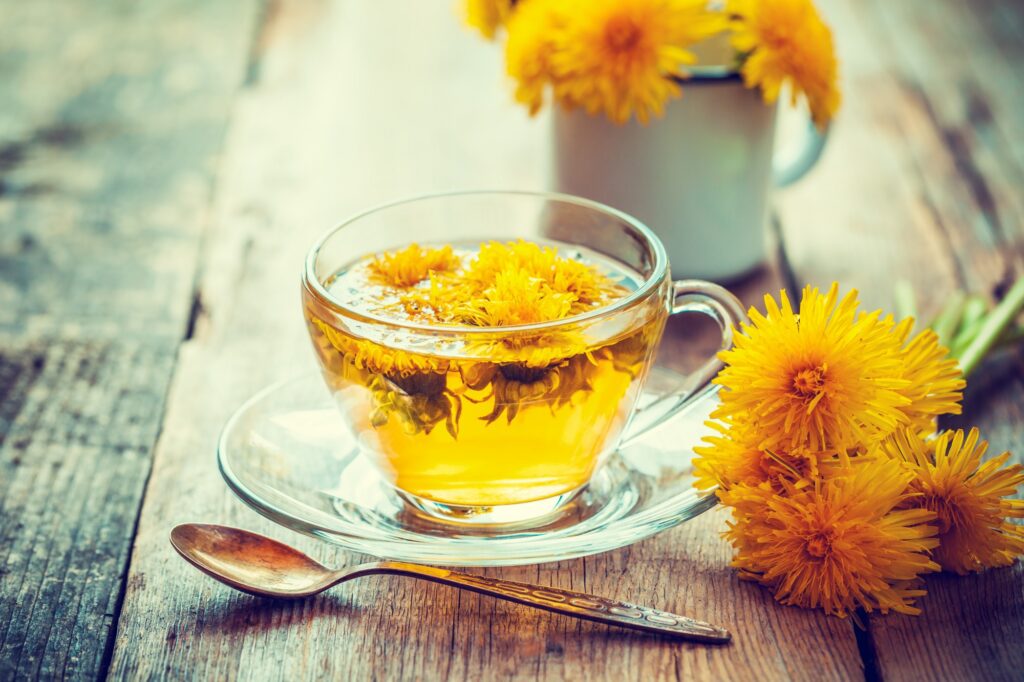
The flowers create a much lighter infusion that can be gently floral and slightly sweet.
Flower tea is considerably less common than root tea.
The part listed on the package matters, especially when comparing a commercial product with a research study.
☕ Does Dandelion Tea Have Caffeine?
Plain dandelion tea is naturally caffeine-free.
The dandelion plant does not naturally contain the caffeine found in:
- Coffee
- Black tea
- Green tea
- Oolong
- Matcha
- White tea
- Yerba mate
This makes roasted dandelion root particularly popular among people who want a dark, roasted drink without caffeine.
However, check the ingredient list on blends.
A “dandelion coffee” or herbal beverage might contain coffee, yerba mate, cacao, black tea, or another caffeinated ingredient.
Dandelion itself is caffeine-free; every product containing dandelion is not necessarily caffeine-free.
🌱 What Does Dandelion Root Tea Taste Like?
Unroasted dandelion root is earthy, herbal, and noticeably bitter.
Depending on the preparation, you may notice flavors reminiscent of:
- Roots
- Chicory
- Earth
- Mild wood
- Herbs
It is not naturally sweet.
That bitterness is part of the reason dandelion root has a long history as a traditional bitter herb.
If you dislike bitter drinks, honey, cinnamon, ginger, or a little milk can make the tea more approachable.
🔥 What Does Roasted Dandelion Root Taste Like?
Roasting changes the flavor dramatically.
Roasted dandelion root can develop notes reminiscent of:
- Toast
- Roasted grain
- Nuts
- Caramel
- Dark bread
- Chicory
- Very light coffee
It does not taste exactly like coffee.
Coffee has much more aromatic complexity, body, bitterness, and acidity.
Still, roasted dandelion root offers enough dark roasted character that it can satisfy some of the ritual of a hot coffee-like beverage without caffeine.
🌿 What Does Dandelion Leaf Tea Taste Like?
Dandelion leaf tea tastes greener and more vegetal than root tea.
Expect:
- Herbaceous flavors
- Leafy greens
- Noticeable bitterness
- A slightly mineral quality
People who enjoy strong herbal teas may appreciate it plain.
Others prefer blending the leaf with mint, lemon balm, ginger, or another herb to soften the bitterness.
The flavor is very different from roasted dandelion root, so disliking one does not mean you will dislike the other.
🌼 What Does Dandelion Flower Tea Taste Like?
Dandelion flower tea is milder.
It can be lightly floral, grassy, and somewhat sweet compared with the root and leaf.
Because the flowers produce a more delicate infusion, they are often combined with other herbs rather than used for an intensely flavored standalone tea.
Make sure flowers intended for tea are properly identified and have not been treated with lawn chemicals or pesticides.
🫖 How to Brew Dandelion Root Tea
For dried unroasted dandelion root, begin with:
- 1 to 2 teaspoons dried dandelion root
- 8 ounces water
Place the root and water in a small saucepan.
Bring to a boil, then reduce the heat and simmer gently for approximately 10 minutes.
Remove from the heat and strain.
Taste before adding anything else.
Root pieces are denser than ordinary tea leaves, so simmering generally extracts more flavor than a very brief steep.
If your packaged dandelion root provides different instructions, follow the producer’s directions.
☕ How to Brew Roasted Dandelion Root Tea
For a darker coffee-style cup, use:
- 1 tablespoon roasted dandelion root
- 8 ounces water
Combine the root and water in a saucepan.
Bring to a boil, then reduce to a gentle simmer for around 10 to 15 minutes.
Strain into a mug.
Drink it plain or add milk, oat milk, honey, cinnamon, or another flavoring.
For a stronger cup, increase the amount of root rather than cooking one small spoonful indefinitely.
🌿 How to Brew Dandelion Leaf Tea
For dried dandelion leaf, use:
- 1 to 2 teaspoons dried leaf
- 8 ounces freshly boiled water
Place the herb in a mug or infuser.
Pour the hot water over it.
Cover and steep for approximately 5 to 10 minutes.
Strain.
If the tea is too bitter, shorten the steep next time or blend it with a milder herb.
Visit our How to Brew Tea section for more brewing guides.
🌼 How to Brew Dandelion Flower Tea
For flower tea, use approximately:
- 1 to 2 tablespoons fresh clean dandelion flowers, or a smaller amount if dried
- 8 ounces hot water
Place the flowers in a cup and pour over the water.
Steep for about 5 to 10 minutes.
Strain carefully.
The result is much lighter than root tea.
Only use dandelions that have been positively identified and harvested from a clean area where herbicides, pesticides, road contamination, pet waste, and other contaminants are not concerns.
☕ Dandelion Tea as a Coffee Alternative
Roasted dandelion root is most interesting as a coffee substitute when you think of it as its own beverage rather than expecting an exact copy of coffee.
It provides:
- Dark color
- Roasted aroma
- Pleasant bitterness
- Warmth
- No natural caffeine
You can make it more coffee-like by brewing it strongly and adding milk.
Commercial coffee-alternative blends may combine dandelion with ingredients such as:
- Chicory
- Roasted barley
- Roasted rye
- Carob
- Roasted fig
Check ingredients carefully if gluten or food allergies are concerns.
🌾 Dandelion Root vs. Chicory Root
Dandelion and chicory are often paired in coffee substitutes.
Both become dark and aromatic when roasted, but they are not identical.
Roasted chicory generally has a strong earthy, woody, caramel-like character.
Roasted dandelion root may taste somewhat lighter and more herbal.
Blending the two creates a fuller drink.
Neither naturally contains caffeine.
🥛 Dandelion Root Latte
For one caffeine-free roasted dandelion latte, use:
- 1 tablespoon roasted dandelion root
- 3/4 cup water
- 1/2 cup milk or oat milk
- Honey or maple syrup to taste
- Pinch of cinnamon, optional
Simmer the dandelion root in water for 10 to 15 minutes.
Strain.
Warm the milk separately and add it to the brewed root.
Sweeten lightly and add cinnamon if desired.
This creates a particularly cozy evening drink.
🤎 Dandelion Cinnamon Tea
Cinnamon helps soften the earthy bitterness of dandelion root.
Add a small piece of cinnamon stick while the root simmers.
Strain both together before serving.
Honey or milk can be added afterward.
This variation is particularly nice with roasted dandelion root during autumn and winter.
🫚 Dandelion & Ginger Tea
Fresh ginger gives dandelion tea a brighter, warmer edge.
Add two or three thin slices of ginger while simmering dandelion root.
For leaf tea, steep the ginger alongside the dried leaves.
The combination can be quite bitter and spicy, so honey works well if you prefer a softer cup.
Explore more ideas in our Ginger Tea collection.
🍋 Dandelion Tea With Lemon
Lemon is better suited to dandelion leaf tea than to a dark roasted-root drink.
Add a thin slice or small squeeze of lemon after brewing.
The acidity brightens the green bitterness of the leaf.
For roasted dandelion root, I prefer warmer additions such as cinnamon, vanilla, or milk.
🍯 Dandelion Tea With Honey
Honey is one of the easiest ways to balance dandelion’s bitterness.
Start with 1 teaspoon per cup.
Taste before adding more.
For roasted root tea, darker honey can complement the toasted flavor.
For leaf or flower tea, a mild floral honey is usually the better match.
🌿 What Are the Benefits of Dandelion Tea?
Dandelion has a long history of food and traditional herbal use.
Modern wellness articles often claim that it:
- Detoxifies the liver
- Flushes excess water
- Treats digestive problems
- Improves gut health
- Lowers blood sugar
- Reduces cholesterol
- Burns fat
- Fights inflammation
- Prevents cancer
That list sounds impressive.
Unfortunately, human evidence does not support most of those claims.
The National Center for Complementary and Integrative Health states that very little research has been conducted on dandelion in people and there is no compelling scientific evidence supporting its use for any health condition.
That should be the starting point for discussing benefits.
🍽️ Dandelion & Digestion
Dandelion root has a history of traditional use for digestive complaints and as a bitter herb.
European herbal monographs recognize traditional-use preparations of dandelion root for mild digestive problems and temporary loss of appetite.
The key word is traditional.
That type of recognition is based heavily on longstanding use rather than the level of clinical evidence required to establish a modern medical treatment.
A bitter herbal drink may feel pleasant after a meal, but ordinary dandelion tea has not been proven to treat ulcers, reflux, irritable bowel syndrome, gallstones, or other gastrointestinal diseases.
🌿 Dandelion Tea & “Detox”
Dandelion may be one of the herbs most heavily associated with the word “detox.”
That term usually creates more confusion than clarity.
Your body already has organs—including the liver and kidneys—that continuously process and eliminate substances.
There is no good clinical evidence that a cup of dandelion tea performs a special “toxin cleanse.”
Drinking an herbal beverage may contribute to fluid intake.
That is very different from flushing unspecified toxins out of your organs.
🫀 Does Dandelion Tea Cleanse the Liver?
Dandelion is frequently promoted as a liver-cleansing herb.
Much of the enthusiasm comes from traditional use, laboratory research, and animal studies involving specific dandelion extracts.
Human evidence is extremely limited.
There is no compelling clinical evidence showing that ordinary dandelion tea cleanses the liver, reverses fatty liver disease, treats hepatitis, or repairs liver damage.
In fact, people with liver or biliary disease may need more caution with medicinal dandelion preparations rather than less.
If you have liver disease, do not self-treat it with a detox tea.
🟢 Dandelion & Gallbladder Claims
You may see dandelion marketed for “bile flow” or gallbladder cleansing.
That deserves particular caution.
European herbal guidance for dandelion root advises against medicinal use in people with conditions including:
- Bile duct obstruction
- Cholangitis
- Gallstones
- Certain liver diseases
- Other biliary disorders
That makes “cleanse your gallbladder with dandelion” especially poor general advice.
Known gallstones, jaundice, persistent upper abdominal pain, fever, vomiting, or other possible biliary symptoms require appropriate medical evaluation.
💧 Is Dandelion a Diuretic?
Dandelion leaf has a traditional reputation as a diuretic—something that increases urine production.
There is a small amount of human research on this claim.
One frequently cited pilot study involved only 17 people who took a fresh dandelion leaf hydroethanolic extract for a single day.
Researchers observed increases in urinary frequency at certain measurement periods.
That is interesting preliminary evidence.
It is not enough to establish dandelion leaf tea as a proven diuretic treatment.
The study also used a specific extract, not an ordinary cup of brewed dandelion tea.
🚽 Does Dandelion Tea Reduce Water Retention?
Because of the traditional diuretic reputation, dandelion is frequently promoted for bloating and “water weight.”
Evidence supporting that use is limited.
More importantly, swelling or fluid retention can sometimes be related to conditions involving the heart, kidneys, liver, circulation, medications, or other medical issues.
It should not automatically be treated by drinking an herbal diuretic.
If swelling is new, severe, persistent, or unexplained, proper medical evaluation matters far more than finding the strongest dandelion tea.
⚖️ Does Dandelion Tea Help With Weight Loss?
There is no compelling human evidence that dandelion tea causes meaningful weight loss.
Some laboratory and animal research involving dandelion has been interpreted as evidence for fat metabolism or weight control.
That is not enough to show that people drinking dandelion tea lose weight.
You may also notice the scale temporarily change if a substance increases urinary output.
Losing water is not the same as losing body fat.
Plain dandelion tea contains very few calories, so using it instead of a sugary beverage may reduce calorie intake.
That is a much more defensible reason to include it in a diet.
🍬 Does Dandelion Lower Blood Sugar?
Laboratory and animal studies have investigated compounds in dandelion in relation to glucose metabolism.
Reliable human evidence is lacking.
Dandelion tea should not be used as a substitute for diabetes medication, blood-glucose monitoring, or dietary care.
NCCIH also notes theoretical concerns that dandelion could interact with antidiabetes medicines.
If you take medication to lower blood glucose and want to use concentrated dandelion products regularly, talk with your clinician or pharmacist.
❤️ Does Dandelion Lower Cholesterol?
Claims about cholesterol rely largely on preclinical research rather than strong human trials.
There is not enough evidence to recommend ordinary dandelion tea as a cholesterol-lowering therapy.
If you have high cholesterol, interventions with much stronger evidence include dietary patterns, exercise, tobacco avoidance, and prescribed lipid-lowering medicines when appropriate.
You can enjoy dandelion tea alongside those measures without asking it to perform a job it has not been shown to do.
🔥 Is Dandelion Anti-Inflammatory?
Dandelion extracts have demonstrated anti-inflammatory activity in laboratory research.
That is an interesting reason for scientists to continue studying the plant.
It does not mean that drinking dandelion tea has been proven to treat inflammatory diseases in humans.
The words “anti-inflammatory” are often used online as though they automatically translate from cells in a laboratory to meaningful relief of arthritis, autoimmune disease, or chronic pain.
They do not.
Research needs to demonstrate actual outcomes in people.
🧬 Does Dandelion Fight Cancer?
Claims that dandelion root tea kills cancer cells are particularly important to handle carefully.
Laboratory studies have investigated dandelion extracts against cancer cells.
Cancer cells in a laboratory dish are not the same as cancer in a person.
A substance can affect cells under laboratory conditions and still fail to become a safe or effective human treatment.
There is no compelling clinical evidence that dandelion tea treats or cures cancer.
Anyone undergoing cancer treatment should discuss herbal products with their oncology team because supplements and medicines can interact.
🌱 Dandelion Root & Inulin
Dandelion root contains inulin, a type of fructan carbohydrate that can function as a prebiotic fiber when consumed in meaningful amounts.
This has led to claims that dandelion tea supplies substantial prebiotic fiber to the gut.
That conclusion is not automatic.
Eating a food containing fiber is different from brewing the plant material and discarding it.
The amount of inulin that ends up in a particular cup depends on the material, preparation, quantity, extraction conditions, and serving size.
It is misleading to describe an ordinary cup of strained dandelion tea as though it provides the same fiber as eating a high-fiber food or consuming a measured inulin supplement.
🥗 Does Dandelion Tea Contain Vitamins?
Fresh dandelion greens contain vitamins and minerals.
That does not mean a cup of tea contains nutritionally meaningful amounts of everything found in the whole leaves.
This is a common problem with herbal-tea articles.
A nutrition table for an edible plant is cited, and then all those nutrients are attributed to the strained beverage.
But you are not eating the leaves or root when you brew and discard them.
Some water-soluble compounds move into the infusion; others do not, and amounts vary.
Dandelion tea should not be treated as a multivitamin.
🌿 Is Dandelion Tea an Antioxidant?
Dandelion contains plant compounds that demonstrate antioxidant activity in laboratory tests.
That statement is reasonable.
But “antioxidant” should not become shorthand for preventing cancer, reversing aging, or curing chronic disease.
Many vegetables, fruits, herbs, teas, spices, legumes, and whole grains contain compounds with antioxidant properties.
The goal is not to identify one magical antioxidant drink.
A varied diet remains much more important.
💧 Is Dandelion Tea Hydrating?
Yes.
A cup of dandelion tea is mostly water and therefore contributes to fluid intake.
The possible diuretic reputation of some dandelion preparations does not mean an ordinary cup magically dehydrates everyone who drinks it.
However, someone using medicinal dandelion products specifically to increase urine output should follow appropriate professional guidance, especially if fluid or electrolyte balance is medically important.
For ordinary culinary use, drink it because you enjoy it.
☕ Dandelion Tea vs. Coffee
The biggest difference is caffeine.
Coffee naturally contains caffeine.
Plain dandelion root does not.
Coffee also has a distinctive combination of aroma, acidity, bitterness, body, and roasted flavors that dandelion cannot perfectly reproduce.
Roasted dandelion root is:
- Lighter
- Earthier
- More herbal
- Naturally caffeine-free
If you approach it expecting coffee, you may be disappointed.
If you approach it as a roasted herbal beverage, it becomes much more interesting.
🌱 Dandelion Tea vs. Green Tea
These drinks have almost nothing in common botanically.
Green Tea is made from Camellia sinensis and naturally contains caffeine.
Dandelion is an herbal infusion and naturally caffeine-free.
Green tea may taste grassy, savory, vegetal, marine, or nutty.
Dandelion root is earthy and bitter, while roasted root is darker and toastier.
Choose between them based primarily on flavor and whether you want caffeine.
🌼 Dandelion vs. Chamomile Tea
Dandelion tea tends to be earthy, bitter, green, or roasted depending on the plant part.
Chamomile Tea is much more floral and naturally gentle.
Both are caffeine-free.
Chamomile fits especially naturally into a quiet evening routine, while roasted dandelion root makes more sense when you want a darker coffee-like cup.
They serve very different moods.
🌺 Dandelion vs. Hibiscus Tea
Hibiscus Tea is tart, fruity, acidic, and brilliant red.
Dandelion is earthy or green.
Both are naturally caffeine-free, but their research profiles are also different.
Hibiscus has a more substantial body of human research, particularly involving blood pressure.
Human research on dandelion remains extremely limited.
That difference is worth remembering when comparing “benefits” claims online.
🌙 Can You Drink Dandelion Tea at Night?
Yes, from a caffeine perspective.
Plain dandelion tea contains no natural caffeine.
Roasted dandelion root can therefore be particularly satisfying in the evening if you miss the flavor ritual of coffee but do not want another stimulant.
Of course, drinking a large mug of any beverage immediately before bed may mean a nighttime trip to the bathroom.
If that bothers you, simply enjoy your tea earlier in the evening.
🛒 How to Buy Dandelion Tea
Start by identifying which plant part you actually want.
For a coffee-like drink, choose:
Roasted dandelion root.
For a green herbal infusion, choose:
Dandelion leaf.
For a traditional bitter root preparation, choose:
Unroasted dandelion root.
Then inspect the ingredient list.
Many products marketed as dandelion tea are actually blends.
That is not necessarily a problem, but it changes the drink.
📦 How to Store Dandelion Tea
Keep dried dandelion products somewhere:
- Cool
- Dry
- Dark
- Airtight
- Away from strong odors
Roasted root can lose aroma over time just as coffee and roasted grains do.
Leaves and flowers can also fade in flavor.
Buying an amount you can reasonably use is preferable to keeping a giant bag in the cupboard indefinitely.
Discard dried herbs if you see moisture, mold, insects, or an unusual musty odor.
🌱 Can You Make Tea From Dandelions in Your Yard?
Potentially—but identification and contamination matter.
Never harvest a plant unless you are completely certain of its identity.
Avoid dandelions from:
- Lawns treated with herbicides
- Areas treated with pesticides
- Road shoulders
- Heavily polluted areas
- Places frequented by pets
- Unknown public landscaping
Wash edible plant material thoroughly.
For most beginners, purchasing food-grade dried dandelion from a reputable source is considerably simpler.
⚠️ Is Dandelion Tea Safe?
Dandelion in amounts commonly eaten as food is considered likely safe for most people.
Much less is known about larger medicinal amounts or concentrated preparations.
Important considerations include:
- Allergies
- Medication interactions
- Pregnancy
- Breastfeeding
- Gallstones and biliary disease
- Liver disease
- Conditions requiring careful fluid management
An ordinary cup of tea and a concentrated extract are also not equivalent exposures.
🌼 Dandelion Allergy
Dandelion belongs to the Asteraceae, or daisy family.
Other members include plants such as:
- Ragweed
- Chrysanthemums
- Marigolds
- Daisies
NCCIH notes conflicting evidence about whether people sensitive to related plants are more likely to experience a dandelion allergy.
Allergic reactions are nevertheless possible.
Stop using the product and seek appropriate medical care if you experience swelling, hives, wheezing, or difficulty breathing.
💊 Dandelion & Medication Interactions
Dandelion can potentially interact with medications.
NCCIH identifies theoretical concerns involving drugs such as:
- Antidiabetes medicines
- Anticoagulants
- Antiplatelet medicines
- Diuretics
There may be additional interactions depending on the specific preparation and medication.
If you take prescription medicines and plan to use dandelion regularly—especially concentrated extracts—ask a pharmacist or clinician rather than assuming an herbal product cannot interact with drugs.
💧 Dandelion & Diuretic Medication
Combining an herbal product used for diuretic purposes with prescription “water pills” deserves particular caution.
Changing urinary output can affect:
- Fluid balance
- Electrolytes
- Blood pressure
- Kidney function
The effect of one ordinary cup may not resemble that of a concentrated extract, but self-prescribing large amounts of dandelion specifically to intensify a diuretic medication is not a sensible approach.
Ask the person managing your medication.
🩸 Dandelion & Blood Thinners
NCCIH also notes theoretical concerns involving anticoagulant and antiplatelet medicines.
The significance may depend on the specific product and medication.
If you use warfarin or another medicine where small changes in drug effect could matter, discuss regular herbal-product use with your health care provider or pharmacist.
Do not change a prescribed dose based on a tea article.
🟢 Dandelion & Gallstones
This deserves repeating because dandelion is often marketed specifically for the liver and gallbladder.
European herbal guidance advises against medicinal dandelion-root use in people with gallstones, bile-duct obstruction, cholangitis, certain liver diseases, or other biliary disorders.
That is nearly the opposite of the simplistic internet claim that everyone with a sluggish gallbladder should drink stronger dandelion tea.
Known biliary disease is a reason for caution, not experimentation.
🤰 Dandelion Tea During Pregnancy
Reliable safety information for medicinal amounts of dandelion during pregnancy is limited.
NCCIH notes that little is known about the safety of consuming amounts greater than those normally found in food during pregnancy.
European herbal guidance likewise does not recommend medicinal dandelion use during pregnancy because adequate data are lacking.
If you are pregnant and want to drink dandelion regularly, particularly in concentrated preparations, discuss it with your obstetric clinician.
🤱 Dandelion Tea While Breastfeeding
Safety information during breastfeeding is also limited.
Again, there is a difference between occasional food-level exposure and using concentrated herbal products medicinally.
If you are breastfeeding and plan to consume dandelion frequently or use extracts, tinctures, or supplements, ask your health care provider.
Limited evidence is not the same as proof of harm—but it is also not proof of safety.
👧 Can Children Drink Dandelion Tea?
There is limited high-quality information about medicinal dandelion use in children.
European herbal guidance for some medicinal preparations does not establish use for younger children.
If you simply want to introduce a child to herbal tea, there are many reasons to choose products specifically intended for the child’s age group rather than experimenting with medicinal herbal preparations.
If the goal is to treat a symptom, discuss it with the child’s pediatrician.
🧪 Dandelion Tea vs. Dandelion Extract
This distinction is essential when reading research.
A cup of dandelion tea is made by extracting plant material in water.
Research may instead use:
- Ethanol extracts
- Hydroethanolic extracts
- Concentrated powders
- Standardized extracts
- Fresh plant juice
- Capsules
- Tinctures
The small human diuretic study, for example, used a fresh leaf hydroethanolic extract, not ordinary dandelion tea.
You cannot assume the two preparations produce identical effects.
🌿 Dandelion Tea vs. Supplements
Supplements may expose you to much larger or more concentrated amounts of plant constituents than a cup of herbal tea.
They may also combine dandelion with other ingredients.
This means safety information about ordinary food use cannot automatically be applied to every capsule labeled “dandelion detox.”
Always read the full ingredient list.
If your goal is simply to enjoy dandelion as a beverage, brewing the root or leaves is usually the simplest approach.
🧊 Can You Make Iced Dandelion Tea?
Yes.
Dandelion leaf tea works particularly well chilled with lemon and mint.
Brew it slightly stronger than usual, strain, cool, and refrigerate.
Serve over ice with:
- Lemon
- Mint
- Orange
- A little honey
Roasted dandelion root can also be chilled and served as a coffee-style iced drink with milk.
🧋 Iced Roasted Dandelion Latte
For a caffeine-free iced drink, brew roasted dandelion root strongly.
Allow it to cool completely.
Fill a glass with ice and add:
- 3/4 cup strong roasted dandelion tea
- 1/2 cup milk or oat milk
- Honey or maple syrup to taste
Stir well.
A sprinkle of cinnamon on top gives it a coffeehouse feel without the caffeine.
🍂 Dandelion Tea for Fall
Roasted dandelion root is particularly suited to cool weather.
Simmer it with:
- Cinnamon
- Ginger
- A tiny piece of orange peel
Strain and add warm milk.
This produces a dark, warming herbal drink that feels much more autumnal than a delicate flower tea.
🎀 Serving Dandelion at a Tea Gathering
Dandelion would be an unusual but interesting addition to an herbal-tea tasting.
Serve several different caffeine-free infusions side by side:
- Roasted dandelion root
- Chamomile
- Rooibos
- Hibiscus
- Peppermint
The contrast is dramatic.
Chamomile is floral.
Hibiscus is tart.
Peppermint is cooling.
Rooibos is woody and gently sweet.
Dandelion root is earthy and roasted.
For more ideas, visit our Tea Parties & Afternoon Tea hub.
🌿 Is Dandelion Tea Worth Trying?
Yes—provided you approach it as a beverage rather than a cure-all.
If you enjoy herbal teas, dandelion adds several completely different flavors to explore.
Try leaf tea if you enjoy bitter greens.
Try flower tea if you want something lighter.
Try unroasted root if you like earthy herbal flavors.
And try roasted root if you want a caffeine-free drink with some of the comforting qualities of coffee.
You do not need a liver cleanse or a weight-loss promise to justify the cup.
🌼 A Humble Plant With an Interesting Cup
Dandelions are easy to overlook because they grow so freely.
But the plant’s familiarity is part of what makes it interesting.
Its leaves can become food. Its flowers can become a delicate infusion. Its root can create an earthy herbal tea—or, after roasting, a dark caffeine-free drink with toasted character.
Dandelion also offers a useful lesson about herbal wellness claims.
A long history of traditional use can be culturally meaningful without automatically proving modern medical effectiveness. Laboratory findings can be promising without demonstrating that a cup of tea will produce the same result in a person. And a plant can be worth drinking even when the most dramatic claims made about it are unsupported.
So brew dandelion for the flavor.
Enjoy the ritual.
Experiment with root, leaf, and flower.
And let the tea be interesting enough without asking it to detox your liver, melt fat, or cure disease.
🔗 Related Articles
- Dandelion Tea
- Herbal Tea
- Tea Varieties
- Tea & Wellness
- How to Brew Tea
- Tea Recipes
- Chamomile Tea Guide
- Hibiscus Tea Guide
- Ginger Tea
- Rooibos
📚 Sources & Further Reading
- National Center for Complementary and Integrative Health — Dandelion: Usefulness and Safety
- European Medicines Agency — Dandelion Root
- European Medicines Agency — Dandelion Root With Herb
- European Medicines Agency — Species Amarae Herbal Preparations
- PubMed — The Diuretic Effect in Human Subjects of an Extract of Taraxacum officinale Folium Over a Single Day