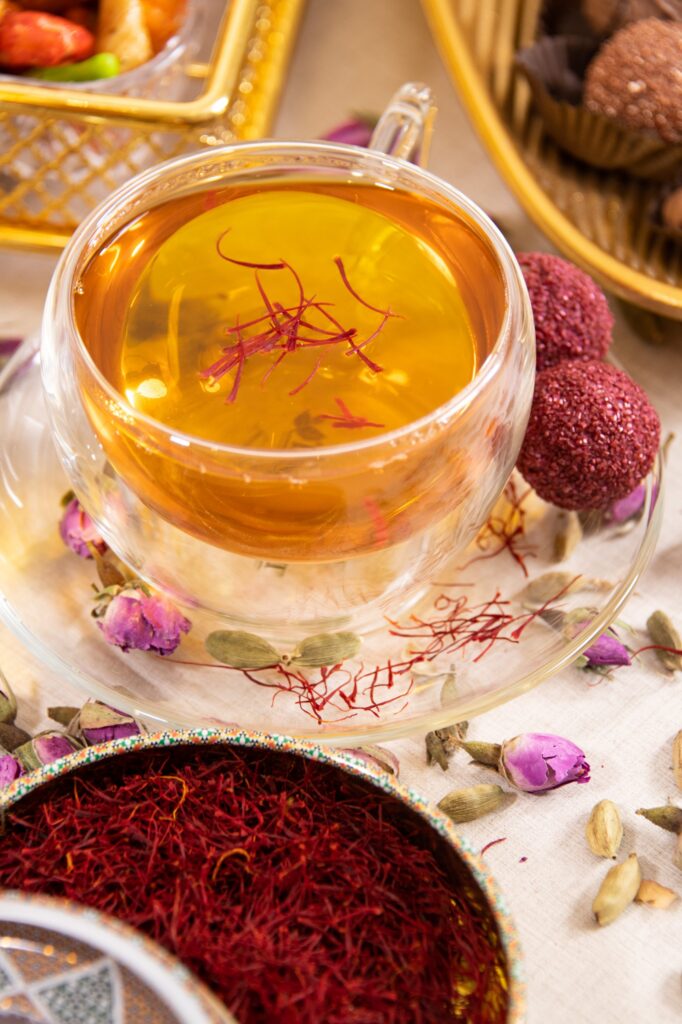
Saffron tea is a simple golden infusion made by steeping saffron threads in hot water. The recipe requires very little saffron, yet the finished drink develops a distinctive color, delicate aroma, and slightly earthy, floral flavor that feels much more elaborate than the short ingredient list suggests.
You can make saffron tea with nothing more than saffron and water, or dress it up with honey, lemon, cardamom, cinnamon, rose, or even a little black or green tea. Because the basic infusion is naturally caffeine-free, it is also an easy option when you want a warm drink without regular tea leaves.
The key is restraint. Saffron has a powerful flavor, and adding more does not necessarily make a better cup. A small pinch steeped patiently in hot water is usually all you need.
🌼 What Is Saffron Tea?
Saffron tea is an herbal-style infusion prepared from the dried red stigmas of Crocus sativus, the plant that produces the spice we know as saffron. Although it is called “tea,” a basic saffron infusion contains no leaves from the tea plant, Camellia sinensis.
That means plain saffron tea does not naturally contain caffeine. However, some traditional and modern versions combine saffron with black tea or green tea, which changes both the flavor and caffeine content.
Saffron is particularly well suited to hot-water infusions because some of its important color-producing compounds are water soluble. As the threads steep, the liquid gradually changes from clear to yellow and then to a rich golden hue.
Its aroma is harder to describe. Saffron can taste floral, earthy, grassy, slightly honey-like, and subtly bitter all at once. It is not supposed to taste intensely sweet or strongly spicy on its own.
☕ Easy Saffron Tea Recipe
This simple version lets saffron remain the dominant flavor. Once you have tried it plain, you can experiment with the variations below.
Servings: 2
Prep time: 2 minutes
Steeping time: 5–10 minutes
Total time: About 10 minutes
Ingredients
- 2 cups water
- 10–15 saffron threads, or a small pinch
- 1–2 teaspoons honey, optional
- 1 thin lemon slice, optional
You do not need to count every saffron thread precisely. The goal is simply to use a small pinch rather than a large spoonful.
🫖 How to Make Saffron Tea
1. Heat the water
Heat 2 cups of fresh water until it reaches a boil, then remove it from the heat. Let it stand briefly before pouring it over the saffron.
There is no need to aggressively boil saffron for a long period. A gentle infusion allows its color and aroma to move into the water without unnecessarily cooking the spice.
2. Lightly crush the saffron
Place the saffron threads in a teapot, heatproof pitcher, or large mug. You can leave them whole or lightly crush them between clean fingers or with the back of a spoon.
Breaking the threads into a few smaller pieces increases their contact with the water and can help the color disperse more quickly. You do not need to grind them into a fine powder.
3. Add the hot water
Pour the hot water over the saffron. Cover the cup or teapot if possible.
Almost immediately, you should notice streaks of yellow-orange color beginning to spread through the water.
4. Steep for 5–10 minutes
Allow the saffron to infuse for at least 5 minutes. For a stronger color and flavor, let it steep closer to 10 minutes.
The resulting tea should be golden rather than deep red. Saffron threads themselves are red, but their water-soluble pigments produce the characteristic yellow-gold color associated with saffron-infused foods and drinks.
5. Taste and sweeten
Taste the tea before adding anything else. If desired, stir in a small amount of honey.
A thin slice of lemon can add brightness, but use it sparingly so the citrus does not overwhelm saffron’s more delicate aroma.
Pour into cups and serve warm.
🌿 What Does Saffron Tea Taste Like?
Saffron does not taste quite like any other common kitchen spice. It has a complex combination of floral, earthy, hay-like, slightly sweet-smelling, and gently bitter characteristics.
Three naturally occurring groups of compounds contribute significantly to saffron’s sensory qualities. Crocins are closely associated with its golden color, picrocrocin contributes to its characteristic bitterness, and safranal is particularly important to its aroma.
A properly made cup should therefore have some complexity. If you expect a sweet floral tea similar to jasmine, saffron may surprise you.
Sweeteners and spices can soften that slight bitterness, but it is best to taste the plain infusion first.
🍯 Saffron Tea With Honey
Honey is one of the easiest additions to saffron tea because it provides sweetness without completely covering the spice.
Prepare the basic saffron tea, then stir approximately 1 teaspoon of honey into each cup while the tea is still warm.
Start with less honey than you think you need. Saffron’s aroma can disappear beneath a heavily sweetened drink.
For extra brightness, add a very thin slice of lemon.
🌿 Saffron and Cardamom Tea
Saffron and cardamom are a particularly natural pairing. Cardamom contributes a fragrant, citrusy-spicy aroma while still allowing saffron to remain noticeable.
For two cups, use:
- 10–15 saffron threads
- 2 cups water
- 2 green cardamom pods, lightly crushed
- Honey or sugar to taste
Add the crushed cardamom pods to the saffron before pouring in the hot water. Cover and steep for about 5–10 minutes, then strain.
The finished drink is more aromatic and spicy than plain saffron tea without becoming particularly heavy.
🍂 Saffron Cinnamon Tea
For a warmer version, add a small piece of cinnamon stick to the saffron while it steeps.
Avoid using a large amount of ground cinnamon. It can make the drink cloudy and easily overpower saffron’s subtler characteristics.
A small cinnamon stick combined with saffron, cardamom, and a little honey creates a warming spice tea that works especially well during cooler weather.
🌹 Saffron Rose Tea
Rose and saffron both have pronounced floral aromas, so they should be combined gently.
Add a few food-grade dried rose petals to your saffron before steeping. Pour over the hot water, cover, and steep for approximately 5 minutes.
Taste before sweetening. A little honey can round out the floral combination without turning it into an overly sweet drink.
Make sure any rose petals used for tea are sold for culinary use rather than flowers intended for decoration or floral arrangements.
🍋 Saffron Lemon Tea
Lemon creates a lighter, brighter cup and is particularly pleasant if you plan to serve saffron tea cold.
Brew the saffron normally, then add a squeeze of fresh lemon juice or a thin lemon slice after steeping.
It is better to start with a small amount. Too much lemon quickly becomes the dominant flavor.
Honey works especially well in this variation.
🫖 Saffron Black Tea
Saffron can also be combined with regular tea rather than served as a caffeine-free infusion.
For two cups, use:
- 10–15 saffron threads
- 2 teaspoons loose black tea or 2 black tea bags
- 2 cups hot water
- 1–2 lightly crushed cardamom pods, optional
- Honey or sugar to taste
Begin by steeping the saffron in hot water for several minutes. Add the black tea and steep according to the directions for that particular tea, generally just a few additional minutes.
Strain and sweeten to taste.
Black tea contains caffeine, so this version is no longer a caffeine-free drink.
🧊 How to Make Iced Saffron Tea
Saffron tea is equally good chilled.
Make a slightly stronger batch by steeping a small additional pinch of saffron in 2 cups of water for about 10 minutes. Add honey while the liquid is still warm if you want a sweetened tea.
Allow the tea to cool, then refrigerate until thoroughly chilled.
Serve over ice with lemon, mint, or a few rose petals.
If you pour freshly brewed hot saffron tea directly over a large glass of ice, the melting ice can dilute its already delicate flavor. Chilling it first usually produces a better result.
🟡 Why Does Saffron Turn Water Yellow?
One of the most striking parts of making saffron tea is watching a few red threads transform a cup of clear water into a golden infusion.
Saffron contains naturally occurring pigments known as crocins. These compounds are water soluble, so they readily move from the saffron into the surrounding liquid during steeping.
This is also why saffron can color rice, sauces, broths, desserts, and other dishes so effectively.
The tea should generally become yellow to golden-orange rather than bright red.
🛒 How to Choose Saffron for Tea
Whole saffron threads are usually the easiest choice when making tea because you can see what you are buying.
Look for deeply colored red threads rather than a container filled with large amounts of pale yellow plant material. The aroma should be noticeable but complex rather than simply sweet.
Ground saffron is convenient, but it can be harder for a shopper to judge its quality visually. Whole threads also make it easier to control exactly how much you add to your cup.
Since saffron is intensely flavored, a small container can last through many batches of tea.
Store it tightly sealed in a cool, dark, dry location away from heat and direct sunlight. Proper storage helps protect the compounds responsible for saffron’s characteristic color and aroma.
🌡️ How Long Should Saffron Tea Steep?
Five to 10 minutes is a convenient starting point for a simple saffron infusion.
There is some flexibility here. Research examining saffron compounds in infusions has used different temperatures and steeping times, and saffron continues releasing color into water as it sits.
If your first cup seems too delicate, try steeping it a little longer before simply adding much more saffron.
Covering the cup or teapot while it infuses can also help retain aroma.
❓ Can You Reuse Saffron Threads?
You can attempt a second infusion, although it will normally be much lighter than the first.
After making your tea, leave the saffron threads in the pot and add another round of hot water. Steep longer than you did for the first cup.
If the resulting tea has very little color or aroma, the threads have given up most of what they have to offer.
☕ Does Saffron Tea Have Caffeine?
Pure saffron tea is naturally caffeine-free because saffron comes from Crocus sativus, not from the tea plant.
However, saffron is frequently combined with black tea or green tea. Those drinks do contain caffeine unless a decaffeinated tea is used.
If avoiding caffeine is important to you, check all of the ingredients in a packaged saffron tea blend rather than assuming that the word “saffron” means the product is caffeine-free.
⚠️ A Note About Saffron and Health Claims
Saffron has attracted considerable scientific attention, and researchers have studied concentrated saffron preparations for a variety of possible health effects. However, drinking a culinary saffron infusion is not the same thing as taking standardized saffron extracts or supplements used in clinical trials.
A cup of saffron tea should therefore be treated primarily as a beverage rather than as a treatment for anxiety, depression, insomnia, inflammation, or other health conditions.
Recent safety research also makes an important distinction between saffron used as a spice in ordinary dietary quantities and larger medicinal or supplemental doses. Clinical studies of concentrated saffron can involve substantially more saffron than you would normally use to flavor a cup of tea.
If you take medications, use saffron supplements, or have a medical condition, discuss medicinal amounts of saffron with an appropriate healthcare professional.
🤰 Can You Drink Saffron Tea During Pregnancy?
Pregnancy deserves additional caution because the evidence surrounding medicinal saffron consumption during pregnancy remains limited.
Research has examined saffron during pregnancy and labor, but dose, timing, preparation, and individual circumstances matter. Higher exposures have raised particular concerns, and the available evidence is not strong enough to treat saffron as a pregnancy remedy.
Rather than using concentrated saffron tea or saffron supplements during pregnancy for a claimed health effect, ask an obstetrician, midwife, or other qualified healthcare professional for individualized guidance.
🫖 Frequently Asked Questions
How many saffron threads should I use for tea?
For a simple two-cup pot, start with a small pinch of approximately 10–15 threads. You can adjust future batches according to the strength of your saffron and your personal preference.
Should I crush saffron before making tea?
You do not have to, but lightly crushing the threads can increase their surface area and help the color disperse. Avoid pulverizing a large quantity into powder unless a recipe specifically calls for it.
Can I boil saffron?
Saffron appears in recipes that use both simmering and steeping methods, so brief heating is not unusual. For a simple cup of tea, however, there is little reason to continuously boil it. Pouring hot water over the saffron and allowing it to steep works well.
Why isn’t my saffron tea red?
That is normal. Although saffron threads are red, they release a yellow-to-golden color into water.
Can I add milk to saffron tea?
Yes. Saffron pairs well with warm milk and is used in many milk-based drinks and desserts. Brew the saffron first or infuse it directly into warm milk, then sweeten to taste.
Can I drink saffron tea cold?
Yes. Brew it hot, let it cool, and refrigerate it before serving over ice. Lemon, honey, mint, cardamom, and rose all work well in chilled versions.
Is saffron tea the same as regular tea?
Not exactly. Saffron alone produces an herbal-style infusion rather than true tea from Camellia sinensis. Some recipes combine saffron with black, green, or other true teas.
🌼 A Simple Tea Worth Making Slowly
Saffron tea demonstrates how a tiny amount of one ingredient can completely transform a cup of water. Given a few minutes to steep, the crimson threads produce a brilliant golden color, distinctive fragrance, and delicate flavor that needs very little embellishment.
Start with the simplest version: saffron, hot water, and perhaps a little honey. Once you understand saffron’s flavor on its own, experiment with cardamom, cinnamon, rose, lemon, black tea, or an iced variation.
Above all, resist the temptation to use too much. With saffron tea, a small pinch and a little patience are usually enough.
🔗 Related Articles
- Saffron Tea by Taja Tea
- How to Brew Tea: Water Temperature, Steeping Times & Brewing Methods
- Steeping into Serenity: A Tea Enthusiast’s Guide to Brewing Tea Herbs and Beyond
- Chamomile Tea: The Caffeine-Free Wonder
- Peppermint Tea: A Caffeine-Free Delight for Health and Relaxation
📚 Sources & Further Reading
- Kew Science — Crocus sativus L. and Saffron Stigma
- Plant Physiology — Crocin Biosynthesis in the Saffron Crocus
- Foods — Distribution of Main Bioactive Compounds From Saffron as a Function of Infusion Temperature and Time
- SAVEUR — Kashmiri Saffron Tea
- PubMed — Adverse Events of Saffron: Systematic Review of Current Evidence
- PubMed — Saffron and Pregnancy: Cultural Practices, Beliefs, and Safety Evidence