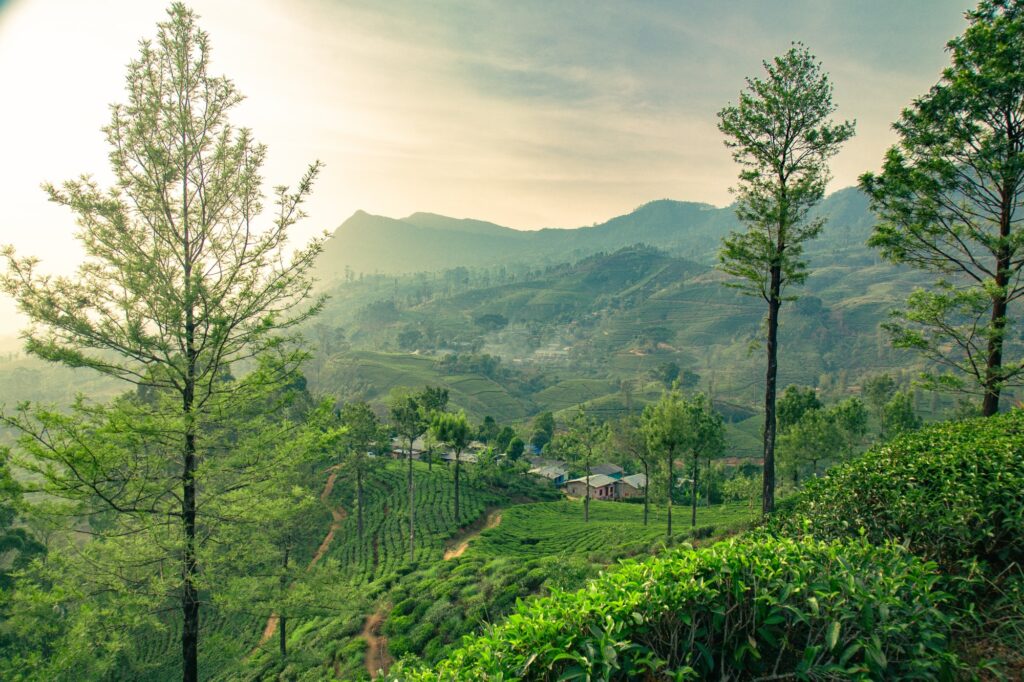
Sri Lanka may be a relatively small island, but its tea landscape is remarkably diverse. The country produces teas at elevations ranging from near sea level to high mountain slopes, and differences in altitude, rainfall, monsoon exposure, soil, and temperature give each growing region its own recognizable character.
Sri Lankan tea is still widely known as Ceylon tea, using the country’s former colonial name. Today, the Sri Lanka Tea Board recognizes seven major agro-climatic tea-growing regions: Nuwara Eliya, Uva, Uda Pussellawa, Dimbula, Kandy, Sabaragamuwa, and Ruhuna. Each is associated with particular elevations and flavor profiles.
Most Ceylon tea is black tea, but the country also produces green, white, and specialty teas. Exploring the seven regions is one of the best ways to understand just how varied Sri Lankan tea can be.
🍵 Nuwara Eliya: Delicate High-Grown Tea
Nuwara Eliya is perhaps the most famous of Sri Lanka’s tea regions. Located high in the central mountains, it has the highest average elevation of the country’s major tea districts.
Cool temperatures, mountain air, and high elevations contribute to teas that are generally lighter and more delicate than those produced at lower elevations. The Sri Lanka Tea Board describes Nuwara Eliya teas as producing the palest liquor among the principal Ceylon tea styles, with a golden color and delicate fragrance.
Good Nuwara Eliya teas can be floral, brisk, fresh, and subtly sweet. They are often enjoyed without milk so that their lighter aromatic qualities remain noticeable.
Whole-leaf grades such as Orange Pekoe can be especially elegant, making Nuwara Eliya a good region to explore if you prefer refined rather than heavily robust black tea.
⛰️ Dimbula: Bright, Mellow, and Aromatic
Dimbula lies among the mountains of central Sri Lanka between the high plateaus around Nuwara Eliya and Horton Plains.
The region includes several important tea-producing subdistricts, including Bogawantalawa, Dickoya, Kotagala, Maskeliya, Nanu Oya, and Talawakelle. Its mountainous terrain creates numerous microclimates, meaning teas from neighboring estates can vary noticeably.
Dimbula teas are generally classified as high-grown. They are known for producing a bright, golden-orange liquor with a refreshing, mellow character.
Depending on the estate and season, aromas may range from floral and citrus-like to slightly woody or spicy.
Dimbula is a useful introduction to classic high-grown Ceylon tea because it often balances brightness, fragrance, and enough body to remain satisfying.
🌿 Uva: Distinctively Aromatic Tea
On the eastern side of Sri Lanka’s central mountains lies Uva, one of the island’s most distinctive tea regions.
Uva is exposed to weather influenced by both the northeast and southwest monsoons. The mountains alter the flow of wind and rainfall, creating a seasonal period when dry winds contribute to particularly aromatic teas.
Traditional Uva tea is famous for a flavor that can be brisk, smooth, and intensely fragrant. Some examples have unusual aromatic qualities described as woody, minty, wintergreen-like, or lightly spicy.
The Sri Lanka Tea Board notes that tea bearing the Uva regional designation is grown within the defined district, generally at elevations of roughly 1,000 to 1,600 meters.
Uva tea is particularly interesting for anyone who wants to see how seasonal weather can influence the aroma of the finished cup.
🌸 Uda Pussellawa: A Small Mountain Tea Region
Uda Pussellawa is a relatively small tea-growing district located between Uva and Kandy on the eastern slopes of the central highlands.
Its subdistricts include Maturata, Ragala, and Halgranoya, and much of the surrounding landscape is mountainous and lightly populated.
Because it lies near Nuwara Eliya, Uda Pussellawa tea is sometimes compared with its more famous neighbor. However, it generally produces a darker infusion with more strength and body.
The Sri Lanka Tea Board describes its teas as medium-bodied and notably tangy, with certain seasonal teas developing a delicate floral character.
For tea drinkers who enjoy high-grown Ceylon tea but want something a little stronger than Nuwara Eliya, Uda Pussellawa is worth seeking out.
🫖 Kandy: Where Sri Lanka’s Tea Industry Began
Kandy occupies a particularly important place in Sri Lankan tea history.
It was in the hills near Kandy that James Taylor, a Scottish planter widely associated with the establishment of Sri Lanka’s commercial tea industry, began producing tea during the nineteenth century.
The region is generally considered mid-grown, with tea cultivated at elevations reaching roughly 1,300 meters.
Kandy teas tend to be stronger and fuller-bodied than the delicate teas of the highest mountain districts. They commonly produce a bright copper-colored infusion with a robust but balanced flavor.
Because of their body and strength, Kandy teas often work well with milk while still retaining plenty of tea character.
For anyone interested in both tea flavor and tea history, Kandy is an especially important region to know.
🌳 Sabaragamuwa: Rich Low-Grown Tea
Sabaragamuwa is the largest of Sri Lanka’s seven recognized tea-growing regions.
Its tea estates range from close to sea level to around 610 meters, placing Sabaragamuwa firmly within the low-grown tea category.
The warmer climate encourages faster leaf growth and contributes to teas that are generally darker and fuller than high-grown Ceylon teas.
Sabaragamuwa teas typically produce a deep reddish-brown infusion with a rich aroma. Some examples develop sweet notes reminiscent of caramel, dried fruit, or malt.
These teas are often smooth rather than sharply brisk, making them appealing to drinkers who prefer a rounded, full-bodied cup.
Their strong color and substantial flavor also make them well suited to breakfast-style tea blends.
🌴 Ruhuna: Bold Tea from Southern Sri Lanka
Farther south lies Ruhuna, another major low-grown tea district.
The region occupies part of southern Sri Lanka’s wet zone, where warm temperatures and abundant rainfall provide excellent conditions for vigorous tea growth.
Ruhuna tea is generally dark, strong, and full-flavored. Depending on the leaf grade and estate, it can display notes of malt, honey, dried fruit, wood, or caramel.
The leaves themselves are often relatively large and dark, while the brewed tea can have an especially deep reddish color.
Ruhuna teas have historically been popular in markets that favor strong black tea, particularly in parts of the Middle East.
If Nuwara Eliya represents the lightest and most delicate side of Ceylon tea, Ruhuna demonstrates the opposite end of the spectrum: warm-grown, dark, rich, and powerful.
🏔️ High-Grown, Mid-Grown, and Low-Grown Ceylon Tea
Sri Lankan tea is often described by elevation as well as by region.
High-grown teas generally come from the mountainous central districts and are typically grown above approximately 1,200 meters. Nuwara Eliya, Dimbula, Uva, and parts of Uda Pussellawa are commonly associated with this category.
High-grown teas are often lighter, brighter, and more aromatic.
Mid-grown teas, including much of the tea produced around Kandy, tend to combine fragrance with greater body.
Low-grown teas, particularly those from Ruhuna and Sabaragamuwa, are cultivated in warmer areas at lower elevations. They frequently produce darker liquors with richer, heavier, and sometimes sweeter flavors.
These categories are helpful, but elevation alone does not determine quality. Estate location, weather, cultivar, harvesting season, and processing all influence the finished tea.
🌦️ How the Monsoons Shape Sri Lankan Tea
Sri Lanka’s tea regions are strongly influenced by two major monsoon systems.
The southwest monsoon generally brings rain to western and southern areas between roughly May or June and September, while the northeast monsoon primarily affects eastern portions of the island later in the year.
Sri Lanka’s central mountains act as a massive barrier, altering wind and rainfall patterns.
When moist winds release much of their rain on one side of the mountains, the air crossing the central ridge can become much drier. These seasonal periods can create what the Sri Lankan tea industry calls quality seasons, during which particular tea regions produce especially desirable aromatic characteristics.
That is why the same estate can produce noticeably different tea at different times of year.
🌱 Why Sri Lankan Tea Varies So Much
Tea plants are highly responsive to their environment.
Elevation affects temperature and growth rate, while rainfall determines how quickly new shoots develop. Sunshine, wind, soil composition, humidity, and nighttime temperatures all influence the leaves.
Sri Lanka’s steep and complex terrain creates numerous microclimates. Even hillsides within the same estate can produce teas with subtle differences.
The Sri Lanka Tea Board notes that variables including plant material, soil, weather, altitude, and exposure can all affect the final tea.
Processing adds another layer of variation. Most Ceylon tea is oxidized into black tea, but leaf grade, rolling method, oxidation time, drying, and sorting can all influence strength and flavor.
🍃 What Does “Ceylon Tea” Mean?
Ceylon was the name used for Sri Lanka during the British colonial period and for several decades afterward. The country officially became Sri Lanka in 1972, but the name Ceylon tea remained because it had already become internationally recognized.
Today, the term refers to tea produced in Sri Lanka.
Regional names such as Uva, Dimbula, Ruhuna, and Nuwara Eliya are more specific. Their commercial use is controlled, and tea carrying one of these regional designations must meet geographic and production requirements established for that district.
The well-known Ceylon Tea Lion Logo is also used to identify qualifying tea that is entirely Sri Lankan in origin and meets standards established by the Sri Lanka Tea Board.
☕ Where to Begin Exploring Ceylon Tea
One of the easiest ways to understand Sri Lankan tea is to taste teas from different elevations side by side.
Start with a Nuwara Eliya tea if you prefer something delicate, floral, and light.
Try Dimbula for a classic bright high-grown tea with a little more body.
Choose Uva if you want something especially aromatic and distinctive.
A Kandy tea offers a stronger, fuller introduction to Sri Lanka’s mid-elevation tea country.
Then compare those with a Ruhuna or Sabaragamuwa tea. Their darker color, richer body, and sweeter or maltier flavors demonstrate just how much the character of tea changes as cultivation moves toward Sri Lanka’s warmer lowlands.
Tasting these teas together can make the influence of geography much easier to recognize.
🌍 Seven Regions, Many Different Cups
Sri Lanka’s tea industry is often summarized by one familiar phrase: Ceylon tea. In reality, however, that name encompasses an extraordinary range of styles.
The cool mountains of Nuwara Eliya, the fragrant highlands of Uva, the bright teas of Dimbula, the tangy character of Uda Pussellawa, the full-bodied teas of Kandy, and the rich low-grown teas of Sabaragamuwa and Ruhuna all tell different parts of the same story.
Learning these regional names makes shopping for Ceylon tea more interesting because the place of origin begins to offer clues about what may be waiting in the cup.
And just as with the tea regions of China and Japan, exploring Sri Lanka region by region turns tea drinking into a journey through landscape, climate, history, and tradition.
🔗 Related Articles
📚 Sources & Further Reading
- Sri Lanka Tea Board — Tea Growing Regions
- Sri Lanka Tea Board — Nuwara Eliya
- Sri Lanka Tea Board — Dimbula
- Sri Lanka Tea Board — Uda Pussellawa
- Sri Lanka Tea Board — Kandy
- Sri Lanka Tea Board — Sabaragamuwa
- Sri Lanka Tea Board — Ruhuna
- Sri Lanka Tea Board — Tea Cultivation