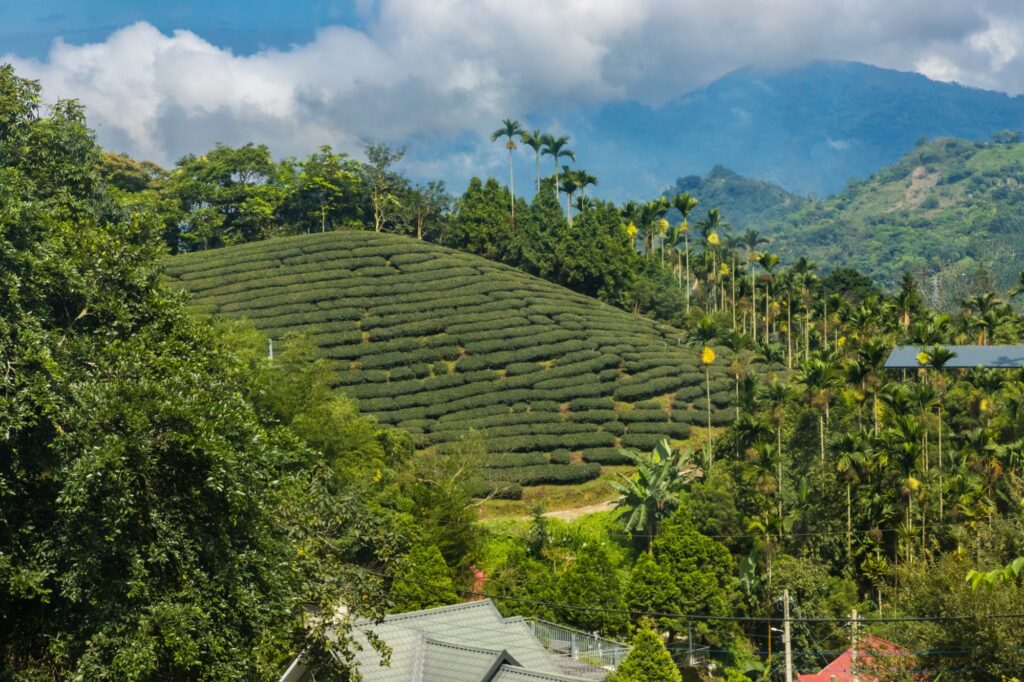
Taiwan has one of the most distinctive tea cultures in the world. Although the island is relatively small, its steep mountains, subtropical climate, frequent mist, varied elevations, and highly skilled tea-making traditions create an impressive range of teas.
Taiwan is especially famous for oolong, including lightly oxidized floral teas, roasted mountain oolongs, traditional Tieguanyin-style teas, and the celebrated Oriental Beauty. Black tea is also important, particularly around Sun Moon Lake, while green and white teas are produced in smaller quantities.
The island’s tea regions are often defined as much by mountain range and elevation as by political boundaries. Names such as Alishan, Lishan, Dong Ding, Pinglin, Muzha, and Sun Moon Lake have become closely associated with particular tea styles.
⛰️ Alishan: Fragrant High Mountain Oolong
Alishan, in Chiayi County, is one of Taiwan’s most famous high-mountain tea regions.
Tea gardens are planted across cool mountain slopes where mist, cloud cover, and relatively low temperatures slow the growth of the tea leaves. These conditions help produce teas with a smooth texture and highly aromatic character.
Alishan oolong is usually lightly oxidized and rolled into tight balls. When brewed, the leaves gradually unfurl and release a fragrance that can suggest orchids, cream, fresh vegetation, and sweet flowers.
The tea is typically soft rather than strongly bitter, with a lingering sweetness that makes it especially approachable for people new to Taiwanese oolong.
Different villages and elevations within the Alishan area produce subtly different teas, so Alishan should be thought of as a broad mountain tea region rather than a single uniform style.
🌄 Lishan: Some of Taiwan’s Highest Tea Gardens
Lishan, or Pear Mountain, is known for some of Taiwan’s highest-elevation commercial tea gardens.
Located in the mountainous interior of central Taiwan, many Lishan gardens sit well above 1,500 meters. Cool temperatures and frequent mist create slow-growing conditions that can produce exceptionally fragrant leaves.
Lishan oolongs are usually lightly oxidized and prized for their refined aroma, thick mouthfeel, and persistent sweetness.
Common tasting descriptions include orchid, lily, cream, alpine flowers, and fresh green vegetation.
Because high-altitude farming is difficult and yields can be limited, genuine Lishan tea is often more expensive than tea from lower elevations.
🌿 Dayuling: Ultra-High Mountain Tea
Dayuling is another celebrated high-elevation tea area in central Taiwan.
Tea gardens in and around Dayuling have historically been among the highest on the island, creating some of Taiwan’s most sought-after high mountain oolongs.
The tea is generally delicate, aromatic, and exceptionally smooth, with floral sweetness and a long finish.
However, tea production in some very high mountain areas has been reduced because of environmental conservation efforts and restrictions on agriculture in sensitive mountain zones.
For that reason, tea marketed as Dayuling can vary greatly in authenticity and origin. Buyers interested in true high-elevation tea should purchase from reputable sellers that clearly state where the leaves were grown.
🍃 Shanlinxi: Cool Forested Mountain Tea
Shanlinxi, in Nantou County, is another important high mountain oolong region.
Its forests, cool climate, and frequent fog create excellent conditions for slow tea growth.
Shanlinxi oolong is often floral and fresh, but it can have a slightly deeper or more herbaceous character than some Alishan teas.
Notes may suggest wildflowers, pine, herbs, cream, or fresh mountain vegetation.
The region is popular among tea drinkers who enjoy high mountain oolong but want something with a little more structure and complexity.
🫖 Dong Ding: Taiwan’s Classic Roasted Oolong
Dong Ding, or Tung Ting, is one of Taiwan’s most historically important oolong tea names.
The tea is associated with the Lugu area of Nantou County, where tea cultivation developed during the nineteenth century.
Traditional Dong Ding oolong is usually more oxidized and more heavily roasted than many modern high-mountain oolongs.
This roasting can create warm flavors reminiscent of toasted nuts, caramel, baked fruit, honey, and wood.
Modern Dong Ding teas vary considerably. Some are lightly roasted and relatively floral, while others follow a more traditional style with deeper oxidation and heavier roasting.
Dong Ding is an excellent choice for tea drinkers who want to explore the roasted side of Taiwanese oolong.
🌸 Pinglin: Baozhong Tea Country
Pinglin, in the hills southeast of Taipei, is famous for Baozhong, also known as Pouchong tea.
Baozhong is one of the lightest-oxidized forms of oolong and can taste surprisingly close to green tea.
Unlike many Taiwanese oolongs, which are tightly rolled, Baozhong leaves are generally twisted into long, loose strips.
Good Pinglin Baozhong is intensely fragrant, with floral notes often compared to gardenia, lilac, orchid, or jasmine.
Its flavor is fresh, silky, and lightly sweet, with relatively little roast character.
For drinkers who enjoy floral teas, Pinglin Baozhong is one of Taiwan’s most distinctive regional specialties.
🌺 Muzha: Traditional Tieguanyin
The Muzha district of Taipei is known for a Taiwanese interpretation of Tieguanyin.
Tieguanyin originated in Fujian Province in China, but immigrants brought the cultivar and processing traditions to Taiwan.
Muzha Tieguanyin is traditionally more oxidized and roasted than many modern mainland Chinese Tieguanyin teas.
The result is a tea with deeper flavors that may suggest roasted nuts, dried fruit, caramel, spice, flowers, and minerals.
Repeated roasting and careful finishing can give good Muzha Tieguanyin exceptional depth.
This style is especially appealing to people who prefer darker, more traditional oolongs over bright, lightly oxidized mountain teas.
🦋 Hsinchu and Miaoli: Oriental Beauty
Northern Taiwan, particularly Hsinchu and Miaoli Counties, is famous for Oriental Beauty, one of the island’s most unusual teas.
The tea is also known by names including Bai Hao Oolong, Dongfang Meiren, and Peng Feng Cha.
Its distinctive character depends partly on tiny insects commonly called tea green leafhoppers. When these insects feed on the tea plants, the plants respond chemically, altering the aroma compounds that later appear in the finished tea.
Only leaves affected by this insect activity are used for the most traditional versions of the tea.
Oriental Beauty is relatively highly oxidized for an oolong. It produces a rich amber infusion with flavors that can suggest honey, ripe fruit, muscat grapes, flowers, and spice.
Unlike many other Taiwanese oolongs, Oriental Beauty is typically not heavily roasted.
The tea is one of the clearest examples of how local ecology can influence the flavor of tea.
🌊 Sun Moon Lake: Taiwan’s Black Tea Region
The area around Sun Moon Lake in Nantou County is particularly famous for black tea.
Black tea production in Taiwan expanded during the Japanese colonial period, when tea researchers introduced Assam-type tea plants suited to the warm climate around the lake.
Today, the region is especially associated with Taiwan Tea No. 18, commonly called Ruby Red or Red Jade.
This cultivar was developed by crossing Taiwanese native tea plants with Assam tea.
Ruby Red black tea can have a highly distinctive aroma, often described as naturally reminiscent of cinnamon, mint, menthol, fruit, or spice.
Sun Moon Lake also produces black tea from other cultivars, including Assam varieties and indigenous Taiwanese tea plants.
For anyone exploring Taiwanese tea beyond oolong, Sun Moon Lake is one of the most important regions to know.
🌱 Yuchi: The Heart of Taiwanese Black Tea
Yuchi Township surrounds much of the Sun Moon Lake area and is frequently used as a regional designation for its black teas.
Warm temperatures, hills, abundant rainfall, and relatively humid conditions make the area particularly suitable for large-leaf tea varieties.
The Taiwan Tea Research and Extension Station has played an important role in developing cultivars and improving tea production in this area.
In addition to Ruby Red, teas from Yuchi may be made from Taiwan Tea No. 8, Assam varieties, and local cultivars.
These black teas tend to be aromatic and full-bodied while retaining a distinctive Taiwanese character.
🌄 Yushan: High Mountain Tea from Central Taiwan
Yushan, or Jade Mountain, is Taiwan’s highest mountain, and the surrounding region also supports high-elevation tea production.
Tea gardens in the broader Yushan area benefit from cool temperatures, mountain fog, and large temperature differences between day and night.
Yushan oolongs are often floral, creamy, smooth, and sweet.
They share some characteristics with teas from Alishan and Lishan but can have their own balance of aroma, body, and freshness depending on the specific garden and elevation.
Because mountain names are sometimes used broadly in tea marketing, precise farm origin can be useful when comparing teas.
🌴 Taitung: Emerging Tea Traditions in Eastern Taiwan
Eastern Taiwan has historically been less dominant in commercial tea production than central and northern regions, but areas such as Taitung have developed interesting specialty teas.
The warm climate and mountainous terrain allow producers to experiment with oolong and black tea styles.
Some eastern Taiwanese teas emphasize fruity aromas, while others make use of local cultivars and distinctive processing methods.
Although Taitung is not as internationally famous as Alishan or Dong Ding, it demonstrates how Taiwan’s tea industry continues to evolve beyond its traditional centers.
🏔️ What Does “High Mountain Tea” Mean in Taiwan?
The term high mountain tea, or gaoshan cha, is widely used for Taiwanese oolongs grown at higher elevations.
There is no single universally applied altitude cutoff, but the term generally refers to teas grown at roughly 1,000 meters or higher.
Famous high mountain areas include Alishan, Lishan, Shanlinxi, Yushan, and historically Dayuling.
Higher elevations create cooler temperatures and slower plant growth. Tea gardens are also frequently covered in mist and cloud.
These conditions can contribute to softer textures, pronounced floral aromas, sweetness, and relatively low bitterness.
However, altitude alone does not guarantee quality. Cultivar, farming practices, harvest timing, processing, oxidation, and roasting are equally important.
🌿 Taiwan’s Most Important Tea Cultivars
Taiwanese tea owes much of its diversity to the cultivars grown across the island.
Qing Xin Oolong is one of the classic cultivars used for high mountain tea and traditional oolong.
Jin Xuan, officially Taiwan Tea No. 12, is often called Milk Oolong because certain well-made examples can have naturally creamy or buttery aromas. Authentic Jin Xuan does not require added milk flavoring.
Si Ji Chun, or Four Seasons Spring, is known for vigorous growth and a strong floral fragrance.
Cui Yu, Taiwan Tea No. 13, is another aromatic cultivar frequently used for lightly oxidized oolong.
For black tea, Taiwan Tea No. 18, or Ruby Red, is especially important around Sun Moon Lake.
The combination of cultivar and region is often just as important as the tea style itself.
🔥 Oxidation and Roasting Matter as Much as Region
Taiwanese tea demonstrates particularly clearly that geography is only part of the story.
A lightly oxidized Alishan oolong might be intensely floral and creamy, while a heavily roasted Dong Ding can taste nutty, caramelized, and warm.
Pinglin Baozhong undergoes very light oxidation, while Oriental Beauty is comparatively highly oxidized.
Muzha Tieguanyin adds substantial roasting, while high mountain oolongs are often only lightly roasted so their fresh floral aromas remain prominent.
Two teas grown from the same cultivar can therefore taste dramatically different depending on how the leaves are processed.
🍵 Where to Begin Exploring Taiwanese Tea
For a first introduction to Taiwanese tea, Alishan oolong is an excellent starting point. Its floral fragrance, smooth texture, and gentle sweetness represent the modern high mountain style.
Next, try Dong Ding to experience how roasting changes oolong.
A Pinglin Baozhong provides an even lighter and more floral contrast.
For something richer and fruitier, try Oriental Beauty from Hsinchu or Miaoli.
Tea drinkers who prefer black tea should seek out Ruby Red from Sun Moon Lake, while fans of darker roasted teas may especially enjoy Muzha Tieguanyin.
Trying several of these teas side by side reveals just how broad Taiwan’s tea spectrum really is.
🌏 A Small Island with Remarkable Tea Diversity
Taiwan’s tea regions demonstrate how dramatically elevation, climate, cultivar, ecology, and processing can shape a cup of tea.
The misty slopes of Alishan and Lishan produce elegant high mountain oolongs. Dong Ding preserves a tradition of roasted tea, while Pinglin is famous for fragrant Baozhong.
Hsinchu and Miaoli produce the honeyed complexity of Oriental Beauty, Muzha maintains its roasted Tieguanyin tradition, and Sun Moon Lake has established Taiwan as a producer of distinctive black tea as well as oolong.
Learning these place names makes Taiwanese tea much easier to explore. Rather than seeing Taiwan simply as an oolong-producing island, you begin to see a landscape of individual mountain districts, cultivars, and tea-making traditions, each creating something different in the cup.
🔗 Related Articles
📚 Sources & Further Reading
- Taiwan Tea Research and Extension Station — Tea Research and Taiwanese Tea
- Taiwan Ministry of Agriculture — Tea Industry Information
- Taiwan Agriculture and Food Agency
- New Taipei City Government — Pinglin and Baozhong Tea
- Nantou County Government — Agriculture and Regional Tea Production
- Taiwan Tourism Administration — Tea Culture and Tea-Growing Areas