At the southern end of Japan’s main islands, Kagoshima has developed into one of the country’s great tea-producing regions. Its warm climate, abundant sunshine, broad agricultural plains and unusually diverse selection of tea cultivars allow growers to produce teas with a character quite different from those of Uji or Shizuoka.
Kagoshima is particularly known for sencha and deep-steamed green tea, but the region is much more diverse than that. Farmers grow cultivars such as Yutakamidori, Saemidori, Asatsuyu and Asanoka alongside the familiar Yabukita. Producers make shaded teas, tencha for matcha, Japanese black tea and teas intended for everything from careful loose-leaf brewing to bottled drinks.
The prefecture also contains several very different tea landscapes. Vast fields spread across Minamikyūshū around Chiran and Ei, misty gardens lie beneath the mountains of Kirishima, and some of Japan’s earliest spring teas emerge on the subtropical island of Tanegashima.
Kagoshima may once have lived in the shadow of better-known Japanese tea names, but that is increasingly difficult to justify. To understand modern Japanese tea, Kagoshima has become essential.
🍵 What Is Kagoshima Tea?
Kagoshima tea, or Kagoshima-cha, refers broadly to tea produced throughout Kagoshima Prefecture.
The prefecture extends from southern Kyushu across numerous islands, creating a remarkable range of growing conditions. Tea is cultivated from warm lowland plains to cooler northern and mountain districts, as well as on islands such as Tanegashima and Yakushima.
This geographical range allows Kagoshima farmers to grow early-, middle- and late-budding cultivars and to harvest tea across an unusually long season.
Most Kagoshima tea is green tea, with sencha remaining central, but the region also produces deep-steamed tea, kabusecha, tencha for matcha, black tea and other styles.
That diversity is one of Kagoshima’s defining characteristics.
🌋 Southern Japan Creates a Different Tea Environment
Kagoshima occupies the southern tip of Kyushu, far from the cooler tea districts around Kyoto.
The warmer climate gives tea plants an earlier start in spring. In the southern islands, the first harvest can begin around the end of March, weeks before many more northerly Japanese tea regions are ready to pick.
Sunshine is abundant, and long growing periods allow several harvests over the year.
The landscape is also strongly shaped by volcanic activity. Much of southern Kyushu is covered by volcanic soils and ash deposited during eruptions over thousands of years.
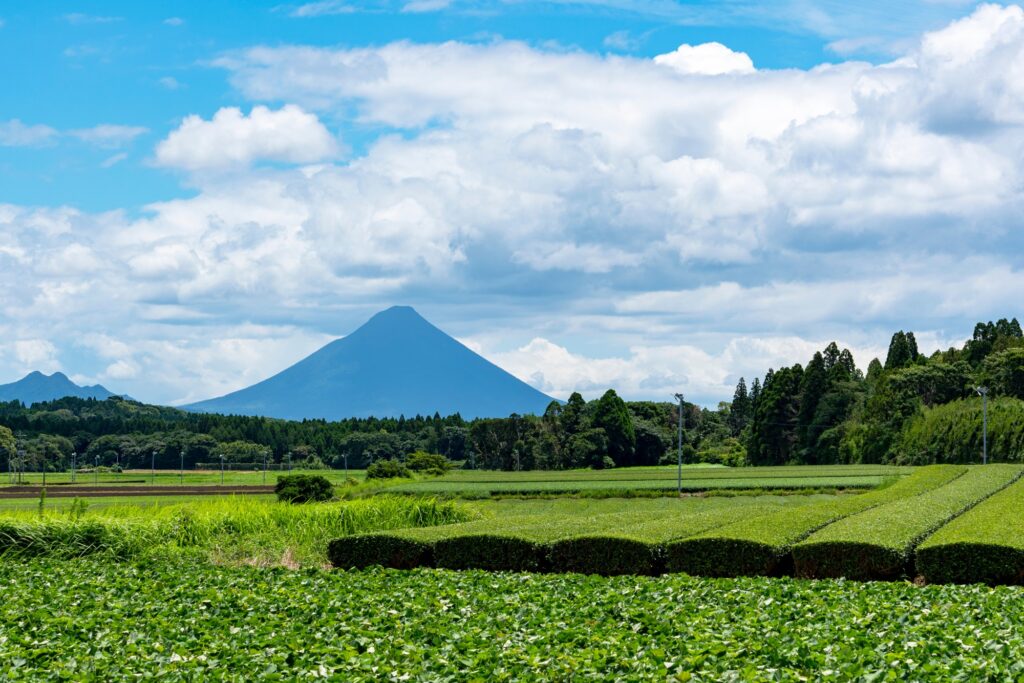
Mountains and volcanic peaks remain visible from many tea-growing areas. Around Chiran, some of the most memorable tea landscapes combine meticulously maintained green fields with the cone of Mount Kaimon rising in the distance.
🌱 Kagoshima Produces Some of Japan’s Earliest New Tea
The arrival of shincha, or new spring tea, is eagerly anticipated throughout Japan.
Kagoshima begins especially early.
On Tanegashima, warm island conditions allow the first young shoots to be harvested from around late March. These extremely early teas are often referred to as hashiri shincha, meaning roughly the first or earliest new tea of the season.
As spring moves northward through Kagoshima, additional tea districts begin their own first harvests.
This creates an unusually long first-tea season within a single prefecture.
The earliest tea is not automatically the finest tea, but it carries a special freshness and seasonal excitement. Drinking shincha is as much about welcoming spring as evaluating tea quality.
🏯 Kagoshima Tea Has Centuries of History
Tea has been grown in Kagoshima for hundreds of years, although the historical record includes several origin stories.
One tradition says that tea was introduced to the area around present-day Minamisatsuma roughly 800 years ago. Another connects early cultivation with seeds brought from Uji to a temple in what is now Yusui during the medieval period.
Tea cultivation later received encouragement under the Satsuma domain.
Kagoshima’s development into a massive modern tea-producing area, however, happened comparatively recently. Large-scale expansion accelerated in the decades after the Second World War as growers, agricultural organizations and local authorities invested heavily in production.
This makes Kagoshima an interesting contrast with Uji.
Uji’s identity is strongly associated with centuries of elite tea culture and ceremony. Kagoshima combines historical roots with an unusually modern agricultural industry.
🫖 Kagoshima Once Produced Large Amounts of Black Tea
Kagoshima’s tea history has not always centered almost exclusively on green tea.
During the postwar period, the prefecture became an important producer of black tea. Japanese black tea was grown for both domestic use and export, and Kagoshima’s warm climate made it well suited to cultivars developed for black-tea production.
The industry declined after imported black tea became more accessible and economically competitive, leading many producers to shift toward green tea.
Yet black tea never disappeared completely.
Today, Japanese black tea, or wakōcha, is experiencing renewed interest, and Kagoshima has once again become a significant producer.
Cultivars such as Benifūki reveal another side of the region beyond sencha and matcha.
🌿 Chiran Is Kagoshima’s Most Famous Tea Name
Among Kagoshima’s tea districts, Chiran is probably the best known internationally.
Chiran lies within Minamikyūshū City in southern Kagoshima. The municipality also incorporates major tea-growing areas around Ei and Kawanabe, creating an immense concentration of tea production.
The broad fields are ideally suited to efficient cultivation and mechanical harvesting. Long lines of tea bushes stretch over gently rolling land, often with Mount Kaimon visible in the distance.
Tea from the wider Minamikyūshū area is marketed under the Chiran Tea name.
The region produces multiple styles and cultivars rather than one narrowly defined tea. Deep-steamed sencha is especially common, but shaded teas and cultivar-specific teas also appear.
If someone encounters a package labeled Chiran-cha, they are tasting tea from the heart of modern Kagoshima production.
🌱 Chiran Is Enormous by Japanese Tea Standards
The scale of Minamikyūshū tea production is remarkable.
Rather than being a collection of tiny gardens hidden among mountains, much of the area consists of broad, highly organized fields that allow farmers to use riding harvesters and other specialized machinery.
This does not mean quality is sacrificed for scale.
Modern cultivation allows producers to control harvest timing carefully and process freshly cut leaves quickly, which is extremely important for Japanese green tea.
The region has also invested heavily in quality management and agricultural certification.
The result is a tea industry capable of producing both large commercial volumes and highly regarded competition-grade teas.
Kagoshima challenges the assumption that excellent tea must always come from tiny hand-picked gardens.
🌫️ Kirishima Offers a Different Side of Kagoshima Tea
Kirishima feels very different from the open southern plains.
The region lies around mountainous volcanic terrain in northern Kagoshima, where mist is common and elevation creates cooler growing conditions.
Even the name Kirishima evokes fog—the landscape is famous for mist settling around its mountains and tea gardens.
Tea from Kirishima is often prized for fragrance and refinement. The cooler conditions can slow leaf development compared with warmer southern districts, helping create aromatic teas with a different balance from the rich, deep-steamed styles often associated with Chiran.
Kirishima is also notable for its work with organic tea.
The region has become an important center for organic-certified Japanese tea and has produced organic tencha for matcha as well as sencha and other styles.
🌴 Tanegashima Produces Exceptionally Early Tea
Tanegashima lies south of mainland Kyushu and has an even warmer climate than much of mainland Kagoshima.
That makes it one of Japan’s earliest tea-growing areas.
Tea harvested around Nishinoomote and other parts of the island can reach the market beginning around late March, giving Kagoshima its reputation for producing Japan’s earliest shincha.
Tanegashima is also interesting for cultivar exploration.
Warm conditions allow growers to work successfully with cultivars that may be more vulnerable to cold farther north.
For tea drinkers interested in seasonal differences, a very early Tanegashima shincha provides an interesting comparison with spring teas harvested weeks later in Shizuoka or Kyoto.
🌲 Yakushima Adds Another Island Tea Landscape
Yakushima is famous internationally for ancient cedar forests, mountains and enormous rainfall, but tea is also cultivated on the island.
The growing environment is lush, humid and markedly different from Kagoshima’s broad mainland plains.
Tea production is much smaller than in Minamikyūshū, which makes Yakushima teas especially interesting for drinkers who enjoy small regional origins.
Organic cultivation is also important among some island producers.
A Yakushima sencha may not be representative of Kagoshima tea as a whole, but that is precisely why it is worth trying.
Kagoshima contains so many different environments that the exceptions are part of the story.
🌱 Yutakamidori Is a Signature Kagoshima Cultivar
One of the most important cultivars in Kagoshima is Yutakamidori.
It is an early-budding cultivar well suited to warmer growing districts, and it occupies a substantial portion of Kagoshima’s tea acreage.
Yutakamidori responds particularly well to shading before harvest and deep steaming afterward.
The finished tea can be richly colored, smooth and full-bodied, with pronounced sweetness and umami.
Compared with Yabukita, Yutakamidori often produces a cup that feels softer and more immediately lush.
For anyone exploring Kagoshima tea by cultivar, Yutakamidori is one of the most logical places to start.
💚 Saemidori Is Known for Sweetness and Color
Saemidori is another cultivar strongly associated with southern Japanese tea.
The name suggests vivid or clear green, and the cultivar is known for producing beautifully colored infusions.
Saemidori contains relatively high levels of amino acids and lower levels of some bitter catechins, contributing to a sweeter and less astringent cup.
The cultivar is especially valued for high-quality sencha and shaded teas.
Its tender character makes it particularly appealing to tea drinkers who enjoy strong umami without aggressive bitterness.
Saemidori is now cultivated outside Kagoshima as well, but the warm climate of southern Kyushu has helped make it one of the region’s standout varieties.
🍃 Asatsuyu Is Sometimes Called Natural Gyokuro
Another cultivar worth knowing is Asatsuyu.
It is famous for rich umami, sweetness and deep green color. Because of its naturally mellow character, it has sometimes been nicknamed “natural gyokuro.”
The comparison should not be taken too literally.
Gyokuro is defined primarily by cultivation and processing methods rather than cultivar alone, and Asatsuyu sencha remains sencha.
Still, the nickname communicates something useful about the flavor.
Well-made Asatsuyu can be remarkably soft, savory and rich even without the prolonged shading associated with true gyokuro.
Deep steaming and pre-harvest covering can intensify those qualities further.
🌿 Asanoka Was Developed in Kagoshima
Asanoka adds another dimension to Kagoshima’s cultivar diversity.
It was developed in Kagoshima and is known for having substantial levels of both amino acids and catechins.
In the cup, that can translate into pronounced sweetness and umami balanced by more noticeable astringency.
That combination gives Asanoka a more assertive personality than some of the region’s exceptionally soft cultivars.
Tea drinkers who enjoy comparing single-cultivar Japanese greens can learn a great deal by tasting Yutakamidori, Saemidori and Asanoka side by side.
All may come from Kagoshima.
None tastes exactly the same.
🌱 Yabukita Is Less Dominant Here
Yabukita dominates Japanese tea production nationally, but Kagoshima is unusual because it relies on it much less heavily than many other tea prefectures.
The warmer climate allows farmers to grow a broader assortment of cultivars with different budding times.
That diversity has practical advantages.
If every field contained the same cultivar, all the tea might become ready for harvest at roughly the same moment. By combining early-, mid- and late-budding cultivars, producers can spread the harvest across a longer period.
The approach also produces enormous flavor diversity.
For tea drinkers, Kagoshima is therefore one of the best regions in Japan for exploring cultivar-specific tea.
⛅ Shading Is Important in Kagoshima Tea
Some Kagoshima teas are covered with dark material for a period before harvest.
Reducing sunlight changes the chemistry of the growing leaves, helping retain amino acids associated with sweetness and umami while moderating the development of some bitter compounds.
The Kagoshima Tea Producers Association specifically describes pre-harvest covering as part of the region’s approach to balancing sweetness and astringency.
Cultivars such as Yutakamidori and Asatsuyu can respond especially well to this treatment.
A shaded Kagoshima sencha can therefore offer impressive richness without necessarily being classified as gyokuro.
When shopping, look for terms such as kabuse or information explaining that the field was covered before harvest.
💚 Deep-Steamed Tea Is Common
Deep steaming, or fukamushi, is another important processing choice.
As in Shizuoka, the freshly harvested leaves are steamed to halt oxidation. A longer steaming period softens the leaves more substantially than standard steaming.
During later rolling and drying, those softened leaves break into smaller pieces.
The resulting tea may not look as pristine or needle-like as lightly steamed sencha, but once brewed it can produce an intensely green, opaque cup with substantial body.
Deep steaming also tends to moderate some astringency and emphasize a rounder, richer flavor.
Many Kagoshima cultivars respond beautifully to this approach.
Yutakamidori fukamushi is a particularly classic combination.
🍵 Kagoshima Sencha Can Be Rich and Accessible
Kagoshima sencha frequently offers an appealing combination of sweetness, body and moderate astringency.
That makes it a very approachable region for people beginning to explore higher-quality Japanese green tea.
A deep-steamed Kagoshima sencha can produce obvious flavor quickly without requiring extremely precise brewing.
At the same time, the prefecture produces enough varieties and styles to keep experienced tea drinkers occupied for years.
A lightly steamed tea from a cooler northern garden may emphasize aroma.
A shaded Saemidori might be remarkably sweet.
Yutakamidori fukamushi can be dense and vegetal.
Kirishima tea may be fragrant and elegant.
“Kagoshima sencha” is therefore a starting category rather than a final flavor description.
🍵 Kagoshima Matcha Is Becoming Increasingly Important
Matcha production is no longer centered exclusively on traditional regions around Kyoto and Aichi.
Kagoshima has dramatically expanded production of tencha, the leaf material used to make matcha.
Tea plants destined for tencha are shaded before harvest. After picking, the leaves are steamed and dried without the intensive rolling used for sencha. Stems and veins can later be removed before the remaining leaf material is ground into matcha.
Kagoshima’s broad fields, warm climate and cultivar diversity give producers considerable flexibility in growing tencha.
The region’s rise in matcha is particularly interesting because it represents a new chapter in Kagoshima tea rather than simply a continuation of centuries-old ceremonial production.
Modern demand is reshaping the tea fields.
🍂 Kagoshima Also Produces Japanese Black Tea
The same cultivar diversity that benefits green tea also supports wakōcha, Japanese black tea.
Black tea is fully oxidized rather than steamed immediately to preserve green color.
Cultivars developed partly for black tea, including Benifūki, can produce fruity, floral and sometimes gently spicy infusions.
Kagoshima’s historical experience with black tea gives modern producers an existing foundation to build upon.
Some tea farms now experiment with black, oolong and other styles alongside sencha.
For someone exploring Kagoshima beyond green tea, wakōcha is one of the most interesting directions to take.
🚜 Flat Tea Fields Encourage Mechanization
A striking feature of Kagoshima tea agriculture is how much of it takes place on relatively flat land.
This allows growers to use riding harvesters and other mechanized equipment efficiently.
Large machines move along precisely shaped rows, cutting the new shoots quickly at the correct height.
Mechanization matters because fresh tea leaves need to reach processing facilities rapidly after harvest. Once picked, the leaf immediately begins changing.
Efficient harvesting and nearby processing allow very large quantities of leaf to be handled while protecting freshness.
The visual effect is distinctive too.
Kagoshima fields often consist of beautifully uniform green rows spreading toward the horizon.
🌋 What Does Volcanic Soil Do for Tea?
Kagoshima is an intensely volcanic region.
Volcanic ash soils cover substantial areas of southern Kyushu, and tea growers have learned to cultivate successfully within those conditions.
It is tempting to attribute a specific flavor directly to “volcanic soil,” but tea terroir is more complicated than that.
Soil structure, drainage, organic matter, fertilizer management, rainfall, cultivar, sunlight and processing all work together.
The more useful point is that Kagoshima growers have developed tea agriculture suited to a landscape shaped by volcanoes.
The tea fields beneath Mount Kaimon or around the Kirishima volcanic region are inseparable from that geology, even if no single tasting note can be reduced simply to volcanic ash.
👃 What Does Kagoshima Tea Taste Like?
There is no single Kagoshima flavor.
Nevertheless, many popular Kagoshima teas emphasize richness, sweetness and strong green color.
Deep-steamed Yutakamidori may taste full, vegetal and savory with relatively gentle astringency.
Saemidori can be softer and sweeter.
Asatsuyu may deliver particularly pronounced umami.
Teas from cooler northern or mountain areas may place greater emphasis on fragrance.
Processing can matter as much as location. A lightly steamed tea and a deeply steamed tea grown only a short distance apart may look and taste dramatically different.
The best way to understand Kagoshima is through comparison.
🌸 First Harvest Versus Later Harvests
Kagoshima’s long growing season supports several harvests.
The first spring harvest, ichibancha, generally commands the greatest attention for high-quality loose-leaf tea. Young spring shoots can offer exceptional sweetness, aroma and delicacy.
Second and later harvests produce different flavor profiles and are important for everyday tea, blending, bottled beverages and other products.
Kagoshima’s warm climate allows production to continue through multiple harvest cycles and even into autumn.
Later-harvest tea is not simply inferior tea.
It serves different purposes and can offer excellent value.
Understanding harvest season helps explain why two packages from the same cultivar and farm can taste noticeably different.
💧 How to Brew Kagoshima Sencha
For standard Kagoshima sencha, begin with water around 70–80°C, or approximately 158–176°F.
A short infusion of roughly 45 seconds to one minute is a useful starting point, depending on leaf size, steaming level and personal preference.
Drain the teapot completely after each infusion.
Cooler water generally emphasizes sweetness and umami, while hotter water brings out more aroma, bitterness and astringency.
If the tea tastes harsh, reduce the temperature or shorten the steep.
If it seems too gentle, slightly increase the temperature, leaf quantity or steeping time.
Japanese green tea responds dramatically to small brewing adjustments.
💚 How to Brew Deep-Steamed Kagoshima Tea
Fukamushi tea extracts very quickly.
Because the leaves are softer and more fragmented, a long first infusion can become overwhelming.
Try water around 70–80°C with a steep of perhaps 30 to 45 seconds.
Second infusions may require only a few seconds.
A teapot with a fine mesh is helpful because deep-steamed tea contains many small leaf particles. Some will still enter the cup, contributing to its characteristically thick, intensely green appearance.
Do not judge fukamushi by the neatness of the dry leaf.
Its beauty appears in the cup.
🧊 Kagoshima Tea Makes Excellent Cold Brew
The rich sweetness of many Kagoshima teas makes them especially good for cold brewing.
Place the leaves in cold water and allow them to steep slowly in the refrigerator.
Cold extraction tends to emphasize sweetness and umami while limiting some of the sharper astringency that hot water can draw from the leaves.
Saemidori and Yutakamidori can be particularly satisfying prepared this way.
Deep-steamed tea produces a vivid green cold brew, though fine particles may settle at the bottom.
Shake or swirl gently if you enjoy a fuller texture.
During hot weather, cold-brewed Kagoshima sencha can be one of the easiest ways to appreciate Japanese green tea.
🫖 Use a Fine-Mesh Kyusu for Fukamushi
A Japanese kyusu works beautifully with Kagoshima tea.
For deep-steamed tea, choose a teapot with a fine mesh rather than a very open ceramic filter. The smaller leaf particles can otherwise pass through too freely or clog larger openings.
Pour completely between infusions.
Leaving water trapped around the leaf continues extraction and can make the next cup overly strong.
For larger-leaf, lightly steamed teas, a more traditional ceramic screen may work perfectly well.
The teapot does not need to be expensive.
The filter simply needs to suit the tea.
🛍️ How to Choose Kagoshima Tea
Start by looking for more information than simply “Kagoshima.”
A specific region such as Chiran, Kirishima or Tanegashima immediately makes the tea more informative.
Next, look for cultivar.
Yutakamidori is an excellent choice for rich classic Kagoshima character. Saemidori is worth seeking if you enjoy sweetness and elegant umami. Asatsuyu can be particularly lush, while Asanoka provides stronger contrast between sweetness and astringency.
Then check the steaming level.
Fukamushi will generally be greener, heavier and softer. Standard or lighter steaming can preserve more leaf shape and emphasize fragrance.
Harvest information is valuable as well.
A first-harvest single-cultivar tea tells you considerably more than a package labeled only “Japanese green tea.”
📦 Freshness Matters With Japanese Green Tea
Kagoshima green tea should be protected from air, heat, moisture, light and strong odors.
Once the package is opened, keep it tightly sealed and try to use it while the aroma remains fresh.
Buying smaller packages often makes more sense than buying a huge quantity, particularly when exploring premium teas.
This also gives you an excuse to compare more cultivars.
An unopened package may be refrigerated if the producer recommends it, but chilled tea should remain sealed while returning to room temperature so condensation does not form on the leaves.
Freshness is particularly noticeable in delicate spring sencha.
🌱 Organic Tea Has a Growing Presence
Kagoshima has become important in Japan’s organic tea sector.
Warm weather creates agricultural challenges as well as advantages, so organic cultivation requires careful field management. Nevertheless, producers in places such as Kirishima, Hioki and Yakushima have invested heavily in certified organic production.
Export demand has helped encourage this development.
Organic certification can be particularly important for overseas buyers who want clearly documented production standards.
For drinkers, organic status does not automatically tell you what a tea will taste like.
It tells you how it was grown.
Flavor still depends on cultivar, field conditions, harvest and processing.
🌍 Kagoshima Tea Is Increasingly International
Kagoshima’s modern tea industry has adapted quickly to changing demand.
Production now includes traditional leaf tea alongside matcha raw material, organic tea, black tea, beverage ingredients and teas designed for export.
That flexibility distinguishes Kagoshima from regions whose identity is tied more narrowly to a particular historical tea style.
It also means the region is likely to become increasingly familiar to international tea drinkers.
Someone who first encounters Kagoshima through matcha may later discover Chiran sencha.
Someone who begins with a bottled green tea might eventually explore single-cultivar Saemidori.
Kagoshima offers multiple entrances into Japanese tea culture.
🍵 Chaippe and the Culture of Hospitality
Tea in Kagoshima is not only an agricultural commodity.
The local expression chaippe or chaippai reflects a simple tradition of hospitality: essentially, “Have a cup of tea before you go.”
That small phrase captures something fundamental about everyday tea culture.
Not every cup needs to be ceremonial.
Tea can mark a pause in conversation, welcome a visitor or provide an excuse to sit together for a few more minutes.
In a region producing enormous quantities of tea through sophisticated modern agriculture, that ordinary social function remains important.
Tea is valuable partly because people drink it together.
🗺️ A Simple Kagoshima Tea Tasting Journey
A useful introduction to Kagoshima can begin with three or four teas.
Start with a Yutakamidori fukamushi from Chiran. Pay attention to its deep green color, substantial body and rich vegetal sweetness.
Next, try a Saemidori sencha and notice how much softer and sweeter the cultivar can seem.
Then choose a Kirishima tea for a more fragrant mountain-grown expression.
Finally, if available, try an early Tanegashima shincha or a Kagoshima wakōcha.
By that point, “Kagoshima tea” will no longer seem like one category.
It will feel like a region.
❤️ Why Kagoshima Matters
Kagoshima represents one of the most dynamic sides of Japanese tea.
Uji shows how tea became intertwined with ceremony, elite culture and shaded cultivation.
Shizuoka tells much of the story of modern sencha and the rise of large-scale Japanese tea agriculture.
Kagoshima shows what happens when warm climate, cultivar diversity, large efficient farms and constant experimentation come together.
Its farmers can harvest extraordinarily early tea on Tanegashima, produce immense quantities of sencha around Chiran, cultivate fragrant teas in misty Kirishima and increasingly make tencha, matcha and black tea for a changing global market.
Most importantly for tea drinkers, Kagoshima rewards curiosity.
Try Yutakamidori beside Saemidori.
Compare Chiran with Kirishima.
Taste fukamushi beside standard-steamed sencha.
The region quickly reveals that Japanese green tea is far more diverse than a single bowl of grassy liquid might suggest.
Kagoshima is not merely another Japanese tea-producing prefecture.
It has become one of the places shaping what Japanese tea will look like next.
🔗 Related Articles
- Japanese Tea Regions Guide: Shizuoka, Uji, Kagoshima, Yame & More
- World’s Best Tea Regions: China, India, Japan, Sri Lanka & Beyond
📚 Sources & Further Reading
- Kagoshima Tea Producers Association — Green Tea of Kagoshima
- Kagoshima Tea Producers Association — About Kagoshima Tea
- Kagoshima Tea Producers Association — Kagoshima Tea Industry
- Kagoshima Tea Producers Association — Major Tea-Producing Areas
- Kagoshima Tea Producers Association — Minamikyūshū Tea Region
- Kagoshima Tea Producers Association — Kirishima Tea Region
- Kagoshima Tea Producers Association — Nishinoomote / Tanegashima Tea Region
- Ministry of Agriculture, Forestry and Fisheries — Kagoshima Tea
- Kagoshima Prefecture — Kagoshima Tea