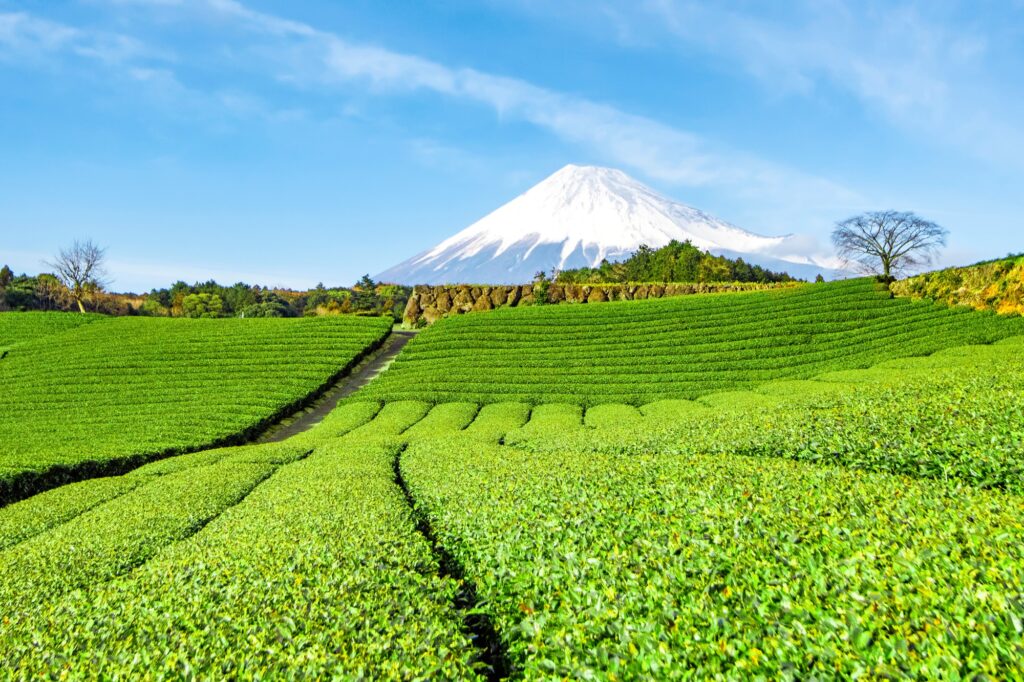
Few landscapes are more strongly associated with Japanese tea than the green tea fields of Shizuoka. Rows of carefully clipped tea bushes stretch across broad plateaus, climb mountain valleys and, in some places, unfold beneath views of Mount Fuji.
Shizuoka is not defined by a single style of tea. That is one of the things that makes the prefecture so interesting.
The broad Makinohara Plateau is famous for deep-steamed fukamushi sencha with vivid green liquor and a mellow flavor. Mountain districts such as Kawane, Honyama and Tenryu produce aromatic teas shaped by mist, altitude and dramatic differences between daytime and nighttime temperatures. Shizuoka is also the birthplace of Yabukita, the cultivar that transformed modern Japanese tea growing.
Today, the prefecture contains more than 20 recognized tea-producing areas. Shizuoka remained Japan’s largest tea-growing prefecture by cultivated area in 2025, with about 11,600 hectares—roughly 35 percent of the national total—and it also ranked first in the value of crude tea production for 2024.
Understanding Shizuoka therefore means understanding not one tea, but an entire landscape of Japanese green tea.
🍵 What Is Shizuoka Tea?
“Shizuoka tea” is an umbrella term for tea produced within Shizuoka Prefecture rather than one narrowly defined style.
Most of the tea is green tea, but even within that category the possibilities are extensive. Producers make regular sencha, deep-steamed sencha, shaded teas, tencha for matcha and smaller quantities of black and oolong tea.
The prefecture’s geography helps explain this diversity. Tea is cultivated on expansive sunny plateaus, steep mountain slopes, river valleys and foothills extending across a large portion of central Japan.
Shizuoka’s official agricultural sources identify more than 20 tea-producing districts, including areas around Makinohara, Iwatahara, Mount Ashitaka, the Abe River, Oi River and Tenryu River.
A package labeled simply “Shizuoka sencha” therefore tells only part of the story. More specific regional names can reveal much more about how the tea may taste.
🏯 Shizuoka Has Around 800 Years of Tea History
Tea cultivation in Shizuoka is traditionally traced back roughly 800 years.
According to Shizuoka Prefecture, the Buddhist monk Shōichi Kokushi returned from Song-dynasty China with tea seeds and planted them near his birthplace in what is now Shizuoka City. This tradition is particularly associated with Ashikubo and the beginnings of what became Honyama tea.
Tea production expanded gradually over the centuries. During the Edo period, tea from the region gained prestige, and Tokugawa Ieyasu, who spent his later years at Sunpu, is closely associated with Shizuoka tea history.
By the late Edo and early Meiji periods, tea had also become an important commercial crop.
Japan’s expanding export trade transformed Shizuoka dramatically during the 19th century, and the prefecture developed from an important tea region into one of the great centers of the Japanese tea industry.
🚢 Tea Exports Helped Transform Shizuoka
The opening of Japan to international trade created enormous new demand for Japanese green tea during the 19th century.
Shizuoka was ideally positioned to participate.
Tea cultivation expanded, processing improved and Shimizu became an important export port. Shizuoka Prefectural Library records note that tea and silk were among Japan’s important early Meiji exports and that Shimizu became a major center of the tea export trade.
This period left a lasting mark on the landscape.
New tea fields were developed across places such as Makinohara, and tea increasingly became one of the industries most strongly associated with the prefecture.
The tea gardens seen across Shizuoka today are therefore not simply picturesque agricultural scenery. They are part of a history linking rural Japan with global trade.
🌿 The Makinohara Plateau Is Tea Country on a Grand Scale
Makinohara is one of Shizuoka’s most impressive tea landscapes.
The broad plateau extends across parts of Makinohara, Shimada, Kikugawa and surrounding areas. Unlike steep mountain tea gardens, Makinohara contains large expanses of relatively open land where tea cultivation can operate on a substantial scale.
The plateau was developed extensively for tea after the Meiji Restoration. Former Tokugawa retainers and others participated in clearing and cultivating the land, helping create what became one of Japan’s great tea-growing districts. Shizuoka’s Tea Research Center describes the plateau as a major center of the prefecture’s tea industry.
Today, the seemingly endless rows of tea bushes across Makinohara create one of the iconic images of Shizuoka.
They also produce the kind of leaf that helped make another style famous.
Deep-steamed tea.
💚 Fukamushi Tea Is a Shizuoka Specialty
Fukamushi means “deep steamed.”
Like ordinary Japanese sencha, the leaves are steamed soon after harvest to stop oxidation. With fukamushi tea, however, the steaming stage lasts considerably longer.
Shizuoka Prefecture describes deep-steamed tea as having less astringency and a milder character than ordinary sencha. The extra steaming softens and breaks down the leaves, causing more fine tea particles to enter the finished infusion.
That produces the appearance many drinkers immediately associate with fukamushi: an opaque or cloudy cup with an exceptionally deep green color.
The flavor is typically rounder and sweeter than many lightly steamed senchas, with reduced sharpness and a rich vegetal character.
For someone who finds traditional sencha too brisk or astringent, Shizuoka fukamushi can be an excellent introduction to Japanese green tea.
🌱 Makinohara and Kikugawa Became Famous for Deep-Steamed Tea
The development of deep steaming is particularly associated with the broad tea-growing districts around Makinohara.
Tea leaves grown in sunny plateau conditions can develop relatively thick leaf tissue. Longer steaming helps soften those leaves and reduces the stronger bitterness and astringency that could otherwise dominate the cup.
Kikugawa became particularly famous for the style during the 20th century. Shizuoka Prefecture notes that its leaves are steamed two to three times longer than ordinary tea and describes the resulting infusion as deep green, mellow and sweet.
Makinohara tea likewise commonly uses deep steaming, producing teas with vivid color and a comparatively gentle flavor.
What began partly as an adaptation to local growing conditions became one of Shizuoka’s signature tea styles.
🍃 Regular Sencha Has a Different Personality
Not all Shizuoka tea is deep steamed.
Traditional sencha receives a shorter steaming treatment, allowing the leaves to retain more of their structure during rolling and drying. Good examples can produce beautifully shaped needle-like leaves and a clearer infusion than fukamushi.
The flavor can be more aromatic and defined, with a balance of sweetness, umami, freshness and refreshing astringency.
Mountain tea regions are particularly well suited to this style because growers often value fragrance and clarity over the heavier body associated with deep-steamed tea.
Trying a mountain-grown Shizuoka sencha beside Makinohara fukamushi is one of the best introductions to the diversity of the prefecture.
Both are sencha.
They can taste remarkably different.
⛰️ Kawane Tea Comes From the Mountains
Kawane is one of Shizuoka’s best-known mountain tea regions.
The tea is grown along the middle and upper reaches of the Oi River, where mountains create shorter periods of direct sunlight, substantial day-night temperature differences and frequent mist.
Shizuoka Prefecture describes Kawane tea as relatively gentle in bitterness, with rich flavor, pleasant astringency, clear liquor and a soothing aroma.
The appearance differs noticeably from many fukamushi teas.
Well-made Kawane sencha can have slender, needle-like leaves and produce a clearer yellow-green cup rather than a dense emerald-green infusion.
This is tea for drinkers who value fragrance and subtlety.
🌫️ Mountain Mist Changes the Growing Environment
Mountain tea districts provide very different growing conditions from broad lowland plateaus.
Tea gardens may receive direct sunlight for fewer hours each day as mountains cast shadows across valleys. Rivers and forests contribute humidity and mist, while significant differences between daytime and nighttime temperatures can slow growth.
Slower-growing shoots can develop different aromatic and flavor characteristics from tea grown in warmer, sunnier plains.
Shizuoka’s official descriptions of Kawane and Tenryu both emphasize mountainous conditions, mist and temperature differences as important parts of their tea character.
This does not mean mountain tea is automatically superior.
It means it expresses a different side of Shizuoka.
🏞️ Honyama Is One of Shizuoka’s Historic Tea Regions
Honyama tea comes from the basins of the Abe and Warashina rivers around Shizuoka City.
Its history is tied directly to the traditional origin story of Shizuoka tea, in which Shōichi Kokushi planted tea seeds in the Ashikubo area roughly eight centuries ago.
Honyama later became prestigious enough to be associated with Tokugawa Ieyasu. Shizuoka Prefecture describes the tea as glossy green with an elegant fragrance and a mellow quality within its astringency.
The area’s steep slopes and river valleys offer a dramatic contrast with Makinohara’s open plateau.
Honyama tea often rewards drinkers who appreciate fragrance and a refined balance rather than sheer intensity.
🌲 Tenryu Tea Is Aromatic and Elegant
Farther west, the Tenryu River basin contains another important mountain tea tradition.
Tea gardens climb slopes surrounded by forest, and many fields experience the mist characteristic of mountain valleys.
Shizuoka’s official food guide describes Tenryu tea as having an elegant fragrance and a harmonious relationship between flavor and bitterness, shaped by altitude, morning mist and substantial temperature differences.
Some producers continue emphasizing careful harvesting and small-scale craftsmanship.
The region is particularly appealing for anyone interested in aromatic mountain sencha.
If Makinohara demonstrates Shizuoka tea at landscape scale, Tenryu demonstrates what happens when tea grows in the tighter spaces of mountains and river valleys.
🌊 Shimizu Has Tea Between Mountains and Sea
Shimizu is widely known for its port and its views of Mount Fuji, but tea also has a long history there.
Important growing areas include Ryōgōchi, Ihara, Kojima, Nihondaira and the Okitsu River basin. Shizuoka Prefecture describes these districts as producing high-quality teas with refined flavors.
The region’s history also intersects with international trade.
Direct tea exports through Shimizu expanded from the early 20th century, strengthening the area’s relationship with the commercial tea industry.
Some Shimizu tea gardens occupy steep mountain slopes, while others sit in landscapes where Mount Fuji can dominate the horizon.
Few tea regions offer a more visually unmistakable sense of place.
🌱 Shizuoka Is the Birthplace of Yabukita
One of Shizuoka’s greatest contributions to Japanese tea is not a tea style at all.
It is a plant.
Yabukita became the dominant tea cultivar in modern Japan because of its combination of quality, adaptability and reliable growth. It produces excellent sencha with a recognizable balance of aroma, umami and refreshing astringency.
The cultivar was selected by Hikosaburō Sugiyama in Shizuoka in 1908. Its name refers to the location where the promising plant grew—on the north side of a bamboo grove, or yabu.
The original Yabukita plant survives in Shizuoka as a tangible connection to the cultivar’s history.
The influence of that one selection eventually extended across nearly every Japanese tea region.
🍵 Yabukita Is Important, but It Is Not the Only Cultivar
Because Yabukita became so successful, Japanese tea can sometimes appear less diverse than it actually is.
Shizuoka growers also cultivate other varieties, and interest in cultivar-specific tea continues to grow.
Cultivars such as Saemidori, Tsuyuhikari, Kōshun and Okuhikari can provide significantly different aromatic and flavor experiences.
Okuhikari, for example, was developed in Shizuoka and is cultivated in mountain districts including Kawane. Shizuoka’s official food-selection program describes Kawane Okuhikari grown around 500 meters in elevation as having a refreshing character and pronounced astringency.
For drinkers accustomed to generic “Japanese green tea,” cultivar exploration opens an entirely new level of tasting.
🌿 First Harvest Tea Is Especially Prized
Spring is the most anticipated season in Shizuoka tea country.
After winter dormancy, tea plants produce tender new shoots that become the year’s ichibancha, or first harvest.
These teas can be especially aromatic and sweet, with a freshness associated with young spring growth.
The exact harvest period varies across Shizuoka because elevation, cultivar, exposure and local climate all affect how quickly the new shoots develop. Lower, warmer districts generally begin sooner than cooler mountain gardens.
Freshly finished first-harvest tea sold soon after production is known as shincha, or new tea.
For many Japanese tea lovers, opening the first package of shincha is one of the great pleasures of spring.
🌱 Tea Fields Beneath Mount Fuji
The image of green tea fields with snow-capped Mount Fuji rising behind them has become almost synonymous with Shizuoka.
Tea is cultivated in eastern parts of the prefecture around areas such as Fuji, Fujinomiya, Numazu and the foothills of Mount Ashitaka.
The landscape is spectacular, but these are active agricultural regions rather than merely scenic viewpoints.
Numazu tea, for example, includes sencha, deep-steamed sencha and guricha, with Shizuoka Prefecture describing the teas as balancing sweetness, astringency and aroma.
The Mount Fuji landscape gives Shizuoka tea one of the strongest visual identities of any tea region in the world.
🌾 Tea Grass Agriculture Preserves Biodiversity
Another important Shizuoka tea tradition is Chagusaba, often translated as tea-grass integrated agriculture.
Farmers cut grasses from semi-natural grasslands surrounding tea fields and spread the material between tea bushes. The grass becomes mulch and eventually organic matter, helping control weeds, conserve moisture and improve soil conditions.
The system also maintains grasslands that support substantial biodiversity.
In 2013, the Food and Agriculture Organization recognized Shizuoka’s traditional tea-grass system as a Globally Important Agricultural Heritage System.
Chagusaba is particularly associated with tea-growing areas around Kakegawa and surrounding districts.
It demonstrates how agricultural quality and ecological management can sometimes reinforce one another rather than existing as separate goals.
👃 What Does Shizuoka Tea Taste Like?
There is no single Shizuoka flavor profile.
A fukamushi sencha from Makinohara may be thick, vivid green, sweet and intensely vegetal.
Kawane tea may be clearer and more aromatic, combining umami with gentle astringency.
Honyama may emphasize elegant fragrance and balance.
Tenryu can show bright aromatic qualities shaped by its mountain environment.
Cultivar, harvest date, steaming depth, elevation, processing and brewing technique all alter the final cup.
That diversity is precisely why Shizuoka deserves to be explored as a region rather than reduced to the phrase “Japanese green tea.”
💚 What Does Fukamushi Taste Like?
Deep-steamed tea deserves special attention because it can surprise drinkers accustomed to clearer sencha.
The leaves may look broken or powdery rather than perfectly needle-shaped. This is not necessarily a sign of poor quality. Extended steaming softens the leaf structure, making it more fragile during later processing.
When brewed, those small leaf particles pass through a traditional teapot screen and enter the cup.
The result is a dense green infusion with substantial body.
Flavor tends toward mellow vegetation, sweetness and umami with comparatively reduced astringency.
It can be an excellent everyday tea because it produces a satisfying cup quickly.
💧 How to Brew Shizuoka Sencha
Regular Shizuoka sencha generally benefits from water considerably cooler than boiling.
A useful starting point is approximately 70–80°C, or 158–176°F.
Use enough leaf to produce flavor without making the infusion excessively long. Depending on leaf size and personal taste, roughly one minute is a reasonable place to begin.
Then drain the teapot completely.
Leaving liquid sitting among the leaves between infusions can overextract the tea and make later cups bitter.
For higher-grade mountain sencha, somewhat cooler water can emphasize sweetness and umami. For brisker everyday teas, slightly hotter water may work well.
💚 How to Brew Fukamushi Sencha
Fukamushi requires a little less patience.
Because the leaves have been softened and partially broken by the longer steaming process, they extract quickly.
Water around 70–80°C works well for many examples, but the steep can be shorter than for regular sencha—often around 30 to 45 seconds as a starting point.
A kyusu with an appropriate fine mesh is particularly useful because the tea contains many small particles.
Do not worry if the cup looks cloudy.
That intense green color is part of the style.
Second and third infusions should be quite short because the leaves are already fully hydrated.
🫖 The Kyusu Is Ideal for Shizuoka Tea
A Japanese side-handled teapot, or kyusu, is an excellent tool for brewing Shizuoka tea.
The shape makes it easy to pour completely, while the built-in screen separates most leaf material from the liquor.
For regular sencha with long intact leaves, a traditional ceramic screen can work beautifully.
For deep-steamed tea, choose a finer mesh capable of handling the smaller leaf particles.
Tokoname pottery is particularly famous for Japanese teapots and is widely used for brewing sencha throughout Japan.
An elaborate teapot is not required, however.
Good water, appropriate temperature and careful steeping matter far more.
🧊 Shizuoka Tea Can Also Be Cold Brewed
Japanese green tea works exceptionally well with cold water.
Cold brewing extracts flavor slowly and tends to emphasize sweetness and umami while limiting some of the astringency drawn out by hot water.
Place Shizuoka sencha or fukamushi in cold water and allow it to infuse in the refrigerator. The exact leaf quantity and steeping time can be adjusted according to strength.
Fukamushi can produce an especially vivid green cold brew.
High-quality sencha can also be brewed over ice using a concentrated infusion, producing a refreshing drink with impressive aroma.
This is one of the easiest ways to enjoy green tea during hot weather.
🛍️ How to Choose Shizuoka Tea
Begin by looking beyond the word “Shizuoka.”
If the package names a more specific region, that information can help you predict the style.
Makinohara or Kikugawa often suggests deep-steamed tea with body and a mellow flavor.
Kawane, Honyama or Tenryu may point toward more aromatic mountain-grown sencha.
The steaming level is also important. Look for words such as asamushi for light steaming, futsumushi for standard steaming or fukamushi for deep steaming.
Cultivar information adds another layer. Yabukita offers a classic reference point, while cultivar-specific teas such as Kōshun or Okuhikari can be useful for exploring different aromas.
Harvest information is valuable too, especially if you are looking for spring shincha or premium first-harvest tea.
📦 Freshness Matters
Japanese green tea is sensitive to heat, light, oxygen and moisture.
Unopened packages should be stored according to the producer’s instructions, ideally in a cool place away from strong odors.
Once opened, keep the tea tightly sealed and use it while its fragrance remains lively.
There is little advantage in buying an enormous package of premium tea if it will sit open for months.
Smaller quantities allow you to explore more regions, cultivars and steaming styles while drinking each tea closer to its best condition.
That approach is especially useful in Shizuoka because there is so much to compare.
🗺️ A Simple Way to Explore Shizuoka Tea
A useful tasting journey through Shizuoka does not require dozens of teas.
Start with a Makinohara or Kikugawa fukamushi sencha. Notice the deep green color, heavier body and reduced sharpness.
Next, try a Kawane or Honyama mountain sencha. Look for clearer liquor, fragrance and a more defined balance between sweetness and astringency.
Then try a cultivar-specific tea that is not Yabukita.
With only three teas, the idea of “Shizuoka tea” begins to expand dramatically.
The goal is not to decide which style is best.
It is to discover how much geography and processing can change leaves from the same species of plant.
🏞️ Tea Is Part of Shizuoka’s Identity
Tea in Shizuoka is more than an agricultural product.
It has shaped landscapes, communities, transportation, trade and everyday culture.
The prefecture notes that tea consumption there is roughly twice the Japanese national average, reflecting how deeply tea remains embedded in daily life.
Tea museums, farm experiences, specialist shops and cafés make the industry increasingly accessible to visitors, but the underlying culture remains agricultural.
Behind every scenic field are people pruning bushes, protecting new shoots from frost, watching weather forecasts, harvesting leaves and adjusting processing equipment according to the condition of each crop.
The beauty of Shizuoka tea country exists because it is still working tea country.
❤️ Why Shizuoka Matters
Uji may represent some of Japan’s most famous traditions of matcha and shaded tea, but Shizuoka tells another essential part of the Japanese tea story.
It is the story of sencha.
It is the story of mountain gardens and vast plateaus, of the international tea trade and the development of modern plantations.
It is the birthplace of Yabukita, the cultivar that reshaped Japanese tea agriculture.
It is also one of the places where deep steaming transformed the character of sencha, producing the brilliant green fukamushi style now enjoyed throughout Japan.
Perhaps most importantly, Shizuoka demonstrates that Japanese tea cannot be understood through one flavor.
A cup from Makinohara may be thick and intensely green. Kawane may be fragrant and clear. Honyama may be elegant and balanced. Tenryu may express the cool character of a mountain valley.
All of them are Shizuoka tea.
That diversity is what makes the region worth exploring one cup at a time.
🔗 Related Articles
- Japanese Tea Regions Guide: Shizuoka, Uji, Kagoshima, Yame & More
- World’s Best Tea Regions: China, India, Japan, Sri Lanka & Beyond
📚 Sources & Further Reading
- Shizuoka Prefecture — Tea Industry in Shizuoka
- Shizuoka Prefecture — Tea Types and Characteristics
- Shizuoka Prefecture — Major Tea-Producing Areas
- Shizuoka Food Information Center — Shizuoka Honyama Tea
- Shizuoka Food Information Center — Kawane Tea
- Shizuoka Food Information Center — Tenryu Tea
- Shizuoka Food Information Center — Kikugawa Deep-Steamed Tea
- Shizuoka Prefectural Library — The History of Shizuoka Tea and Yabukita