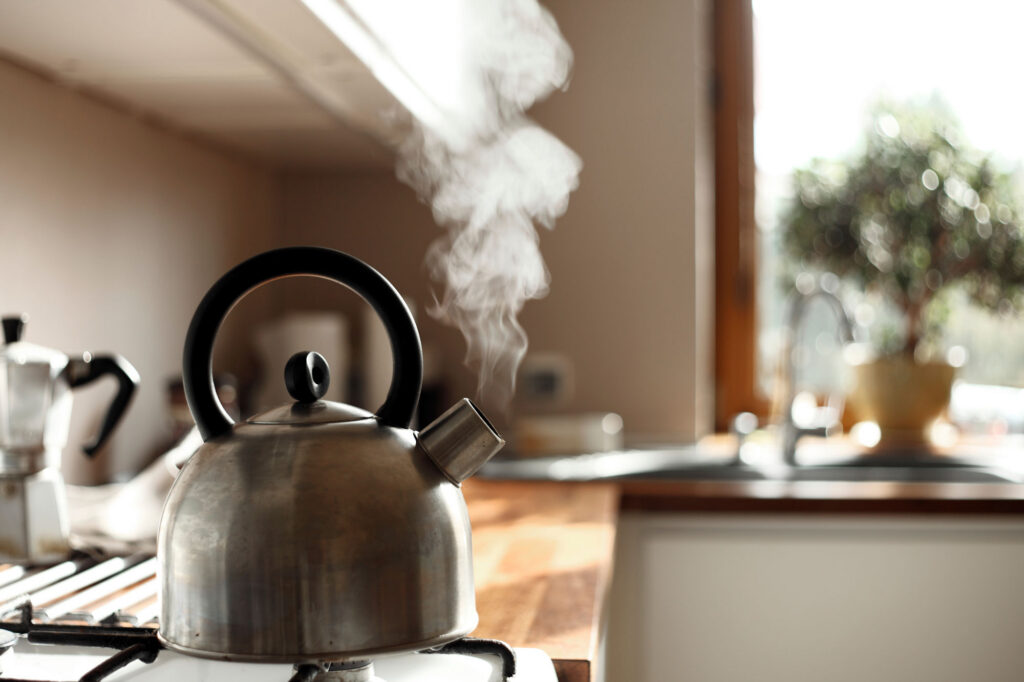
A clean tea kettle is one of those small things that makes an everyday tea routine more enjoyable. Whether you use an electric kettle with adjustable temperature settings or a traditional stovetop model, keeping it clean helps maintain its appearance, heating performance, and the quality of the water you use for brewing.
Over time, however, even a kettle used only for heating water can develop an unpleasant-looking layer of residue. You might notice white flakes floating in the water, chalky deposits collecting along the bottom, or a stubborn ring forming near the waterline.
Sometimes the inside develops brownish stains, while the outside becomes covered with fingerprints, water spots, and kitchen grease.
These problems are common, particularly in households with hard water. Fortunately, they usually don’t mean there’s anything wrong with your kettle.
The easiest way to remove ordinary mineral buildup from many tea kettles is to descale them with a manufacturer-approved solution of diluted white vinegar or citric acid. These mild acids help dissolve the calcium deposits that accumulate when water is repeatedly heated.
However, the correct cleaning method depends on whether you have an electric or stovetop kettle and what materials it contains. Some finishes, coatings, and electrical components require special care.
This guide explains how to clean a tea kettle safely, remove stubborn limescale, maintain different kettle materials, and prevent mineral deposits from returning too quickly.
🫖 Why Does a Tea Kettle Need Cleaning?
It might seem surprising that a tea kettle gets dirty when you use it only to heat water.
Unlike a teapot, which comes into direct contact with tea leaves and brewed tea, a typical kettle doesn’t accumulate large amounts of tannins, tea oils, or other brewing residues.
Instead, its most common cleaning problem comes from minerals naturally present in drinking water.
Water frequently contains dissolved calcium and magnesium. These minerals contribute to what is known as water hardness.
When water is heated, certain dissolved compounds can form solid deposits that collect on the kettle’s interior surfaces.
Over time, these deposits become more noticeable, especially around the heating plate, bottom, or waterline.
This buildup is called limescale.
Small amounts of limescale are common and don’t automatically indicate that the water is unsafe. However, excessive deposits can affect the kettle’s performance.
Manufacturers such as KitchenAid and Fellow explain that mineral buildup may reduce heating efficiency, contribute to inaccurate temperature readings in some models, or interfere with normal operation.
Loose mineral particles can also appear in the water when you pour it.
Cleaning the kettle helps remove these deposits before they become difficult to manage.
Regular exterior cleaning is useful for a different reason. Fingerprints, grease, splashes, and water spots can accumulate on the outside, particularly if the kettle sits close to the stove.
A little routine maintenance keeps both the kettle and your tea preparation area looking and working their best.
🪨 What Is the White Buildup Inside a Tea Kettle?
The white, chalky material inside a kettle is usually limescale, which consists largely of calcium carbonate.
You might notice it as a thin white film along the bottom, tiny pale flakes floating in the water, or a hard crust that gradually develops around the heating surface.
In some cases, the buildup forms a distinct ring at the level where water is usually left standing.
The appearance depends on your water’s mineral composition and how often you heat it.
Hard water contains relatively high concentrations of calcium and magnesium, making mineral deposits more likely.
If you live in a hard-water area and use your kettle several times a day, noticeable buildup may appear relatively quickly.
However, limescale isn’t necessarily pure white.
Depending on the minerals present, some deposits look gray, cream-colored, or slightly brown.
Iron and other substances in water can contribute to darker discoloration.
It’s also important not to mistake damaged metal or rust for ordinary mineral deposits.
If your kettle has rough reddish-brown corrosion, flaking interior coatings, exposed metal beneath chipped enamel, or other signs of material deterioration, consult the manufacturer before continuing to use it.
Cleaning can remove mineral deposits, but it cannot repair a damaged lining or corroded component.
🍋 How to Clean a Tea Kettle With Vinegar
White vinegar is one of the most accessible solutions for removing mineral buildup from compatible kettles.
Its acidity helps dissolve calcium carbonate deposits, making them easier to rinse away without aggressive scrubbing.
Many electric-kettle manufacturers recommend diluted vinegar as an alternative to a dedicated descaling product.
For example, KitchenAid provides instructions for certain electric models using one part white vinegar to three parts water. Breville and Fellow also provide vinegar-based cleaning methods, although their recommended concentrations and soaking times differ.
Because those instructions vary, always check your kettle’s owner manual before using vinegar, especially if the kettle has an electric heating system, a coated interior, or an unusual finish.
The following method is appropriate for many kettles whose manufacturers permit this type of descaling.
What You’ll Need
- Plain white vinegar
- Clean water
- A soft cloth or nonabrasive sponge
- A measuring cup
- A soft brush, if needed
Step 1: Empty and Inspect the Kettle
Begin by pouring out any remaining water.
If you’re cleaning an electric kettle, unplug it and allow it to cool completely before handling or inspecting the interior.
Look inside to determine how much mineral buildup is present.
A light white film may disappear after one treatment, while thick, crusty deposits may require a longer soak or a second cleaning cycle.
If you notice damaged coatings, severe corrosion, or unusual discoloration that doesn’t resemble mineral deposits, stop and consult the manufacturer’s guidance.
Step 2: Add Diluted White Vinegar
For a kettle whose instructions permit a 1:3 vinegar-to-water solution, combine one part plain white vinegar with three parts water.
For example, you could use:
- 1 cup white vinegar
- 3 cups water
However, never exceed the kettle’s maximum fill line, and make sure you meet its minimum fill requirement if the instructions call for heating.
The exact quantity should be adjusted to the capacity and design of your kettle.
You generally need enough liquid to cover the mineral deposits, not necessarily to fill the entire appliance.
If your manufacturer specifies a different ratio or recommends a commercial descaler instead, follow those directions.
Step 3: Heat or Soak According to the Manufacturer
Some manufacturers recommend bringing the diluted vinegar mixture to a boil and allowing it to stand for an extended period.
Others recommend a shorter treatment or a room-temperature soak.
Follow the procedure specified for your model rather than assuming that every kettle should be boiled with vinegar.
Never leave a heating kettle unattended or allow the cleaning solution to boil dry.
For an electric kettle, make sure the base and electrical connections remain completely dry throughout the process.
As the vinegar reacts with the mineral deposits, the buildup should begin to loosen and dissolve.
Step 4: Empty and Rinse Thoroughly
Once the recommended soaking period is complete, allow the solution to cool sufficiently before pouring it away.
Rinse the kettle several times with fresh water.
If softened deposits remain, gently wipe accessible interior surfaces with a soft cloth or nonabrasive sponge.
Avoid steel wool, metal scrapers, and abrasive cleaning powders.
These can scratch stainless steel, damage coatings, or create surfaces where mineral deposits accumulate more readily.
Step 5: Boil Fresh Water and Discard It
If your kettle’s manufacturer recommends a final rinse boil, refill the kettle with clean water, bring it to a boil, and discard the water.
Some manufacturers recommend repeating this process twice to remove lingering vinegar odors and flavors.
After the final rinse, the kettle should be ready for ordinary use.
If the water still smells strongly of vinegar, rinse again before preparing tea.
The goal is to remove the mineral buildup without leaving any cleaning residue that might affect your next cup.
🍋 How to Clean a Tea Kettle With Citric Acid
Citric acid is another effective option for removing limescale.
It occurs naturally in citrus fruits and is also sold as a food-grade powder that can be dissolved in water.
Like vinegar, citric acid reacts with calcium carbonate and helps break down mineral deposits.
One advantage is that citric acid generally leaves less noticeable odor than vinegar.
This makes it appealing if you dislike the smell of warm vinegar or find yourself repeatedly rinsing your kettle afterward.
Several manufacturers, including Fellow and Krups, provide citric-acid descaling instructions for compatible kettles.
However, the recommended concentrations vary.
Some models call for a measured amount of powder added to heated water, while others recommend a dedicated descaling product.
To clean your kettle with citric acid, begin by checking whether the manufacturer permits its use.
If it does, measure the quantity specified in the manual and dissolve it in the recommended amount of water.
Follow the instructions for heating or soaking, then discard the solution and rinse thoroughly.
If deposits remain, repeat the approved treatment rather than increasing the concentration substantially or using abrasive tools.
Food-grade citric acid is useful for descaling, but it should still be handled carefully. Avoid getting the powder in your eyes, and don’t combine it with unrelated household cleaning chemicals.
For anyone who cleans a kettle frequently, a manufacturer-approved citric-acid product can be a convenient alternative to vinegar.
⚡ How to Clean an Electric Tea Kettle
Electric kettles require particular attention because their heating components and electrical connections must be protected from water.
Although the inside of an electric kettle is designed to hold water, the outside, power base, cord, and electrical contacts generally are not.
Before cleaning, unplug the kettle and allow it to cool.
Remove the kettle from its power base if the design allows it, then empty any remaining water.
For routine exterior cleaning, wipe the kettle with a soft, slightly damp cloth. If there are fingerprints or water spots, gentle wiping is usually sufficient.
Use a dry cloth to remove remaining moisture.
Never immerse an electric kettle or its powered base in a sink full of water.
Avoid allowing cleaning liquid to enter the electrical connectors, control panel, or other openings not intended for water.
For the interior, follow the manufacturer’s descaling instructions.
Many electric kettles have a stainless-steel heating plate that gradually develops a white mineral film. A suitable descaling solution can dissolve this buildup without requiring aggressive scrubbing.
Some kettles also have a removable mesh filter near the spout.
This filter catches loose mineral flakes before they reach your cup. Over time, it can become coated with the same chalky deposits found inside the kettle.
If the filter is removable, take it out according to the manufacturer’s instructions.
Rinse it under warm water and gently remove deposits with a soft brush or cloth.
If the manufacturer permits soaking it in diluted vinegar or citric acid, that may help dissolve stubborn scale.
Allow the filter to drain and reinstall it securely before using the kettle again.
Regular cleaning is particularly useful for variable-temperature electric kettles because some mineral deposits can affect heating performance and temperature sensing.
If your kettle continues malfunctioning after cleaning, however, don’t assume that more descaling will solve the problem. Follow the manufacturer’s troubleshooting instructions.
🔥 How to Clean a Stovetop Tea Kettle
Stovetop kettles are generally simpler to maintain because they don’t contain the same electrical components as electric models.
However, the best cleaning method still depends on the material.
A stainless-steel stovetop kettle may tolerate cleaning methods that would be unsuitable for an aluminum, copper, or enamel-coated kettle.
Begin by allowing the kettle to cool completely.
Empty any remaining water and rinse the interior.
If your kettle is made from compatible stainless steel and the manufacturer permits vinegar or citric acid, use the recommended descaling method to remove mineral deposits.
For exterior cleaning, a soft cloth with warm water and a small amount of mild dish soap can remove grease and fingerprints from many compatible finishes.
Rinse or wipe away the soap residue and dry thoroughly.
Pay particular attention to the area around the lid, spout, and handle, where dirt can collect.
If the kettle has a removable whistle or other component, clean it only according to the manufacturer’s instructions.
Avoid forcing water into parts that aren’t designed to be submerged.
For enameled, painted, or decorative finishes, use additional caution.
Harsh cleaners and abrasive scrubbers may damage the surface even when the underlying metal remains intact.
A traditional stovetop kettle can last for many years with regular care, but it shouldn’t be treated as indestructible.
Cleaning gently and following the correct material-specific instructions is more effective than trying to remove every stain through force.
🥇 Cleaning Different Tea Kettle Materials
The material of your kettle affects both its appearance and the way it should be maintained.
Stainless steel, glass, enamel, copper, and aluminum can respond differently to cleaning solutions.
Understanding those differences can help prevent accidental damage.
Stainless Steel Tea Kettles
Stainless steel is popular because it’s durable, relatively easy to clean, and resistant to corrosion under normal conditions.
For routine cleaning, wipe the exterior with a soft cloth and mild soapy water, then rinse or wipe clean and dry.
To remove mineral deposits inside a compatible stainless-steel kettle, use the manufacturer’s recommended descaling solution.
Avoid steel wool and other abrasive tools, which may scratch the finish and damage the protective surface.
If the exterior has water spots, drying it after each cleaning can help maintain its appearance.
Glass Tea Kettles
Glass kettles make it easy to see mineral buildup because the deposits are visible through the sides.
A white film may develop along the bottom or around the waterline.
Many glass kettles can be descaled using an approved diluted vinegar or citric-acid solution, but the heating base and attached components still require care.
Avoid sudden temperature changes that could stress the glass.
Never pour cold water into an extremely hot glass kettle unless the manufacturer specifically permits it.
Use soft cleaning tools rather than abrasive brushes.
If the glass develops a crack or chip, discontinue use and follow the manufacturer’s replacement guidance.
Enamel Tea Kettles
Enameled kettles have a glasslike coating fused to a metal base.
They are often chosen for their colorful appearance and traditional kitchen style.
The enamel surface can be durable, but it may chip if struck or exposed to unsuitable cleaning tools.
Use gentle cleaning methods approved by the manufacturer.
Avoid scraping stubborn deposits with metal utensils or abrasive pads.
If the interior enamel is chipped or flaking, consult the manufacturer about whether the kettle remains safe to use.
A descaling solution cannot repair damaged enamel.
Copper Tea Kettles
Copper kettles require more careful maintenance because copper can react with certain substances.
Some copper kettles have a stainless-steel or another suitable food-contact lining, while others have different interior constructions.
The correct cleaning method depends on both the outer copper surface and the material that actually contacts the water.
Do not assume that a homemade acidic cleaner suitable for stainless steel is appropriate for an unlined or damaged copper kettle.
Follow the manufacturer’s instructions for descaling the interior and polishing the exterior.
If the lining is damaged or you’re uncertain whether the kettle is intended for heating drinking water, seek manufacturer guidance before using it.
Aluminum Tea Kettles
Aluminum is lightweight and conducts heat efficiently, but it can react with acidic cleaning solutions.
For that reason, vinegar and citric acid should not automatically be used inside an aluminum kettle.
Consult the manufacturer’s instructions before attempting any acidic descaling treatment.
Gentle washing and drying may be appropriate for routine maintenance, but stubborn mineral deposits should be treated only with a compatible product.
For more information about the differences between kettle materials, see How to Choose a Tea Kettle: Electric vs. Stovetop, Materials & Features.
🧽 How to Clean the Outside of a Tea Kettle
Most kettle exteriors need relatively little maintenance.
A regular wipe with a soft cloth helps remove fingerprints, splashes, and dust before they develop into stubborn residue.
However, stovetop kettles can accumulate grease if they’re kept near cooking burners.
Steam, cooking oils, and airborne particles may settle on the kettle and form a slightly sticky film.
For a compatible stovetop kettle, mild dish soap and warm water are often sufficient to remove ordinary kitchen grease.
Use a soft sponge, rinse carefully, and dry with a clean cloth.
For an electric kettle, keep the power base and electrical components dry. A lightly dampened cloth is generally preferable to washing the exterior under running water.
Avoid spraying cleaning products directly onto switches, vents, seams, or electrical connections.
Stainless-steel kettles may develop fingerprints and water spots. A clean microfiber cloth can help restore their appearance without scratching the finish.
Painted and enamel-coated kettles should be treated gently to avoid damaging their decorative surfaces.
If you use a specialty cleaner or polishing product, make sure it’s suitable for your kettle’s specific finish.
The objective is to maintain the exterior, not to remove protective coatings or alter the material.
🧼 How to Remove Stubborn Mineral Buildup
If you haven’t cleaned your kettle for a long time, the mineral deposits may be thicker than the light white film that develops with ordinary use.
You might notice hard, crusty areas around the bottom or large pieces of scale breaking loose into the water.
These deposits can be difficult to remove with ordinary rinsing.
However, aggressive scrubbing is usually unnecessary and may damage the kettle.
Instead, use a manufacturer-approved descaling treatment and allow the recommended soaking time.
The mild acid gradually dissolves the mineral deposits.
If substantial buildup remains after the first treatment, repeat the approved process.
For thick deposits, several gentle treatments may be safer than one overly concentrated solution.
Don’t attempt to chip away scale with a knife, screwdriver, metal spoon, or other hard object.
Scratching the heating surface can damage the kettle and create additional areas where deposits may collect.
If the buildup doesn’t respond to the recommended cleaner, check whether you’re dealing with another type of residue or material damage.
Severe corrosion, damaged coatings, and other surface deterioration require a different response from ordinary limescale.
When in doubt, contact the manufacturer rather than experimenting with increasingly harsh products.
🌡️ How Often Should You Clean a Tea Kettle?
The ideal cleaning schedule depends on how frequently you use the kettle and how much mineral content is present in your water.
If you heat water several times a day, limescale may accumulate more quickly than it would in a kettle used only occasionally.
Hard-water areas also tend to produce more deposits.
KitchenAid recommends descaling an electric kettle approximately once a month when it’s used daily, with more frequent cleaning potentially necessary in hard-water conditions.
Other manufacturers provide similar guidance but may recommend different intervals.
For most households, a practical routine is to wipe the outside regularly and inspect the inside every week or two.
If you notice a chalky film developing, descale according to the manufacturer’s instructions.
You don’t necessarily need to perform a full descaling treatment every week if the interior remains clean.
Conversely, don’t wait several months when thick mineral deposits are already visible.
A kettle that’s used frequently in a hard-water area may benefit from descaling approximately once a month.
A kettle used less often with softer water may need much less frequent attention.
The most useful approach is to follow the manufacturer’s recommendations and adjust the schedule according to the amount of buildup you actually see.
💧 How to Prevent Limescale in a Tea Kettle
Limescale develops naturally when mineral-containing water is heated, so it may not be possible to prevent it completely.
However, a few habits can help slow buildup and make cleaning easier.
Begin by using fresh drinking water each time you heat the kettle.
Avoid repeatedly boiling the same small amount of water and allowing it to evaporate, since this can concentrate dissolved minerals.
When you’ve finished making tea, you can empty remaining water once the kettle has cooled if the manufacturer recommends doing so.
Allowing the kettle to dry between uses may reduce the appearance of waterline deposits.
Water filtration can also affect mineral buildup, but not every filter reduces hardness.
Many ordinary activated-carbon filters are primarily designed to improve taste and odor rather than remove substantial amounts of calcium and magnesium.
A treatment system designed to reduce hardness may limit limescale more effectively, but it isn’t necessary for every household.
If you’re considering changing your brewing water, remember that minerals can also influence tea flavor.
Extremely low-mineral water isn’t automatically best for every tea.
For more information, see Tap Water vs. Filtered Water for Tea: Which Makes a Better Cup?.
Regular descaling remains the simplest way to manage the mineral deposits that inevitably develop in many kettles.
🍵 Can a Dirty Tea Kettle Affect the Taste of Tea?
Yes, although the effect depends on the type and amount of residue present.
A kettle containing substantial mineral buildup may release loose particles into the heated water.
These deposits can also affect heating efficiency, potentially making it more difficult for some kettles to maintain their intended performance.
However, the minerals that contribute to limescale are also naturally present in many safe drinking-water supplies.
A light film of calcium carbonate inside a kettle doesn’t automatically mean that the water will taste bad.
The composition of the water itself often has a more direct effect on tea flavor than a small amount of residue on the kettle’s interior.
Calcium, magnesium, pH, and other water characteristics can change how tea compounds are extracted.
This is especially noticeable in delicate teas, such as certain Japanese green teas, white teas, and lightly oxidized oolongs.
Unwanted odors are another concern.
If the kettle smells strongly of cleaning solution after descaling, it hasn’t been rinsed adequately.
Always complete the manufacturer’s recommended rinsing procedure before preparing tea.
A clean kettle helps eliminate avoidable variables in the brewing process, allowing you to focus on the tea leaves, water quality, temperature, and steeping time.
For a deeper explanation, see Does Water Quality Affect Tea? How Minerals, Hardness, and pH Change the Flavor.
🚫 Common Mistakes When Cleaning a Tea Kettle
One common mistake is treating every kettle as though it’s made from the same materials.
A vinegar solution recommended for a stainless-steel electric kettle may not be suitable for an aluminum kettle or one with a special interior coating.
Always check the manufacturer’s instructions before choosing a cleaner.
Another mistake is using abrasive tools to scrape away mineral deposits.
Steel wool, knives, and hard scrubbing pads can scratch interior surfaces, damage coatings, and create problems that ordinary descaling would have avoided.
Some people also try to speed up cleaning by increasing the concentration of vinegar or citric acid.
However, stronger isn’t always better. A more concentrated solution may be unsuitable for seals, finishes, or other components.
Use the approved dilution and repeat the treatment if necessary.
Mixing household cleaning chemicals is another important safety concern.
Never mix vinegar or citric acid with chlorine bleach. The combination can release dangerous chlorine gas.
Similarly, avoid combining cleaning products unless the manufacturer explicitly instructs you to do so.
A kettle used for drinking water doesn’t need experimental mixtures of multiple cleaners.
Finally, don’t neglect rinsing.
Even a cleaning solution that effectively removes limescale can leave an unpleasant taste if it remains inside the kettle.
Rinse thoroughly and complete any recommended fresh-water boiling cycles before using the appliance for tea.
❓ Frequently Asked Questions
What is the best way to clean a tea kettle?
For many compatible kettles, a manufacturer-approved diluted white vinegar or citric-acid solution is an effective way to dissolve mineral buildup. Follow the instructions for your specific kettle, then rinse thoroughly. Routine exterior cleaning can usually be done with a soft cloth and an appropriate mild cleaner.
How do you get white buildup out of a tea kettle?
White buildup is usually limescale, which consists mainly of calcium carbonate. A suitable acidic descaling solution can dissolve it. White vinegar and citric acid are common options when approved by the kettle manufacturer. Thick deposits may require a longer soak or repeated treatment.
Can you clean a tea kettle with vinegar?
Yes, many manufacturers recommend diluted white vinegar for descaling compatible kettles. However, the correct concentration and procedure depend on the model. Some materials or coatings require different care, so consult the owner’s manual before using vinegar.
How much vinegar should I use to clean a kettle?
The amount varies by manufacturer. For certain KitchenAid models, the recommended solution is one part white vinegar to three parts water. Other manufacturers specify different ratios. Always follow your particular kettle’s instructions rather than assuming one formula works for every appliance.
Can you clean a kettle with citric acid?
Yes. Citric acid is an effective descaler for many compatible kettles. It helps dissolve mineral deposits and typically leaves less odor than vinegar. Use the concentration and procedure recommended by the manufacturer.
Can you clean a tea kettle with baking soda?
Baking soda can help with certain odors or residues when the manufacturer permits it, but it isn’t usually the best choice for removing limescale. Mineral deposits such as calcium carbonate respond more effectively to suitable acidic descalers. Avoid assuming baking soda and vinegar should be mixed together for better cleaning.
How often should you descale an electric kettle?
Many manufacturers recommend descaling approximately once a month for frequently used kettles, with more frequent cleaning in hard-water areas. The ideal schedule depends on usage and mineral buildup. Inspect the interior regularly and follow the manufacturer’s maintenance instructions.
Is the white buildup in my tea kettle harmful?
Ordinary limescale consists largely of mineral deposits and doesn’t automatically mean your drinking water is unsafe. However, the appearance of residue cannot establish water safety. If your water has an unusual odor, discoloration, or known quality problem, investigate the water supply separately.
Why are there white flakes floating in my kettle?
White flakes are often loose pieces of limescale that have broken away from interior surfaces. Descaling can help remove the deposits. If the particles appear unusual or you suspect a damaged interior coating, consult the manufacturer before continued use.
Why is the bottom of my kettle turning brown?
Brown discoloration may result from minerals such as iron, other water deposits, or changes to the kettle’s surface. However, reddish-brown corrosion can indicate rust, and damaged coatings require special attention. Don’t assume every dark mark is harmless limescale.
Can vinegar damage a stainless-steel kettle?
Diluted vinegar is recommended for descaling many stainless-steel kettles, but prolonged exposure or improper concentrations may be unsuitable for some finishes and components. Follow the manufacturer’s instructions rather than using undiluted vinegar for an extended period.
Can I put an electric kettle in the dishwasher?
Generally, no. Most electric kettles and their power bases are not designed to be submerged or cleaned in a dishwasher. Unless the manufacturer explicitly states otherwise, wipe the exterior with a damp cloth and clean the interior using the approved method.
Should you boil vinegar in an electric kettle?
Only when the manufacturer recommends it. Some electric-kettle instructions specify boiling a diluted vinegar solution, while others recommend different procedures. Never exceed the maximum fill line, allow the kettle to boil dry, or use a cleaning solution prohibited by the manual.
How do you clean the filter inside an electric kettle?
If the kettle has a removable mesh scale filter, remove it according to the manufacturer’s directions. Rinse it under warm water and gently clean with a soft brush or cloth. Some manufacturers allow soaking in a diluted descaling solution. Rinse thoroughly before reinstalling.
Does filtered water prevent limescale?
It depends on the filtration method. Many ordinary carbon filters improve taste and odor without significantly reducing hardness minerals. A water treatment system specifically designed to reduce calcium and magnesium may help limit mineral buildup.
Can you use lemon juice to clean a kettle?
Lemon juice contains citric acid and may remove light mineral deposits in compatible kettles. However, commercial descalers or measured food-grade citric acid generally provide more predictable concentrations. Consult the manufacturer’s instructions before using lemon juice.
How do you get rid of the vinegar smell after cleaning a kettle?
Rinse the kettle thoroughly with fresh water. If the manufacturer recommends it, fill the kettle with clean water, boil it, and discard the water. Repeat the process until the vinegar odor disappears.
Is it safe to use a kettle with limescale?
A small amount of ordinary mineral buildup is common and doesn’t necessarily make a kettle unsafe. However, excessive scale can interfere with performance. Descale according to the manufacturer’s instructions, and discontinue use if you notice damaged coatings, electrical problems, or significant corrosion.
Should you leave water in a tea kettle overnight?
Leaving water in a kettle overnight isn’t automatically a problem when the water is safe and the kettle is maintained properly. However, emptying cooled leftover water can reduce repeated heating and evaporation that concentrate minerals. Follow the manufacturer’s storage and cleaning recommendations.
What should you do if limescale won’t come off?
Repeat the manufacturer’s approved descaling process rather than scraping the deposits with hard tools. If the residue remains after appropriate treatment, check whether it could be corrosion, staining, or a damaged coating rather than ordinary limescale.
✨ Final Thoughts
Keeping a tea kettle clean is a simple part of making better tea at home.
Most kettle-cleaning problems come from minerals naturally present in water rather than dirt or tea residue. When water is repeatedly heated, calcium compounds can form the white, chalky deposits known as limescale.
These deposits are particularly common in hard-water areas and may accumulate quickly in kettles used several times a day.
For many compatible kettles, a manufacturer-approved vinegar or citric-acid solution can dissolve the buildup without aggressive scrubbing.
However, the correct method depends on the appliance.
Electric kettles require special care around their power bases and electrical connections, while stovetop kettles need cleaning methods suited to their materials.
Stainless steel, glass, enamel, copper, and aluminum should not automatically be treated the same way.
The best maintenance routine combines gentle exterior cleaning with periodic interior descaling.
Inspect the kettle regularly, remove mineral deposits before they become excessive, and rinse thoroughly after every cleaning treatment.
Avoid harsh abrasives, overly concentrated solutions, and unnecessary mixtures of household cleaners.
If you use hard water, you may need to descale more frequently, but there’s no reason to clean an already spotless kettle with strong products simply because a certain amount of time has passed.
Most importantly, remember that a clean kettle is only one part of preparing a delicious cup of tea.
Fresh, safe drinking water, an appropriate brewing temperature, and the correct steeping time all contribute to the finished infusion.
With a little routine care, your kettle can continue doing its job reliably, leaving you free to enjoy the aroma, flavor, and quiet pleasure of your favorite tea.
🔗 Related Articles
- How to Choose a Tea Kettle: Electric vs. Stovetop, Materials & Features
- Best Tea Makers: Electric Brewers, Kettles & Infusers Compared
- Does Water Quality Affect Tea? How Minerals, Hardness, and pH Change the Flavor
- Tap Water vs. Filtered Water for Tea: Which Makes a Better Cup?
- Best Water Temperature for Tea: A Complete Brewing Guide by Tea Type
- How to Brew Tea: Water Temperature, Steeping Times & Brewing Methods
- How to Brew Tea Bags: Water Temperature, Steep Time & Easy Tips
📚 Sources & Further Reading
- KitchenAid — How to Clean an Electric Kettle
- KitchenAid Product Help — Descaling an Electric Kettle
- Fellow — How to Clean, Maintain and Descale an Electric Kettle
- Krups — Kettle Cleaning and Descaling Instructions
- KitchenAid Product Help — Electric Kettle Cleaning, Filters, and Odors