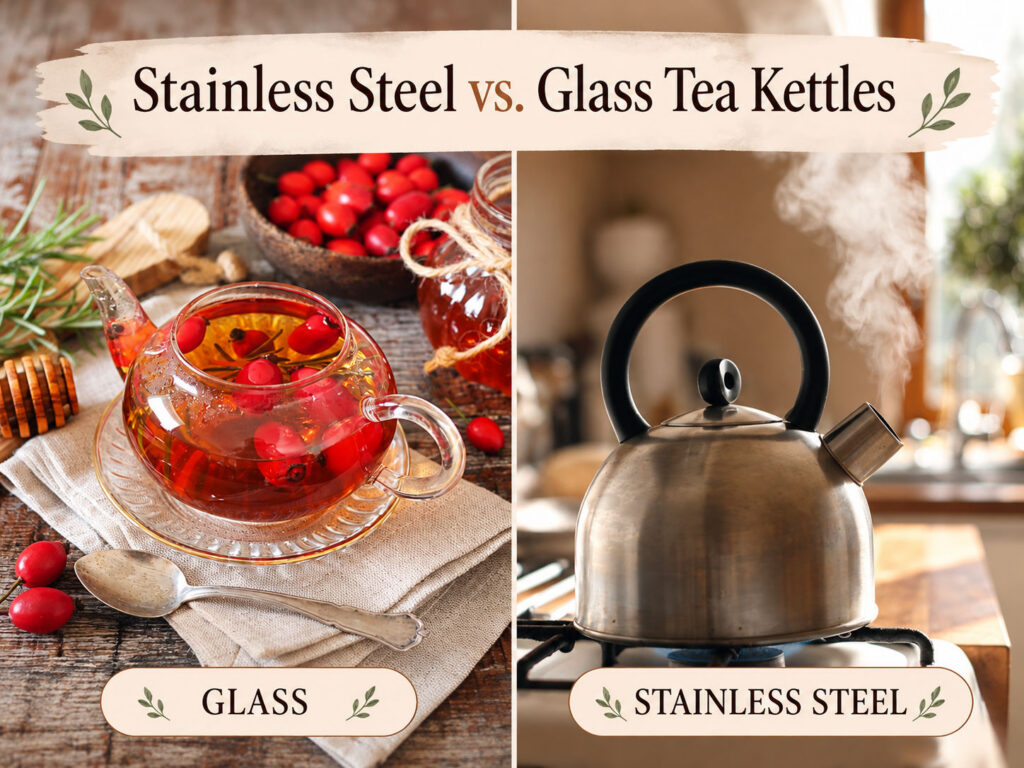
Choosing the right tea kettle can make your daily tea routine easier, more convenient, and more enjoyable. Whether you prefer a traditional stovetop kettle or a modern electric model with temperature controls, the material is one of the first things you’ll notice when comparing your options.
Two of the most popular choices are stainless steel and glass.
Stainless-steel kettles are known for their durability, practical designs, and ability to withstand everyday kitchen use. They’re available in traditional whistling styles, modern electric models, and precise gooseneck designs intended for controlled pouring.
Glass kettles offer a different experience. Their transparent bodies allow you to watch the water heat, see exactly how much remains inside, and notice mineral deposits before they become difficult to remove. Many use heat-resistant borosilicate glass and have a sleek, modern appearance.
But does one material actually heat water faster, keep it hot longer, or make better-tasting tea?
Stainless steel is generally the better choice for durability and long-term everyday use, while glass is ideal for anyone who values visibility, easy water-level monitoring, and a modern appearance. Both can heat water efficiently, and neither material is automatically better for tea flavor.
The quality of the kettle’s construction, heating system, temperature controls, and safety features often matters more than the material alone.
Understanding the differences will help you choose a kettle that suits your favorite teas, your kitchen, and the way you prefer to prepare hot water.
🫖 What’s the Difference Between Stainless Steel and Glass Tea Kettles?
The most obvious difference is the material used to construct the kettle’s main body.
Stainless-steel kettles have a metal water chamber made from a corrosion-resistant steel alloy. Stainless steel is widely used in kitchen equipment because it’s strong, relatively easy to maintain, and capable of tolerating repeated heating when used as intended.
A stainless-steel kettle may have a brushed, polished, painted, or coated exterior. Some models feature insulated double-wall construction, while others have a single metal wall.
Glass kettles are generally made with heat-resistant glass, frequently borosilicate glass, which is designed to tolerate temperature changes better than ordinary glass.
Most modern glass electric kettles also contain other materials.
For example, the main body may be glass, but the heating plate, spout filter, lid components, and base may include stainless steel, silicone, or plastic.
This means that choosing a glass kettle doesn’t necessarily mean that every surface touching the water is made from glass.
Similarly, a stainless-steel kettle may include a plastic water-level window or interior lid components.
When comparing kettles, look at the complete construction rather than assuming the name of the main material describes every part.
Both stainless steel and glass can be excellent choices when they’re used in well-designed, food-safe kettles intended for heating drinking water.
⚖️ Stainless Steel vs. Glass Tea Kettles at a Glance
| Feature | Stainless Steel | Glass |
|---|---|---|
| Durability | Generally resists everyday impact better | More vulnerable to cracks and breakage |
| Water visibility | Requires a window or opening the lid | Water level and boiling are visible |
| Heating speed | Depends mainly on heating system and power | Depends mainly on heating system and power |
| Heat retention | Insulated models can retain heat well | Single-wall models may cool relatively quickly |
| Cleaning | Usually straightforward, but deposits are hidden | Deposits are easy to see but more noticeable |
| Appearance | Traditional, modern, or industrial | Transparent, contemporary appearance |
| Weight | Depends on thickness and construction | Depends on thickness and construction |
| Temperature controls | Available on many electric models | Available on many electric models |
| Best for | Durability, frequent use, and practicality | Visibility, appearance, and easy inspection |
These are general differences rather than universal rules.
A high-quality glass kettle may have better temperature controls than an inexpensive stainless-steel model. Likewise, a double-wall stainless-steel kettle may retain heat much longer than a basic single-wall design.
The individual kettle’s features and construction should ultimately guide your decision.
🔥 Which Kettle Heats Water Faster?
One common assumption is that stainless-steel kettles boil water faster because metal conducts heat more efficiently than glass.
Although stainless steel and glass have different thermal properties, that doesn’t automatically mean one type of electric kettle will heat water substantially faster.
In an electric kettle, the heating element provides the energy needed to raise the water temperature.
The time required depends on several factors, including the heating element’s wattage, the amount of water, its starting temperature, the kettle’s efficiency, and the surrounding conditions.
For example, Breville offers both glass and stainless-steel electric kettles with powerful heating elements designed to bring water to a boil quickly.
Its Crystal Clear glass kettle uses an 1,800-watt heating system, demonstrating that glass-bodied kettles are fully capable of rapid boiling.
The manufacturer’s stainless-steel models are also available with powerful heating elements.
A well-designed glass kettle may therefore heat water faster than a less powerful stainless-steel model, while the opposite can also be true.
If boiling speed matters to you, compare the actual wattage and manufacturer-stated heating performance rather than relying on the material alone.
Also consider the minimum fill level.
If you usually make one cup of tea, a kettle that safely heats a small quantity of water may be more convenient than a large model that requires substantially more water for each cycle.
For most households, choosing a kettle with suitable capacity and heating performance matters more than whether its body is made from stainless steel or glass.
🌡️ Which Kettle Keeps Water Hot Longer?
Heat retention is another factor worth considering, particularly if you enjoy several cups of tea throughout the morning.
However, stainless steel isn’t automatically better at holding heat simply because it’s metal.
Stainless steel conducts heat more readily than glass, and a basic single-wall metal kettle can lose heat through its exterior.
A single-wall glass kettle can also cool relatively quickly.
The larger difference often comes from insulation.
Some stainless-steel electric kettles feature double-wall construction, with an inner chamber and an outer shell separated by an insulating space or material.
This design can reduce heat loss and may help prevent the exterior from becoming as hot as a comparable single-wall kettle.
For example, COSORI offers double-wall stainless-steel kettles designed with insulation and a cooler-touch exterior.
Glass kettles are also available in different constructions, but many common electric models have transparent single-wall bodies.
If your main concern is keeping water warm for an extended period, look for insulated construction or an electric kettle with a dedicated keep-warm setting.
Breville offers both stainless-steel and glass temperature-controlled kettles with keep-warm functionality.
That feature may be more useful than relying on passive heat retention alone.
It’s also worth remembering that holding water at a selected temperature consumes additional electricity.
If you only make one cup at a time, reheating a suitable amount of fresh water when needed may be more practical than keeping a full kettle hot.
👀 Why Choose a Glass Tea Kettle?
The greatest advantage of a glass kettle is visibility.
With a clear body, you can see the water level before you begin heating, monitor the formation of bubbles, and watch the water reach a rolling boil.
This makes the process feel more interactive than using a solid metal kettle.
The transparency is also convenient when you’re trying to avoid heating more water than necessary.
Instead of relying on a narrow water-level window, you can see the contents directly through the glass.
Glass kettles are particularly attractive in modern kitchens because the water itself becomes part of the appearance.
Some electric models include subtle lighting that illuminates the kettle while it’s operating.
However, appearance isn’t the only benefit.
Glass makes mineral deposits easy to notice.
If you live in a hard-water area, you may see a thin white film beginning to form along the bottom or waterline.
Being able to see that buildup encourages regular descaling before it becomes excessive.
Glass is also generally a neutral material for contact with ordinary drinking water when the kettle is properly manufactured and maintained.
However, these advantages come with a few drawbacks.
Glass can crack or break if the kettle is dropped, struck against a hard surface, or subjected to inappropriate temperature changes.
It also reveals fingerprints, water spots, and mineral buildup that might be less noticeable on an opaque metal kettle.
If you enjoy watching water heat and don’t mind a little extra attention to handling and appearance, glass can be an excellent choice.
🥇 Why Choose a Stainless-Steel Tea Kettle?
Stainless steel is one of the most practical materials for everyday kettle use.
Its main advantage is durability.
Unlike glass, stainless steel doesn’t shatter when struck. A metal kettle can still dent, become damaged, or develop problems with its handle or heating components, but the body generally tolerates ordinary kitchen bumps better than glass.
This can be especially useful in a busy household where kitchen appliances are moved, stored, and handled frequently.
Stainless steel is also available in an enormous variety of designs.
Traditional stovetop whistling kettles commonly use stainless steel, as do modern electric kettles, double-wall insulated models, and specialized gooseneck kettles.
This gives you considerable flexibility.
If you prefer heating water on the stove, stainless steel is a practical choice when the kettle is designed for your particular cooktop.
If you prefer electric convenience, there are models with basic on-off switches, preset brewing temperatures, or adjustable temperature controls.
Another advantage is that the metal body can conceal ordinary mineral marks that might be obvious through transparent glass.
However, this can also be a disadvantage.
Because you can’t see through solid stainless steel, you’ll need to inspect the interior periodically for limescale.
Some stainless-steel kettles have viewing windows, which provide a useful compromise.
The metal exterior can also become extremely hot during operation, particularly on single-wall models.
A stainless-steel kettle should never be assumed safe to touch immediately after boiling unless its manufacturer specifically describes a suitable cool-touch design.
For households that prioritize durability, versatility, and a straightforward everyday appliance, stainless steel is often the most practical choice.
🍵 Does Stainless Steel or Glass Make Better-Tasting Tea?
For most tea drinkers, the kettle’s material has relatively little direct effect on the flavor of the finished tea.
Both properly manufactured stainless-steel and glass kettles can heat drinking water without introducing noticeable unwanted flavors during normal use.
However, other factors can make a substantial difference.
Water quality is particularly important.
Tea is mostly water, so minerals, chlorine, and other characteristics of your water supply can influence the finished infusion.
A kettle won’t automatically correct water that already has an unpleasant taste.
Limescale is another consideration.
Mineral deposits can accumulate inside either material, especially when hard water is used regularly.
Heavy buildup can interfere with the performance of some kettles and may release small mineral particles into the water.
Residual cleaning products can also affect flavor.
If a kettle hasn’t been rinsed thoroughly after descaling, traces of vinegar or another cleaning solution may make the next cup taste unusual.
Some people are concerned about metallic flavors from stainless steel.
A properly manufactured, undamaged food-contact stainless-steel kettle generally shouldn’t impart a noticeable metallic taste to ordinary drinking water.
If your water develops a persistent metallic or chemical odor, inspect the kettle, follow the manufacturer’s cleaning instructions, and investigate the water supply rather than assuming the material itself is always responsible.
Glass also doesn’t guarantee that water contacts only glass, because many electric models use stainless-steel heating plates or other components.
Ultimately, the water you use, the temperature you choose, and the way you brew your tea have a much greater influence on flavor than whether your kettle is glass or stainless steel.
For more information, see Does Water Quality Affect Tea?.
🍃 Which Kettle Is Better for Green, White, Black, and Oolong Tea?
Tea varieties have different brewing requirements, particularly when it comes to water temperature.
This makes temperature control more important than kettle material for many tea enthusiasts.
Green Tea
Many everyday green teas benefit from water around 160–185°F, although some varieties require cooler or hotter temperatures.
Delicate Japanese teas such as gyokuro may be prepared with much cooler water, while roasted hojicha can tolerate boiling water.
A temperature-controlled kettle is especially helpful because it allows you to heat the water directly to the temperature you want.
Both glass and stainless-steel electric kettles are available with variable-temperature controls.
Although watching bubbles form in a glass kettle can be interesting, their appearance is not a precise substitute for measuring water temperature.
Choose a kettle with reliable temperature settings if you regularly brew delicate green teas.
White Tea
White tea is often prepared with moderately hot water, although recommended temperatures vary significantly.
A variable-temperature kettle makes it easier to experiment with different white teas without repeatedly bringing the water to a full boil.
Either glass or stainless steel works well.
The material is less important than controlling the water temperature and allowing the tea leaves to steep appropriately.
Black Tea
Many black teas, including robust Assam and breakfast blends, are commonly prepared with water at or near boiling.
A simple electric or stovetop kettle can handle this task effectively.
If you primarily drink black tea, you may not need adjustable temperature settings at all.
A durable stainless-steel kettle could be a particularly practical choice, but glass works equally well when designed for boiling water.
Oolong Tea
Oolong teas vary considerably.
Lightly oxidized floral oolongs may benefit from somewhat cooler water, while darker roasted varieties often respond well to hotter temperatures.
If you enjoy experimenting with different oolongs, a kettle with adjustable temperature controls is useful.
Both glass and stainless-steel models can provide that flexibility.
Herbal Tea
Many herbal infusions are prepared with water near boiling, although the correct method depends on the ingredients.
Peppermint, chamomile, rooibos, and many fruit blends can be prepared using a basic kettle.
Some roots and other ingredients require simmering or a different preparation method, so follow the directions for the particular herb.
If you mostly drink ordinary herbal teas, either kettle material is suitable.
For more detailed temperature recommendations, see Best Water Temperature for Tea: A Complete Brewing Guide by Tea Type.
🧼 Which Is Easier to Clean: Stainless Steel or Glass?
Both stainless-steel and glass kettles can be relatively easy to maintain, but they have different advantages.
Stainless steel usually tolerates everyday handling well and can be wiped clean with a soft cloth.
Glass makes it easier to see whether the interior needs descaling.
However, a clear kettle may require more frequent exterior wiping if you want it to remain spotless.
Mineral buildup is the most common cleaning problem for both materials.
When hard water is heated, calcium compounds can form chalky deposits known as limescale.
These deposits frequently collect near the bottom of the kettle or along the waterline.
KitchenAid recommends descaling frequently used kettles approximately once a month, with more frequent cleaning potentially necessary in hard-water conditions.
The correct cleaning method depends on the particular appliance.
For some compatible electric kettles, KitchenAid recommends a solution of one part white vinegar to three parts water.
However, other manufacturers specify different solutions, concentrations, and soaking times.
Always follow the directions for your kettle.
For routine exterior cleaning, a soft, slightly damp cloth is usually sufficient.
Avoid steel wool and aggressive scouring pads, which can scratch stainless steel or damage glass and other components.
Never immerse an electric kettle or its power base in water unless the manufacturer explicitly permits it.
If your kettle has a removable scale filter near the spout, clean it according to the manufacturer’s instructions.
Ultimately, glass makes buildup easier to spot, while stainless steel may make small stains less noticeable.
Neither material eliminates the need for occasional descaling.
🪨 Which Kettle Is Better for Hard Water?
If your home has hard water, you can expect mineral deposits to develop inside either a glass or stainless-steel kettle.
The kettle material doesn’t remove calcium and magnesium from the water.
As the water is repeatedly heated, some of these minerals can form scale on the interior surfaces.
A glass kettle offers the practical advantage of allowing you to see the deposits immediately.
That can make it easier to decide when cleaning is necessary.
However, the white or cloudy appearance may become frustrating if you prefer your kettle to look spotless at all times.
A stainless-steel kettle conceals the scale behind its opaque walls, but the deposits still accumulate.
You need to inspect the inside rather than relying on the exterior appearance.
A kettle with a wide lid opening is helpful because it provides easier access for cleaning and inspection.
A removable scale filter can also catch some loose mineral particles before they reach your cup.
If hard water is a major concern, choose whichever material you prefer and look for a design that’s easy to descale.
Using appropriate water treatment may help reduce mineral buildup, but not every household water filter removes hardness.
Many activated-carbon filters primarily improve taste and odor rather than substantially reducing dissolved calcium and magnesium.
Our Tap Water vs. Filtered Water for Tea guide explains the differences.
🛡️ Are Glass or Stainless-Steel Kettles Safer?
Both materials can be used safely for heating drinking water when the kettle is properly designed, maintained, and operated according to its instructions.
However, the potential hazards are somewhat different.
Glass kettles are vulnerable to breakage.
Even heat-resistant borosilicate glass can chip, crack, or shatter after impact or exposure to conditions outside its intended limits.
Never continue using a glass kettle that has developed a crack or damaged rim.
Stainless-steel kettles are generally more resistant to impact, but their exterior surfaces can become extremely hot.
This is especially important with single-wall designs.
Glass kettle bodies can also become hot enough to cause burns, so don’t assume the transparent surface is safe to touch while the water is boiling.
Use the handle and avoid touching exposed hot surfaces.
For electric kettles, look for automatic shutoff, boil-dry protection, stable bases, and lid designs that help control steam.
Breville, for example, offers glass and stainless-steel models with automatic shutoff and lids designed to reduce hot-water splashing.
These safety features are associated with the kettle’s design rather than its body material.
Another consideration is the materials that contact the water.
A glass kettle may contain stainless-steel heating components and plastic or silicone parts. A stainless-steel model may also include nonmetal components around its lid, filter, or water-level window.
If minimizing contact with certain materials is important to you, examine the manufacturer’s specifications rather than assuming the entire interior is made from the advertised body material.
Neither a glass nor a stainless-steel label automatically guarantees superior health outcomes.
The most important factors are safe construction, appropriate food-contact materials, and proper use.
🔥 Stainless Steel vs. Glass for Stovetop Kettles
The distinction between stainless steel and glass becomes particularly important when choosing a stovetop kettle.
Stainless steel is widely used for traditional stovetop models because it can tolerate direct heat when properly constructed.
Many include a whistle that signals when the water has reached a boil.
However, compatibility still depends on the cooktop.
For example, an induction stove requires cookware with a suitable magnetic base.
Not every stainless-steel kettle is induction-compatible, so check the manufacturer’s specifications.
Glass stovetop kettles are less common and require special attention.
Some glass kettles are specifically manufactured for direct stovetop use, but many glass vessels are designed only for receiving hot water or use with an electric heating base.
A glass teapot is not automatically a stovetop-safe kettle, even if it’s made from borosilicate glass.
Never place a glass electric kettle on a burner.
Likewise, don’t put an ordinary glass teapot directly on a stove unless its manufacturer explicitly approves that use.
If you want a simple, durable stovetop kettle for everyday boiling, stainless steel is generally the more straightforward choice.
If you specifically want a glass stovetop kettle, look for a model with clear instructions describing the permitted heat source, burner size, and temperature limitations.
For a broader comparison of heating methods, see How to Choose a Tea Kettle: Electric vs. Stovetop, Materials & Features.
⚡ Stainless Steel vs. Glass Electric Kettles
Electric kettles offer convenience because they heat water using an integrated electrical element rather than a stovetop burner.
Many models shut off automatically once boiling is complete.
Some also provide preset temperatures, digital displays, and keep-warm settings.
Both stainless steel and glass are widely used in electric-kettle construction.
A stainless-steel model may be available with insulated walls or a particularly durable outer shell.
A glass model provides an unobstructed view of the water and may include decorative illumination during heating.
However, the heating technology can be similar.
In many electric kettles, the heating element transfers energy through a metal plate at the bottom of the water chamber.
This is why a glass-bodied kettle may still contain stainless steel inside.
If you’re choosing between electric models, compare the features that affect your everyday routine.
A temperature-controlled kettle may be especially helpful for someone who enjoys several types of tea.
A basic boil-only model may be perfectly adequate for someone who mainly drinks black tea or ordinary herbal infusions.
Capacity, heating speed, ease of pouring, safety features, and cleaning access often matter more than the material itself.
💰 Which Kettle Is More Affordable?
Stainless-steel and glass kettles are both available at a wide range of prices.
You can find inexpensive electric versions of either material, along with premium models featuring digital controls, specialty construction, and precise temperature settings.
The price often reflects much more than the kettle’s body material.
Features such as adjustable temperatures, double-wall insulation, keep-warm settings, high-quality lids, and specialized pouring spouts can increase the cost.
A basic stainless-steel kettle may cost considerably less than a premium glass model.
However, an inexpensive glass kettle may also be more affordable than a sophisticated stainless-steel gooseneck kettle.
If you’re comparing costs, look at what the kettle actually offers.
A simple, well-designed model that reliably heats the amount of water you need may be a better purchase than an expensive appliance with features you’ll rarely use.
Durability is also worth considering.
Because stainless steel generally withstands impact better than glass, it may be a more forgiving long-term choice for a busy kitchen.
However, overall lifespan also depends on the heating element, switches, seals, electrical components, and how well the kettle is maintained.
An expensive kettle isn’t necessarily a better value unless its construction and features suit your needs.
🛍️ What Should You Look for When Buying a Tea Kettle?
Once you’ve decided which material appeals to you, pay attention to the design details that will affect everyday use.
Start with capacity.
If you usually make one or two cups of tea, a smaller kettle may be perfectly sufficient.
For households preparing several cups at once, a kettle holding approximately 1.5–1.7 liters may be more convenient.
However, make sure the minimum fill requirement suits your normal brewing quantity.
Heating more water than necessary wastes time and energy.
Next, consider the handle and pouring spout.
The handle should feel comfortable when the kettle is full, and the spout should allow you to pour without excessive dripping or splashing.
A gooseneck spout can be useful for controlled pouring, particularly when preparing pour-over coffee or using small brewing vessels.
However, ordinary tea brewing usually doesn’t require the precision of a gooseneck.
Lid design is another important feature.
A wide opening makes the kettle easier to fill and descale.
A secure lid helps reduce the risk of accidental spills, while a controlled opening mechanism can help manage hot steam.
For electric models, check whether the kettle has automatic shutoff and boil-dry protection.
If you enjoy temperature-sensitive teas, look for adjustable temperature settings rather than relying exclusively on a full-boil function.
Finally, examine the materials and cleaning instructions.
A good kettle should be easy enough to maintain that you won’t dread cleaning it.
🏡 Which Kettle Is Better for Everyday Tea Drinking?
For most households, a stainless-steel kettle is a practical all-around choice.
It’s durable, widely available, and suitable for many different kitchen arrangements.
If you make tea several times a day, a reliable stainless-steel electric kettle with an easy-to-clean interior and appropriate capacity may be all you need.
An insulated model can also be useful if you want better passive heat retention.
However, glass is an excellent alternative.
If you enjoy watching the water heat, prefer a transparent design, or want to see when mineral buildup begins forming, a glass kettle can make the routine more pleasant.
It may be especially appealing in a kitchen where the kettle stays on the counter and becomes part of the overall appearance.
Neither material determines whether you can make excellent tea.
If you regularly brew delicate green or white teas, reliable temperature control may be the most valuable feature.
If you primarily drink strong black tea, a simple boil-only kettle may be enough.
If your household is busy and equipment gets knocked around frequently, stainless steel may be the more forgiving option.
If appearance and visibility are your priorities, glass may be more satisfying.
The right choice is the one that fits the way you actually use your kettle.
❓ Frequently Asked Questions
Is a stainless-steel or glass kettle better?
Stainless steel is generally better for durability and everyday impact resistance, while glass offers visibility and a modern appearance. Both materials can heat water efficiently and make excellent tea. The better choice depends on your priorities and the individual kettle’s features.
Do stainless-steel kettles boil water faster than glass?
Not automatically. In electric kettles, boiling time depends heavily on heating power, water quantity, starting temperature, and overall design. A powerful glass kettle can heat water faster than a less powerful stainless-steel model.
Do stainless-steel kettles keep water hotter?
Some stainless-steel kettles have insulated double-wall construction that helps retain heat. However, an ordinary single-wall steel kettle isn’t guaranteed to retain heat better than every glass model. Insulation and design are more important than material alone.
Are glass kettles safe for boiling water?
Yes, glass kettles specifically manufactured for boiling water are designed for that purpose. Many electric models use heat-resistant borosilicate glass. However, glass can still break or crack if damaged or used improperly, so follow the manufacturer’s instructions.
Is stainless steel safe for boiling drinking water?
Properly manufactured food-contact stainless-steel kettles are widely used for heating drinking water. Follow the manufacturer’s instructions and discontinue use if the interior becomes severely corroded, damaged, or otherwise unsuitable.
Does a glass kettle make tea taste better?
Not inherently. A clean glass kettle and a properly maintained stainless-steel kettle should both provide neutral-tasting hot water under ordinary conditions. Water quality, brewing temperature, tea quantity, and steeping time usually have a greater effect on flavor.
Can stainless-steel kettles make water taste metallic?
A properly manufactured and maintained stainless-steel kettle generally shouldn’t produce a noticeable metallic taste. If the water tastes unusual, inspect the kettle, follow the cleaning instructions, and consider whether the water supply itself may be responsible.
Do glass kettles develop limescale?
Yes. Glass kettles develop mineral deposits just like stainless-steel kettles when used with hard water. The difference is that the transparent walls make those deposits easier to notice.
Which kettle is easier to clean?
Both can be straightforward to clean. Glass makes it easy to see stains and limescale, while stainless steel often conceals minor marks. The width of the lid opening, heating-plate design, and manufacturer’s cleaning instructions can matter more than the material.
Are glass kettles more fragile than stainless steel?
Generally, yes. Glass can crack or shatter after impact, while stainless steel is more resistant to breakage. However, stainless-steel kettles can still dent or develop problems with their handles, lids, and electrical components.
Can you put a glass tea kettle on the stove?
Only if the manufacturer specifically approves that exact model for stovetop heating. Many glass electric kettles and ordinary glass teapots aren’t designed for direct heat. Never place an electric kettle on a stove burner.
Are stainless-steel kettles compatible with induction stoves?
Some are, but not all. Induction cooking requires a suitable magnetic base. Check the manufacturer’s compatibility information before using a stainless-steel kettle on an induction cooktop.
Which kettle is better for green tea?
A kettle with reliable temperature controls is especially convenient for green tea because many varieties are brewed below boiling. Both glass and stainless-steel electric kettles are available with adjustable temperatures.
Are glass kettles heavier than stainless-steel kettles?
Not necessarily. Weight depends on the thickness of the glass or steel, capacity, insulation, handle, lid, and heating components. Compare the specifications of individual models rather than assuming one material is always lighter.
Do glass kettles contain plastic?
Some do. A glass kettle may have plastic or silicone components in the lid, handle, seals, or other areas. If water-contact materials matter to you, check the complete construction rather than relying on the description of the main body.
Is a glass or stainless-steel kettle better for hard water?
Both require descaling when used with hard water. Glass makes mineral buildup easier to see, while stainless steel may conceal it. A wide opening, removable scale filter, and straightforward cleaning instructions are useful features for either material.
Can you use a kettle to brew tea leaves directly?
Only when the kettle is specifically designed for brewing tea. Most ordinary kettles are intended to heat water rather than steep loose leaves. Using tea leaves in an unsuitable kettle can create staining, clog filters, or interfere with the appliance.
Is a more expensive kettle worth it?
It depends on the features. Adjustable temperature controls, good pouring design, insulation, and reliable safety features may justify a higher price if you’ll use them regularly. However, a simple, well-made kettle can be perfectly adequate for everyday tea.
🌸 Final Thoughts
Stainless-steel and glass tea kettles both have advantages, and neither is automatically the best choice for every household.
Stainless steel is generally the more durable option.
It withstands ordinary bumps and handling well, comes in a wide range of electric and stovetop designs, and can offer excellent heat retention when combined with suitable insulation.
Glass provides a different experience.
Its transparent body allows you to watch water heat, monitor the fill level, and notice mineral buildup before it becomes excessive.
It can also be a beautiful addition to a modern kitchen.
However, glass requires more careful handling because it can crack or break, and its clear surface makes water spots and scale more noticeable.
When it comes to boiling speed and tea flavor, the differences are less dramatic than they may initially appear.
A kettle’s heating system, wattage, capacity, and construction have a greater influence on boiling performance than its body material alone.
Likewise, clean stainless steel and glass can both provide excellent water for brewing tea.
For anyone who enjoys delicate green, white, or oolong teas, adjustable temperature controls may be more useful than choosing one material over the other.
If durability and everyday practicality are your priorities, stainless steel is an excellent choice.
If you love the appearance of a clear kettle and appreciate being able to see exactly what’s happening inside, glass may be more enjoyable.
Ultimately, the best tea kettle is one that’s safe, easy to use, comfortable to pour, and well suited to the teas you drink most often.
Choose the material that fits your routine, then pay attention to the features that make preparing your favorite cup of tea simpler and more consistent.
🔗 Related Articles
- How to Choose a Tea Kettle: Electric vs. Stovetop, Materials & Features
- Best Water Temperature for Tea: A Complete Brewing Guide by Tea Type
- Best Water Temperature for Green Tea: Sencha, Matcha, Gyokuro & More
- Tap Water vs. Filtered Water for Tea: Which Makes a Better Cup?
- How to Choose a Teapot: Materials, Sizes & Best Teapots for Every Tea
- Tea Gear & Accessories: Teapots, Kettles, Infusers, Cups & More
- Best Tea Makers: Electric Brewers, Kettles & Infusers Compared
📚 Sources & Further Reading
- KitchenAid — Types of Tea Kettles: Buying Guide
- KitchenAid — How to Clean an Electric Kettle
- Breville — The Crystal Clear Glass Electric Kettle
- Breville — The Smart Crystal Luxe Glass Kettle
- Breville — The Smart Kettle Luxe Stainless-Steel Kettle
- COSORI — Double-Wall Stainless-Steel Electric Kettle
- COSORI — Electric Kettle User Manuals and Care Instructions