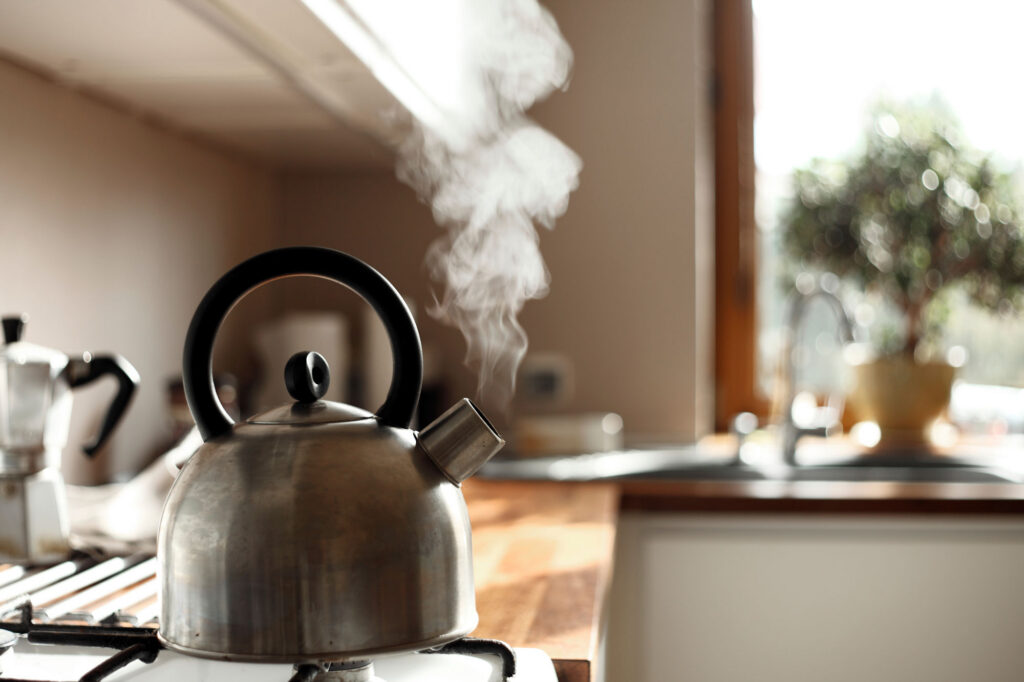
There’s something comforting about putting the kettle on for a fresh cup of tea. Whether you’re preparing a delicate green tea or a strong morning black tea, the process usually begins with clean water heated to the right temperature. But what happens when the kettle starts producing an unpleasant smell?
Perhaps your new electric kettle smells like plastic whenever it heats up. Maybe an older stainless-steel kettle has developed a metallic odor, or the water has started smelling musty even though the inside looks reasonably clean.
Some people notice a sulfur-like smell when water reaches a boil, while others discover that their kettle smells like vinegar long after they’ve finished descaling it.
These problems have different causes, and understanding the type of odor is the first step toward finding the right solution.
A tea kettle may smell because of new-appliance materials, mineral deposits, cleaning-product residue, trapped moisture, or an odor already present in the water. However, a burning electrical smell can indicate a potentially dangerous appliance problem and should never be treated as an ordinary cleaning issue.
Fortunately, many unpleasant kettle odors can be resolved through proper cleaning, descaling, and rinsing.
The important thing is to identify where the smell originates before attempting to remove it.
Here’s why tea kettles develop unusual odors, how to troubleshoot them, and when cleaning is appropriate versus when the kettle should no longer be used.
🫖 Why Does a Tea Kettle Develop an Unpleasant Smell?
A tea kettle is designed primarily to heat water, so it generally accumulates less food residue than a saucepan or coffee maker.
However, several things can affect the smell of the kettle and the water inside it.
One possibility is residue left during manufacturing. New kettles may have odors associated with packaging, plastic components, or materials that haven’t yet been through their initial cleaning and heating cycles.
Another common cause is mineral buildup.
When water containing dissolved calcium and magnesium is repeatedly heated, mineral deposits can form along the bottom and walls of the kettle. This buildup is known as limescale.
Limescale itself isn’t generally responsible for a strong rotten-egg or burning smell, but heavy deposits can interfere with heating performance and make cleaning more difficult.
Lingering cleaning products are another possibility.
If you’ve recently descaled your kettle with vinegar or another solution, traces of the cleaner may remain when the kettle hasn’t been rinsed thoroughly.
Odors can also originate from the water rather than the appliance.
Heating may make certain existing water odors easier to notice, particularly when gases or other volatile substances escape into the air.
Finally, a kettle can develop smells from problems outside the water chamber.
A stovetop kettle may have grease or food residue burning on its exterior, while an electric kettle may develop a dangerous odor if an electrical component overheats.
These possibilities require different responses, which is why simply pouring vinegar into every smelly kettle isn’t the best approach.
👃 What Different Tea Kettle Smells May Mean
The type of smell can help narrow down the possible cause.
| Smell | Possible explanation | What to do first |
|---|---|---|
| Plastic or chemical smell in a new kettle | New materials or manufacturing residue | Follow first-use cleaning instructions |
| Metallic smell | Water chemistry, residue, or material deterioration | Compare the water before and after heating |
| Musty or stale smell | Trapped moisture, residue, or water-quality problem | Inspect and clean the kettle |
| Rotten eggs or sulfur | Hydrogen sulfide or a water-supply issue | Check the water separately from the kettle |
| Vinegar | Residue from descaling | Rinse using the manufacturer’s procedure |
| Soap or detergent | Incomplete rinsing | Rinse thoroughly with clean water |
| Burning plastic or electrical smell | Overheating or appliance fault | Stop using the kettle immediately |
| Burnt food or grease | Residue on a stovetop kettle’s exterior | Turn off heat, cool, and inspect |
These are possible explanations rather than confirmed diagnoses.
An odor alone cannot establish whether drinking water is safe or whether an electrical appliance is functioning correctly.
If the smell is strong, chemical, burning, or otherwise concerning, don’t continue using the kettle simply to see whether it eventually disappears.
🧴 Why Does My New Electric Kettle Smell Like Plastic?
A plastic-like smell is one of the most common complaints associated with new electric kettles.
Even kettles advertised as stainless steel or glass may contain plastic or silicone components around the lid, handle, seals, or electrical housing.
Some new appliances develop a noticeable odor during their first heating cycles.
Manufacturers including T-fal and Krups acknowledge that certain new kettles, particularly models with plastic water chambers, can initially give water a plastic-like taste.
Their guidance recommends discarding water from the first few uses and provides additional cleaning instructions for compatible models when necessary.
However, this doesn’t mean every plastic smell should automatically be considered harmless.
A faint first-use odor that disappears after the manufacturer’s recommended cleaning procedure is different from a strong chemical smell that persists or becomes more intense.
If you’ve just purchased a kettle, begin by reading the first-use section of the owner’s manual.
Remove all packaging materials and protective films as instructed. Check that nothing remains around the lid, exterior, or heating base.
Follow the manufacturer’s recommended initial rinse and boiling procedure, discarding the water rather than using it for tea.
Some kettles require one initial boil, while others recommend repeating the process.
If the manufacturer provides a specific odor-removal treatment, use that procedure rather than experimenting with household cleaners.
If the kettle continues producing a strong plastic or chemical smell after the recommended preparation, stop using it and contact the manufacturer or retailer.
A persistent odor shouldn’t be dismissed simply because the appliance is new.
🥇 Why Does My Stainless-Steel Tea Kettle Smell Metallic?
A metallic smell can be particularly noticeable when heating water in a stainless-steel kettle.
However, properly manufactured food-contact stainless steel generally shouldn’t contribute a strong metallic odor during normal use.
If you notice one, several possibilities are worth investigating.
The smell may be coming from the water itself. Water containing relatively high concentrations of iron or other substances can develop metallic tastes or odors.
The U.S. Environmental Protection Agency identifies metallic taste as one possible sign associated with certain water-quality characteristics, including iron and corrosion.
Another possibility is residue inside a new kettle.
Manufacturing or packaging residue should be addressed through the manufacturer’s first-use cleaning procedure.
In an older kettle, unusual discoloration, corrosion, or damage to the interior may also warrant inspection.
Mineral deposits can appear white, gray, cream-colored, or slightly brown, depending on the water.
However, ordinary limescale shouldn’t automatically be confused with rust or deteriorating metal.
If you notice pitting, flaking material, significant corrosion, or damage to an interior coating, discontinue use until the manufacturer confirms that the kettle remains suitable for heating drinking water.
To investigate a metallic odor, compare the water before and after heating.
If the smell is present in fresh, unheated water, the kettle may not be responsible.
If it appears only after heating in that particular appliance, cleaning or manufacturer troubleshooting may be appropriate.
For more on kettle materials, see Stainless Steel vs. Glass Tea Kettles: Which Is Better?.
🪨 Can Limescale Make a Tea Kettle Smell?
Limescale is one of the most common types of buildup inside tea kettles.
It forms when certain dissolved minerals in water become solid deposits during heating.
The deposits usually appear as a chalky white film, crusty patches, or small flakes that break away from the interior.
Limescale isn’t normally associated with a strong odor on its own.
However, heavy mineral buildup can contribute to poor kettle performance and may make the appliance more difficult to maintain.
Fellow explains that substantial limescale can affect heating efficiency, temperature readings, and the way water behaves during boiling.
In some situations, residue may also accumulate around mineral deposits or in difficult-to-clean areas.
If your kettle smells unpleasant and has visible buildup, descaling is a reasonable maintenance step when the material and manufacturer permit it.
However, don’t assume that removing limescale will solve every smell.
A sulfur-like odor originating from the water supply, for example, requires a different investigation.
Likewise, descaling cannot repair damaged electrical components or eliminate a dangerous burning smell.
For a detailed explanation of the cleaning process, see How to Remove Limescale From a Kettle.
🌫️ Why Does My Tea Kettle Smell Musty?
A musty or stale odor can develop when moisture remains trapped in parts of a kettle that don’t dry easily.
Although the main chamber is designed to hold water, the lid, spout, filter, and other small components may collect residue.
Some electric kettles contain a removable mesh filter near the pouring spout.
This filter is designed to catch loose mineral particles before they enter your cup.
Over time, it can become coated with deposits or collect other residue.
If the kettle is stored damp for extended periods, particularly after sitting unused, an unpleasant smell may develop.
However, a musty odor doesn’t automatically prove that mold is growing inside the kettle.
It may also come from the water supply or surrounding environment.
Begin by emptying the kettle and inspecting all accessible areas after it has cooled.
Check the underside of the lid, filter, spout, and interior surfaces.
If your manufacturer permits routine washing with mild dish soap, clean the approved parts gently and rinse thoroughly.
For removable scale filters, follow the instructions for taking them out and cleaning them separately.
KitchenAid recommends rinsing its compatible mesh filters with hot water and gently removing deposits using a soft brush or cloth.
Allow the kettle and removable components to dry before storing.
If you see mold-like growth, damaged seals, or inaccessible contamination that cannot be thoroughly cleaned, don’t continue using the kettle until the issue has been resolved.
A persistent musty odor after proper cleaning may also indicate that the water itself needs investigation.
🥚 Why Does My Kettle Water Smell Like Rotten Eggs?
A rotten-egg smell is often associated with hydrogen sulfide, a gas that can occur in certain water supplies.
Hydrogen sulfide may be present in groundwater or produced through bacterial activity involving sulfur compounds.
The Minnesota Department of Health explains that rotten-egg odors can originate from different parts of a household water system, including groundwater, wells, water softeners, and water heaters.
This is an important distinction because the tea kettle may simply be making an existing water odor more noticeable.
When water is heated, dissolved gases can escape more readily, bringing the smell into the surrounding air.
To investigate, compare the water at the source before heating it.
Use a clean glass to collect cold water from the faucet and move away from the sink before checking its odor.
This helps distinguish an odor in the water from one originating in the sink drain.
If the cold water smells unusual before it enters the kettle, cleaning the kettle won’t solve the underlying problem.
If only household hot tap water smells, the issue may involve the home’s water heater rather than the cold drinking-water supply.
The Minnesota Department of Health provides guidance for distinguishing these situations.
However, a household water heater is not the same appliance as a tea kettle, and it shouldn’t be assumed to be responsible when you’re filling the kettle directly from the cold tap.
If the odor is new, persistent, or present throughout the water supply, contact your water provider or an appropriate water-testing professional.
For private wells, consult your local health department about suitable testing.
Don’t assume that boiling suspicious-smelling water will remove every possible contaminant or make it safe to drink.
🔥 Why Does My Electric Kettle Smell Like It’s Burning?
A burning smell is different from an ordinary stale-water or vinegar odor.
If your electric kettle smells like burning plastic, overheated wiring, or smoke, stop using it immediately.
Switch it off and unplug it if doing so is safe. If the plug or outlet is damaged, smoking, sparking, or too hot to handle safely, avoid touching it and disconnect power only through a safe method.
Do not run another boiling cycle to see whether the smell disappears.
Some manufacturers note that a faint odor may occur during the first use of a new appliance. However, a persistent, strong, or worsening burning smell is not normal.
Possible causes include overheating, electrical faults, damaged components, or an appliance that has operated without sufficient water.
Electric kettles commonly include boil-dry protection, but this feature isn’t a reason to ignore evidence of overheating.
A kettle that has boiled dry may become extremely hot before shutting itself off, and certain components could be damaged.
Inspect the appliance only after it has cooled and the power has been disconnected.
Look for obvious problems such as melted plastic, discoloration, cracking, or damage around the base.
If any damage is present, do not use the kettle.
Contact the manufacturer for guidance about repair or replacement.
Never attempt to open or repair electrical components unless you’re qualified to do so.
A burning smell is a reason to prioritize safety, not an invitation to try increasingly strong cleaning solutions.
🔥 Why Does My Stovetop Kettle Smell Burnt?
Stovetop kettles can develop unpleasant burning odors for reasons unrelated to the water inside.
Kitchen grease, cooking oil, and food residue may collect on the kettle’s exterior, particularly when it sits near other burners.
When the kettle is heated, these substances can begin producing an odor.
Fellow recommends keeping stovetop kettles clean and dry, noting that oils and other kitchen residue may accumulate on their surfaces.
Another possibility is that the kettle has been heated without enough water.
Allowing a stovetop kettle to boil dry can cause extreme overheating and may damage its finish, handle, whistle, or other components.
Some kettles have heat-resistant nylon or plastic parts that are not designed to tolerate direct flames or excessive heat.
If your stovetop kettle develops a burnt smell, turn off the burner and allow the kettle to cool.
Do not touch hot metal or attempt to rinse an extremely hot kettle with cold water.
Once it has cooled, inspect the exterior and interior for residue or damage.
If the smell appears to come from ordinary cooking grease and the kettle is otherwise undamaged, follow the manufacturer’s cleaning instructions.
If there are melted parts, significant discoloration, warped components, or another sign of overheating, stop using the kettle.
If the odor resembles leaking gas rather than burning food, follow gas-leak safety procedures: leave the area and contact the gas utility or emergency services from a safe location.
🍋 Why Does My Kettle Smell Like Vinegar After Cleaning?
Vinegar is commonly used to remove mineral deposits from compatible tea kettles.
Its acidity helps dissolve the calcium carbonate that accumulates during repeated heating.
However, vinegar has a strong smell, and some of that odor may remain if the kettle isn’t rinsed thoroughly afterward.
This is especially noticeable when hot water releases the remaining vinegar aroma into the air.
Fortunately, lingering vinegar odor after an approved descaling treatment is usually a rinsing issue.
KitchenAid recommends boiling and discarding fresh water twice after completing the vinegar descaling process for certain electric kettles.
Fellow also emphasizes thorough rinsing after vinegar treatments.
If your kettle smells like vinegar after cleaning, begin by rinsing it with fresh water.
Then follow the manufacturer’s recommended post-descaling boiling and draining procedure.
If the odor remains, rinse again.
Don’t add other cleaning chemicals in an attempt to neutralize the smell.
In particular, never combine vinegar or citric acid with chlorine bleach because the reaction can release dangerous chlorine gas.
A thorough rinse is generally more appropriate than adding another household cleaning product.
If you dislike the smell of vinegar, citric acid may be an alternative for kettles whose manufacturers permit it.
Fellow identifies citric acid as an effective descaling option that generally leaves less lingering odor.
🧼 How to Clean a Smelly Tea Kettle
If the odor appears to come from ordinary residue and there are no signs of an electrical problem, physical damage, or suspicious water contamination, cleaning is a sensible next step.
However, the correct procedure depends on the appliance.
The following approach is suitable for many everyday kettles, but the manufacturer’s instructions should always take priority.
Step 1: Turn Off the Kettle and Let It Cool
For an electric kettle, switch it off, unplug it, and allow it to cool completely.
For a stovetop kettle, turn off the heat and wait until the kettle is cool enough to handle.
Never attempt to scrub or dismantle a hot kettle.
If there’s evidence of electrical overheating or other damage, stop here and seek manufacturer assistance rather than continuing with cleaning.
Step 2: Empty and Inspect the Interior
Pour out any remaining water.
Look for white mineral deposits, loose particles, unusual discoloration, or residue near the bottom.
Check the lid, spout, and removable filter.
Ordinary chalky limescale can generally be treated with a compatible descaler.
However, visible corrosion, flaking coatings, damaged seals, or suspected mold require separate attention.
Step 3: Wash the Approved Surfaces
Follow the manufacturer’s routine cleaning directions.
For kettles that permit mild dish soap, gently clean accessible interior surfaces with warm water and a soft sponge.
Rinse thoroughly.
Wipe the exterior with a suitable damp cloth, avoiding electrical connections and other components that must remain dry.
Never immerse an electric kettle or its power base in water.
If your kettle has a removable scale filter, clean it according to the manufacturer’s directions.
Step 4: Descale if Necessary
If visible limescale has developed, use the approved descaling solution and procedure.
For some KitchenAid models, the recommended mixture consists of one part white vinegar and three parts water.
Fellow recommends different concentrations for its compatible kettles.
These differences are important because there isn’t one universal descaling recipe suitable for every appliance.
Use the manufacturer’s specified dilution, heating instructions, and soaking time.
Avoid steel wool or abrasive scrapers.
Step 5: Rinse Thoroughly
Once cleaning is complete, empty the kettle and rinse with fresh water.
Make sure any loose mineral particles and cleaning residues have been removed.
If the manufacturer requires fresh-water boiling cycles after descaling, complete them and discard the water.
Never use cleaning solution left inside the kettle to prepare tea.
Step 6: Let the Kettle Dry
After the final rinse, allow the kettle to drain and dry according to its instructions.
Where appropriate, leave the lid open temporarily to improve airflow.
Make sure removable filters and other washable components are dry before reassembly.
If the odor disappears, the problem may have been ordinary residue or cleaning-product buildup.
If it persists, investigate the water supply and appliance condition rather than automatically repeating the same treatment.
For more detailed instructions, see How to Clean a Tea Kettle.
💧 How to Tell Whether the Smell Comes From the Kettle or the Water
One of the most useful troubleshooting steps is to determine whether the unpleasant smell exists before the water enters the kettle.
Begin by collecting a little fresh cold tap water in a clean glass.
Move away from the sink before checking its odor. This helps avoid confusing a drain smell with an odor actually present in the water.
If the water already smells unusual, the source may be your plumbing or water supply.
You can also check whether the odor occurs at multiple faucets.
If it appears throughout the home, it’s less likely to be a problem involving only the kettle.
However, if the water smells normal before heating and develops a noticeable odor only after being heated in the kettle, the appliance or the effect of heating may be contributing.
This comparison is a troubleshooting clue, not a water-safety test.
Some contaminants have little or no detectable smell, while others may become more noticeable when water is warmed.
The EPA recommends appropriate testing when private-well water develops unusual odors or other changes.
If your water smells like gasoline, solvents, or another suspicious chemical, don’t use it for drinking or attempt to make it safe by boiling. Contact your water supplier or local health department for guidance.
Boiling can address certain microbial hazards when specifically recommended by public-health authorities, but it doesn’t remove every chemical contaminant.
For more information on brewing water, see Tap Water vs. Filtered Water for Tea.
🍵 Can a Smelly Tea Kettle Affect the Taste of Tea?
Yes. An unpleasant odor associated with the kettle or water can sometimes become noticeable in the finished tea.
Tea has its own delicate balance of aromas and flavors, and unwanted smells may interfere with that experience.
This can be particularly noticeable when preparing lightly flavored teas.
For example, a delicate white tea or Japanese green tea may reveal unwanted odors more readily than a strongly spiced chai.
If your kettle retains a vinegar smell after descaling, the next cup may have an acidic aroma or taste.
Similarly, water containing noticeable sulfur compounds may produce unpleasant flavors even when the tea leaves are fresh and properly brewed.
However, an unusual flavor doesn’t automatically mean the kettle is responsible.
Water hardness, chlorine, dissolved minerals, and other water characteristics can change the way tea tastes.
Brewing temperature also matters.
A green tea made with excessively hot water may taste bitter even when the kettle and water are perfectly clean.
If your tea suddenly tastes different, examine the kettle and water before changing the brewing recipe.
Our Does Water Quality Affect Tea? guide explores these differences in more detail.
🛡️ When Should You Replace a Smelly Tea Kettle?
Not every unpleasant smell means you need a new kettle.
A lingering vinegar odor, ordinary mineral buildup, or mild residue may be resolved through appropriate cleaning.
However, certain problems deserve a more cautious response.
If an electric kettle produces a strong burning smell, smoke, sparks, or repeated electrical problems, stop using it.
The appliance may need professional repair or replacement.
A new kettle that continues producing a strong chemical or plastic smell after the manufacturer’s recommended first-use cleaning should also be evaluated by the manufacturer.
Visible damage is another important consideration.
Cracked glass, significant corrosion, flaking interior coatings, melted components, and damaged electrical connections can make continued use inappropriate.
Likewise, if the kettle contains material or residue that cannot be safely removed, replacement may be more practical than repeated cleaning.
Don’t continue using a questionable appliance simply because it still heats water.
A kettle is a relatively simple part of tea preparation, but it must operate safely.
If the source of a persistent odor cannot be identified, contact the manufacturer and describe when the smell occurs, what it resembles, and whether it developed suddenly or gradually.
This information can help determine whether cleaning, service, or replacement is appropriate.
🌿 How to Prevent Tea Kettle Odors
Once you’ve resolved the smell, a few everyday habits can help prevent similar problems.
Begin by using fresh, safe drinking water whenever you prepare tea.
Avoid repeatedly boiling the same small amount of water until it has nearly evaporated.
Repeated evaporation can concentrate minerals and contribute to limescale deposits.
Inspect the kettle periodically for white buildup, unusual discoloration, or trapped residue.
If your water is hard, you may need to descale more frequently than someone living in an area with softer water.
KitchenAid and Fellow both recommend periodic cleaning, with the ideal frequency depending on water hardness and usage.
Check removable filters regularly.
A scale filter may collect particles that aren’t immediately visible from the top of the kettle.
Keep the exterior clean, especially if you use a stovetop kettle near cooking burners.
Grease and other kitchen residue can create unpleasant odors when heated.
Follow the manufacturer’s drying and storage recommendations, and avoid leaving the kettle unnecessarily damp for extended periods.
Finally, pay attention when the appliance’s behavior changes.
A kettle that suddenly takes much longer to heat, develops an unusual smell, or begins operating differently deserves inspection.
Cleaning and maintenance can prevent many everyday problems, but they shouldn’t be used as substitutes for addressing damaged equipment.
❓ Frequently Asked Questions
Why does my tea kettle smell bad?
Common causes include new-appliance odors, mineral deposits, cleaning-product residue, trapped moisture, and smells already present in the water supply. The type of odor and when it appears can help identify the cause. A strong burning or chemical smell requires a more cautious response than ordinary stale-water residue.
Why does my new kettle smell like plastic?
Some new kettles produce a temporary odor associated with their materials or manufacturing process. Follow the manufacturer’s first-use cleaning instructions and discard the initial boiling water as directed. If the smell is strong, persistent, or worsening, discontinue use and contact the manufacturer.
Is it safe to use a kettle that smells like plastic?
A faint first-use odor that disappears after the manufacturer’s recommended preparation is different from persistent chemical fumes or a burning smell. Don’t assume that every plastic odor is harmless. If the smell remains strong or affects the water after proper preparation, stop using the kettle until the manufacturer has evaluated the issue.
Why does my stainless-steel kettle smell metallic?
Possible explanations include the water’s mineral composition, manufacturing residue, or deterioration of the kettle’s interior. Compare the odor of fresh water before and after heating. If you notice corrosion, damaged coatings, or a persistent metallic smell, consult the manufacturer.
Can limescale cause an unpleasant kettle smell?
Limescale is primarily mineral buildup and isn’t normally associated with a strong odor by itself. However, thick deposits can interfere with normal heating and make cleaning more difficult. Descaling is appropriate when deposits are visible, but it may not resolve odors caused by the water supply or other problems.
Why does my kettle smell like rotten eggs?
A rotten-egg odor may indicate hydrogen sulfide or related water-quality issues. Check whether the odor is present in the cold water before heating. If the smell comes from the water supply, cleaning the kettle won’t address the underlying cause. Contact your water provider or an appropriate testing professional.
Why does my kettle smell musty?
A musty smell may come from trapped moisture, residue around the lid or spout, a dirty filter, or an issue with the water. Clean the kettle according to its manufacturer’s instructions and allow it to dry properly. Persistent musty odors or visible mold-like growth require further attention.
Why does my kettle smell like vinegar after descaling?
Vinegar residue may remain after an incomplete rinse. Rinse the kettle thoroughly and follow the manufacturer’s recommended fresh-water boiling and draining procedure. Don’t mix additional household chemicals into the kettle to eliminate the smell.
Why does my electric kettle smell burnt?
A burning smell can indicate overheating, boil-dry damage, or an electrical fault. Stop using the kettle immediately. If it’s safe to do so, switch it off and unplug it. Don’t run another test cycle, and contact the manufacturer about repair or replacement.
Why does my stovetop kettle smell burnt?
Grease or food residue on the exterior may produce an odor when heated. An empty or nearly empty kettle can also overheat and damage handles, whistles, or other components. Turn off the heat, allow the kettle to cool, and inspect it before deciding whether cleaning is appropriate.
Can I use baking soda to remove kettle odors?
Some manufacturers recommend baking soda treatments for particular kettles, especially certain new models that retain a plastic taste. However, the amount and procedure vary. Use baking soda only when the manufacturer permits it, and don’t assume it’s appropriate for every material or odor.
Should I boil vinegar to remove a bad kettle smell?
Not automatically. Vinegar is primarily useful for removing mineral scale, and the correct descaling method varies by kettle. It won’t repair damaged electrical components or fix contaminated water. Use vinegar only when the manufacturer approves it and the problem calls for descaling.
Can filtered water stop kettle odors?
It depends on the source of the odor and the filtration method. Some filters reduce chlorine-related tastes and smells, while others address different contaminants. Ordinary carbon filters don’t necessarily remove hardness minerals or every substance responsible for unpleasant odors. Test or investigate the water before choosing a treatment.
Should I replace my kettle if the smell won’t go away?
A persistent odor may justify replacement, particularly when cleaning doesn’t help or the smell is accompanied by visible damage. Strong chemical or burning smells should prompt immediate discontinuation of use. Contact the manufacturer before deciding whether the appliance can be repaired safely.
🌸 Final Thoughts
A tea kettle that develops an unusual smell can quickly make your favorite tea less enjoyable, but the cause isn’t always difficult to identify.
Sometimes the problem is as simple as residue inside a new kettle or lingering vinegar after descaling.
Other times, mineral buildup, trapped moisture, or an unclean filter may contribute to unpleasant odors.
Water quality can also play a role, especially when the smell resembles sulfur, chlorine, or another substance already present in the water.
The most useful first step is to identify the type of odor and determine whether it comes from the kettle or the water itself.
For ordinary buildup, follow the manufacturer’s cleaning instructions and descale when necessary.
Rinse thoroughly after every cleaning treatment and make sure the kettle is properly maintained between uses.
However, don’t assume that every smell can be resolved with vinegar or baking soda.
Strong burning odors, electrical problems, damaged components, and persistent chemical smells deserve immediate attention.
A kettle that may be unsafe should not be used simply because it still heats water.
With regular cleaning, suitable water, and proper maintenance, a well-made kettle can provide reliable service for years.
And when the kettle heats clean water without unwanted odors, you can return to the most enjoyable part of tea preparation: choosing your favorite leaves, finding the right brewing temperature, and settling in with a fresh, flavorful cup.
🔗 Related Articles
- How to Clean a Tea Kettle: Remove Limescale, Stains, and Mineral Buildup
- How to Remove Limescale From a Kettle: Easy Descaling Methods
- Stainless Steel vs. Glass Tea Kettles: Which Is Better?
- How to Choose a Tea Kettle: Electric vs. Stovetop, Materials & Features
- Does Water Quality Affect Tea? How Minerals, Hardness, and pH Change the Flavor
- Tap Water vs. Filtered Water for Tea: Which Makes a Better Cup?
- Best Water Temperature for Tea: A Complete Brewing Guide by Tea Type
- Tea Gear & Accessories: Teapots, Kettles, Infusers, Cups & More
📚 Sources & Further Reading
- KitchenAid — Smells and Odors: Electric Kettle
- Fellow — How to Clean, Maintain and Descale an Electric Kettle
- T-fal — Electric Kettle Care and Frequently Asked Questions
- Fellow — How to Keep a Stovetop Tea Kettle Clean
- Minnesota Department of Health — Why Does My Water Smell Like Rotten Eggs?
- U.S. Environmental Protection Agency — Protect Your Home’s Water
- U.S. Environmental Protection Agency — Secondary Drinking Water Standards: Guidance for Nuisance Chemicals
- KitchenAid — Cleaning the Filter in an Electric Kettle